
TPMS Won’t Relearn After New Tires? Here’s How a Frequency Mismatch Fooled a Mach-E Owner
The owner of a 2025 Mustang Mach-E GT had done everything by the book. When the temperatures dropped, he mounted a proper set of winter tires and wheels, gave Tire Rack the vehicle details, and picked up four new Schrader TPMS sensors to go with them. On paper, the whole job was routine. In practice, he spent the next 200 miles watching the tire-pressure warning light refuse to go out.
The Setup That Should Have Just Worked
Winter tire swaps are the single most common reason a driver buys new TPMS sensors. The plan is straightforward: keep the summer wheels and sensors intact, mount sensors on the winter set so both can be bolted on without swapping valve stems every season. Most drivers do exactly that and never think about it again.
After mounting, the Mach-E’s sensors needed to go through a “relearn” — the procedure that teaches the car’s receiver to recognize each wheel’s transmitter ID and position. On paper it’s almost automatic on newer Fords, but the owner ran the relearn several times with no luck. The light stayed on. The system simply refused to see the sensors at all.
It’s the kind of situation that pushes a competent owner toward a wrong conclusion. New sensors are new sensors, after all — so if the car won’t learn them, the instinct is to blame the relearn procedure, or the receiver module, or the shop that mounted them. In this case none of those were the problem.
The Diagnosis that Kept Pointing in the Wrong Direction
A tire pressure monitoring system is not sophisticated on the surface. Small battery-powered transmitters inside each wheel take pressure and temperature readings, then broadcast them over a radio signal to a receiver in the vehicle. When one of those two radios speaks a different language than the other, no amount of relearning fixes it. The sensors don’t “sort of” work; they simply fail to communicate at all.
That’s what was happening here, and it took a while to surface because of a detail every serious TPMS buyer needs to know before ordering: sensors come in more than one radio frequency, and the frequency a car expects can change from one model year to the next.
Where the Problem Actually Was
The customer had been sold Schrader 20452 sensors. These are excellent 315MHz units — and 315MHz is the frequency Ford had used on the Mach-E in earlier years. The trouble is that for the 2025 model year, the Mach-E made a quiet switch to 433MHz. The parts catalog and many online fitment lists hadn’t caught up, so the order looked correct while the hardware underneath was fundamentally incompatible.
This is worth slowing down on, because it’s the entire lesson of the story. The two dominant TPMS frequencies are 315MHz and 433MHz, and they are not interchangeable. A vehicle tuned to receive 433MHz signals will not hear a 315MHz transmitter, and vice versa. The standards that govern the systems — SAE J2657 for the TPMS protocol and FMVSS 138, the U.S. federal regulation that has mandated TPMS on every new passenger vehicle sold in America since 2008 — describe a system built on a precise frequency match, not on generic compatibility.
The phrase “universal sensor” is what trips most people up. A universal sensor can sometimes be cloned or programmed to mimic the original, but that flexibility only works when the frequency is right in the first place. A 315MHz universal sensor is still a 315MHz sensor. It cannot be reprogrammed into a 433MHz sensor any more than an AM radio can be tuned into an FM station.
How He Confirmed It, and What Fixed It
The breakthrough was embarrassingly simple once it clicked. Checking the correct frequency against the actual vehicle — which is what every professional ultimately does through a VIN lookup — revealed the 2025 model year’s change. The owner swapped the four 315MHz sensors for Schrader 29018 or 33500 units built for 433MHz, and the relearn succeeded the first time. The light went out, the pressures read correctly, and the car stopped nagging about its tires.
Two hundred miles is a long time to drive with a warning light on, and it’s a long time to wonder whether your tires are actually low or the system is just broken. The resolution required no special tooling and no dealer visit — only the recognition that the wrong frequency is a binary failure, not a partial one.
What to Check Before You Order Another Sensor
The habit worth keeping from this case applies to any aftermarket sensor, whether you’re shopping for a Mach-E, an Audi, a Porsche, a Lamborghini, or a Volkswagen. Before you commit, confirm three things: the exact frequency your model year expects, the OE part number it cross-references to, and that the fitment chart was updated for your specific year rather than for the platform as a whole.
For 433MHz platforms — which have become the dominant standard across European brands and an increasing share of North American models — a correct-frequency aftermarket sensor is often the smartest dollar you can spend, since it delivers the same radio behavior as the factory part at a meaningful savings. A sensor like the BH-Sens 433MHz TPMS unit, which cross-references OE numbers 32134419, 3WA907255, and 95C907255 and fits Audi, Lamborghini, Polestar, Porsche, and Volkswagen applications, is a direct example of getting the frequency right from the start rather than discovering the hard way that “close enough” doesn’t exist in radio.
Battery life matters too. TPMS transmitters are sealed units with a coin-cell battery that typically lasts five to ten years, with seven to nine being the realistic norm. When you buy a sensor, you’re buying that entire service life up front — which means every dollar wasted on a wrong-frequency sensor you can’t return is a dollar that never gets used on the road.
The Takeaway
The Mach-E story ends well — the right 433MHz sensors are in, the pressures read true, and the owner has a permanent reminder to confirm frequency before ordering. If your own TPMS won’t relearn after new tires, and the sensors are new, and the relearn was performed correctly, stop blaming the procedure. The problem is very likely the one thing most fitment charts get wrong: the radio frequency.

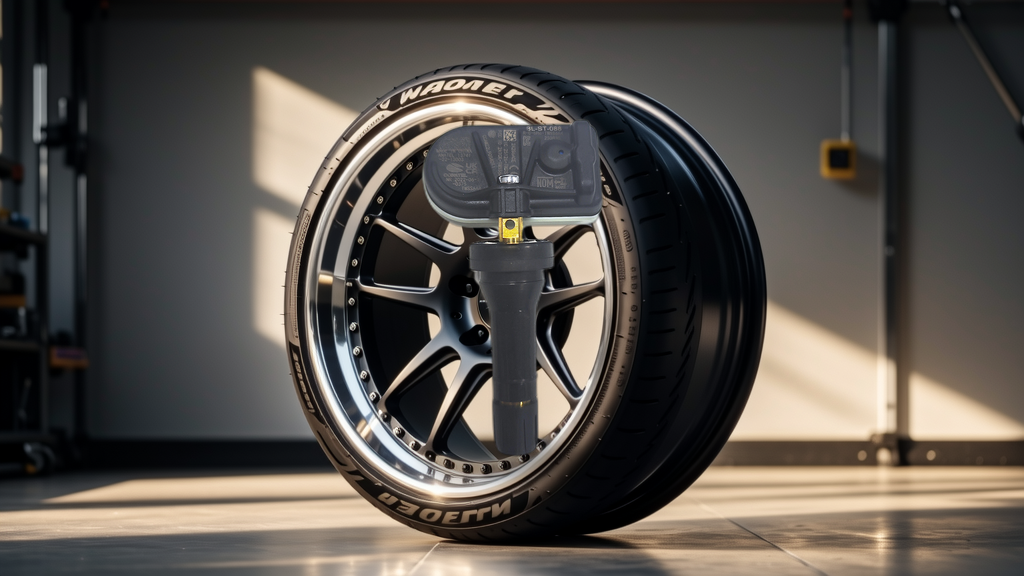
**Recommended Part:** BH-Sens 433MHz TPMS Tire Pressure Sensor (SKU: BL-ST-088) — fits Audi, Lamborghini, Polestar, Porsche, and VW. OE# 32134419 / 3WA907255 / 95C907255. BL-ST-088 | BH-Sens 433MHz TPMS Tire Pressure Sensor | OE# 32134419
Shop BL-ST-088 at longweiparts.com — in stock now.