
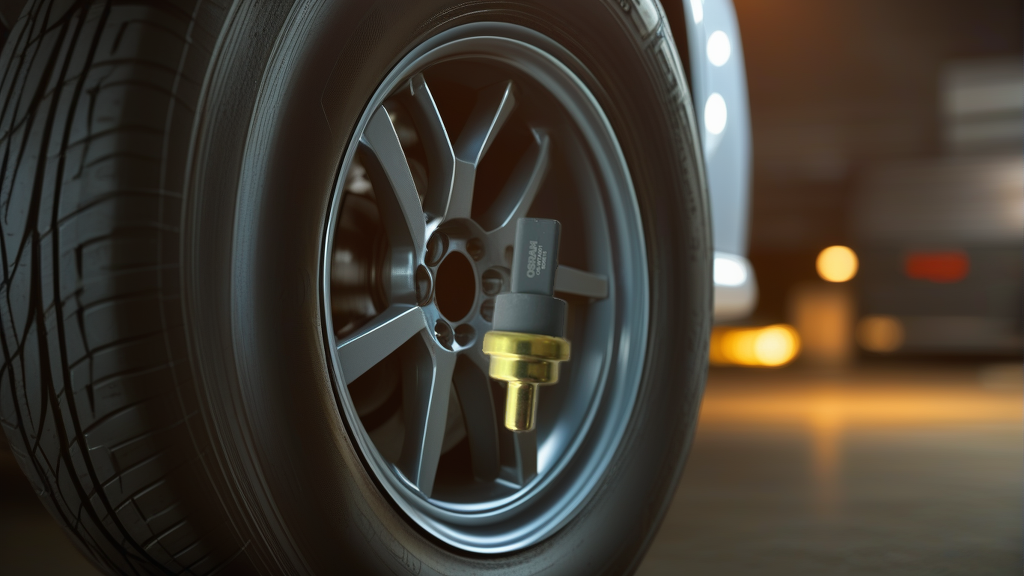
If you’ve ever watched a 2.0 TFSI’s temperature gauge spike on a hot July afternoon, you already know the plot. The engine isn’t dead—yet. But the coolant sensor is lying to you, or worse, it’s dead. For Audi owners, the coolant temperature sensor (CTS) is a small, cheap part that can cause big, expensive illusions. It’s not just about the dash gauge; it’s about fuel trims, fan activation, and the ECU’s entire thermal management strategy.
Here’s the reality: in the last five years, aftermarket sensor sales for the Audi 3.0 TFSI and 2.0 TFSI families have grown steadily, but so has the incidence of “phantom overheat” complaints that trace back to a 15-dollar sensor, not a 3,000-dollar cooling system overhaul. Understanding how that sensor works—and what signals it sends—separates a profitable repair from a comeback.
The Measurement Principle: NTC Thermistors and the Art of Resistance
Audi’s coolant temperature sensors are overwhelmingly negative temperature coefficient (NTC) thermistors. That’s not marketing jargon; it’s physics. In an NTC, resistance drops as temperature rises. At 20°C, the sensor might read around 2,500 ohms. At 90°C, that drops to roughly 200-300 ohms. The ECU sends a regulated 5V reference voltage through the sensor, and measures the voltage drop across it. That measured drop is converted into a digital temperature reading via an analog-to-digital converter.
But here’s where it gets tricky. The Audi ECU isn’t just reading a single curve. It compares the CTS reading against a modeled temperature—calculated from intake air temp, engine load, and runtime. If the sensor’s resistance drifts even 5% due to age, the ECU sees a mismatch. It doesn’t necessarily throw a code immediately. Instead, it starts adjusting fuel enrichment and ignition timing based on a temperature that’s wrong. You get poor cold-start idle, increased emissions, and a frustrating lack of power until the engine “catches up” to reality.
Signal Types: Analog Voltage vs. Digital CAN-Bus
There’s a common misconception that all Audi coolant sensors are simple two-wire analog devices. That’s true for the older 1.8T and early 2.0T engines. But newer models, particularly the B9 and C8 platforms, use a more complex setup. Some sensors output a PWM (pulse-width modulation) signal, while others communicate directly via the CAN bus (LIN bus in some cases). The sensor still uses an NTC element, but the signal conditioning happens inside the sensor housing.
The part that matters for replacement is the OS-WTA001, an OSRAM-branded coolant temperature sensor that fits three Audi applications. It’s designed as a direct OE cross-reference to the L06A919501A. If you’re working on a car that originally used a two-pin analog sensor, this unit plugs in and behaves identically. No coding required. For the technician, that’s the difference between a 20-minute job and a diagnostic headache.
| Signal Characteristic | Older Analog (Pre-2010) | Modern Digital/LIN (2013+) |
|---|---|---|
| Output Type | Analog 0-5V | PWM / LIN Bus |
| Wiring | 2-pin (plus ground) | 3-pin (power, ground, signal) |
| ECU Interpretation | Direct resistance curve | Digital packet / duty cycle |
| Common Failure Mode | Drift, open circuit | Internal short, communication loss |
| Scan Tool Readout | Live data temp via OBD | Live data temp via OBD (same) |
Pressure, Height, and Radar: The Broader Sensor Ecosystem
The coolant sensor doesn’t work in isolation. It feeds data into the same ECU that processes signals from the manifold absolute pressure (MAP) sensor, the barometric pressure sensor, and on adaptive-suspension models, the ride-height sensors. Here’s how the logic flows:
- Pressure sensors (MAP/baro) use a piezoresistive bridge. A diaphragm deforms with pressure, changing resistance in a Wheatstone bridge configuration. The output is a precision voltage proportional to absolute pressure.
- Height sensors on Audi’s air suspension use a Hall-effect element and a magnet mounted on the control arm. As the arm swings, the magnetic field rotates across the Hall IC, producing a linear output that tells the air compressor to add or release pressure.
- Radar sensors for adaptive cruise use frequency-modulated continuous wave (FMCW) signals. They transmit a 77 GHz sweep, measure the frequency shift of the reflected wave, and calculate distance and relative velocity.
All of these signals—pressure, height, radar, temperature—converge on the ECU’s signal conditioning stage. They’re filtered, amplified, and converted to digital. The CTS is the most basic of them, but it’s also the most critical for engine protection. A failed radar sensor won’t melt a piston. A failed coolant sensor can.
The Real-World Repair: Why the OS-WTA001 Makes Sense
You’re at the lift. A 2015 Audi A6 2.0 TFSI comes in with an intermittent low-coolant warning and a slightly elevated temp reading on the highway. The customer says “it’s probably the thermostat.” You scan it—no codes, but live data shows coolant temp jumping from 88°C to 104°C in a matter of seconds, which is physically impossible. That’s a classic sensor drift.
You could gamble on a no-name sensor from the parts house. You’ll save six bucks. But you’ll also risk a connector that doesn’t seat properly and a resistance curve that’s off by 10% at operating temperature. That’s not a gamble worth taking on a German sedan.
The smart move is the OSRAM-built OS-WTA001 | OSRAM Coolant Temperature Sensor | Fits Audi | OE# L06A919501A. It’s a direct fit for the three Audi applications, uses the correct NTC curve, and the connector is molded to match the OE latch. It reads true—meaning the ECU stops chasing its tail, fans cycle properly, and the customer doesn’t come back in two weeks with a “check engine light” for the same complaint.
Pro Tips for Installation
Pro Tip: Do not use thread sealant on the sensor threads. The O-ring does the sealing. Sealant can push into the coolant passage and clog the tiny orifice inside the sensor, causing slow response or false readings.
Also, always bleed the cooling system after replacement. Air pockets sit right at the sensor location and give you a false temperature spike for the first few minutes of operation. And inspect the harness connector for corrosion. Water ingress is the number one cause of intermittent CTS failure on B8 and B9 platforms.
Market Outlook and Buyer Takeaway
The aftermarket for Audi sensors is shifting. OEM prices haven’t dropped, and the Chinese manufacturing base has improved quality control significantly in the last three years. The OSRAM brand, while traditionally known for lighting, has expanded into automotive sensing with solid results. The OS-WTA001 | OSRAM Coolant Temperature Sensor | Fits Audi | OE# L06A919501A sits at a price point that makes it a no-brainer for a shop that wants to offer a “better than OEM” option without going full OEM on the invoice.
For the DIY owner: if you see a temp fluctuation at idle that smooths out at speed, suspect the sensor before the pump. It’s a 20-minute job, a 15-dollar part, and it’ll save you from chasing a coolant leak that doesn’t exist.
For the shop: stock this sensor. It’s a fast mover, it fits three of the most common Audi models on the road, and it eliminates the “trial and error” returns that eat your margin. The signal chain in an Audi is only as strong as its weakest link. Don’t let it be a 15-dollar sensor.

Recommended Part: OS-WTA001 – OE-grade replacement, in stock now.