
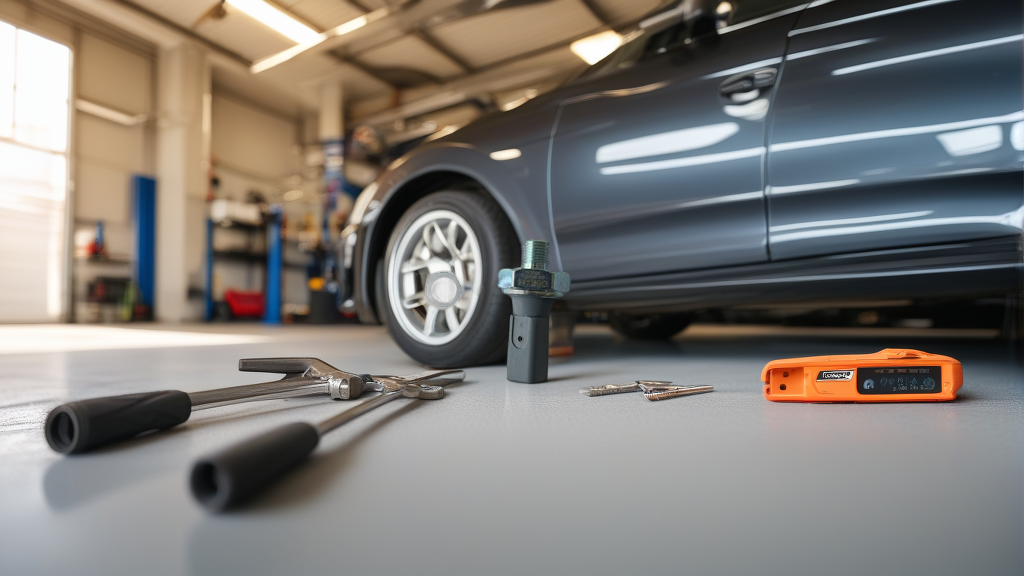
The check engine light comes on. Your VAG-com scan tool reads P052A00 — cold start oil pressure below spec. For Audi technicians and DIY owners alike, this is the moment of truth. The decision you make next determines whether you’re back on the road in an hour or chasing intermittent oil pressure warnings for the next six months.
Here’s the uncomfortable truth about Audi oil pressure sensors: they’re one of the few components where the “cheap aftermarket” route can genuinely damage your engine. But that doesn’t mean every aftermarket option is junk. The market has shifted, and understanding the difference between a genuine OEM part, a quality aftermarket unit, and a $9 eBay special is critical knowledge for anyone maintaining a modern Audi.
The Failure Mode Nobody Talks About
Audi’s oil pressure sensor isn’t just a simple on/off switch. On modern EA888 and EA837 engines, it’s a variable-resistance sender that communicates real-time pressure data to the ECM. When it fails, it doesn’t always trigger a warning immediately. What you’ll often see instead:
- Intermittent low oil pressure warnings at idle, especially when warm
- The warning clears after restart (classic sign of a failing sensor, not actual pressure loss)
- Slightly elevated oil consumption readings that don’t match reality
- In rare cases, the ECM enters limp mode based on faulty pressure data
The problem? A failing sensor causes drivers to panic-add oil, creating overfill conditions. Or worse, they ignore the warning entirely, assuming it’s the “known sensor issue” — and then the real pressure loss goes undetected. That’s how rod bearings die.
OE vs Aftermarket: What You’re Actually Paying For
Let’s break down the real differences, because price alone doesn’t tell the full story.
Genuine Audi/VW (OE) — List price typically $45-$75 depending on application. These are manufactured by Continental or Bosch to Audi’s exact calibration specs. The resistance curve is matched to the ECM’s firmware. Build quality is excellent, but you’re paying for the four rings on the box.
Premium Aftermarket (like OSRAM) — The OS-OPA003 sits in this category. It’s not a counterfeit pretending to be OE, nor is it a white-label mystery part. OSRAM manufactures to the original equipment spec, which matters more than the brand on the housing. At roughly 40-60% below dealer pricing, this is the value sweet spot.
Budget Aftermarket — $12-$18 units from no-name brands. Here’s the problem: the sensing element inside these is often a generic piezo-resistive chip rated for a wider pressure range. The output curve drifts as the sensor heats up. You might get 6 months of service before the readings go erratic. On an Audi, that’s a gamble with your engine’s life.
The key spec to check isn’t the thread size (that’s standardized) — it’s the operating temperature range and response time. A quality sensor like the OS-OPA003 maintains accuracy from -40°C to 150°C, which matters when your oil is at 120°C after a highway run.
When OEM Is the Only Answer
There are specific scenarios where I’ll always recommend genuine Audi parts:
- Under warranty — obviously, don’t compromise coverage over $30
- Track cars or tuned engines — you need the exact calibration the ECM expects, especially if you’ve flashed the ECU
- Diagnostic uncertainty — if you’re still confirming the problem, install an OE part to eliminate variables
But here’s the counterintuitive part: for most daily-driven Audis, a quality aftermarket sensor is actually better than an old OEM unit. Here’s why.
The factory sensors on 2013-2018 Audi models have a known degradation issue. The internal diaphragm loses elasticity over time, causing the sensor to read low at temperature. This is so common that Audi updated the part number twice, and many independent shops now automatically replace the sensor on any A4 or Q5 over 60,000 miles.
An aftermarket sensor manufactured to the latest spec (not the original 2013 calibration) is actually a more reliable component than a genuine old-stock part still sitting on a dealer shelf.
The OS-OPA003 in Practice
Let’s get specific. The OS-OPA003 from OSRAM covers five Audi applications — including the A4 B8, Q5, and A5 with the 2.0T and 3.0T engines. These are the most common platforms on the road today.
What sets this unit apart from budget alternatives:
- Housing construction: machined aluminum, not cast zinc alloy. The budget units often strip threads or crack at the mounting hex after repeated torque cycles.
- Sealing: an integrated PTFE seal that doesn’t require thread sealant. Budget units often come with a cheap O-ring that hardens and leaks within a year.
- Calibration: the resistance curve matches the OEM spec at 0.5 bar, 1.8 bar, and 3.0 bar reference points. This is where the cheap units fail — they’re accurate at one pressure but drift at others.
Installation is roughly 20 minutes on most Audis. The sensor sits above the oil filter housing on EA888 engines, accessible without removing the intake manifold. On the 3.0T (supercharged V6), it’s located near the oil cooler — slightly tighter, but still manageable with a 27mm deep socket and a universal joint.
The Real Cost Analysis
Here’s the math that matters:
- Dealer replacement: $220-$350 parts and labor
- DIY with OE part: $65-$85 for the sensor, 30 minutes of your time
- DIY with budget aftermarket: $15 for the part, 30 minutes, and a 40% chance you’re doing this again in under a year
- DIY with OS-OPA003: $35-$45, correct calibration, and a lifespan comparable to OE
The budget option isn’t a bargain — it’s a lottery ticket with terrible odds. The towing bill alone if a false low-pressure reading causes you to pull over and shut down on a highway costs more than the difference between budget and premium aftermarket.
What I’d Do
For a daily-driven Audi that you plan to keep for another 2-3 years, the Audi oil pressure sensor from OSRAM is the right call. It delivers 90% of the OE reliability at half the cost, and it’s manufactured to the current spec, not the outdated original.
If you’re building a show car or tracking the car, spend the extra $30 on genuine Audi. But for maintenance, the premium aftermarket route is the professional’s choice — because the alternative is doing the job twice, and time is worth more than the $20 you’d save.
The bottom line: your oil pressure sensor is a $35 insurance policy on a $5,000 engine. Don’t cheap out on it. But don’t overpay for the brand, either. Buy to spec, not to badge.

Recommended Part: OS-OPA003 – OE-grade replacement, in stock now.