
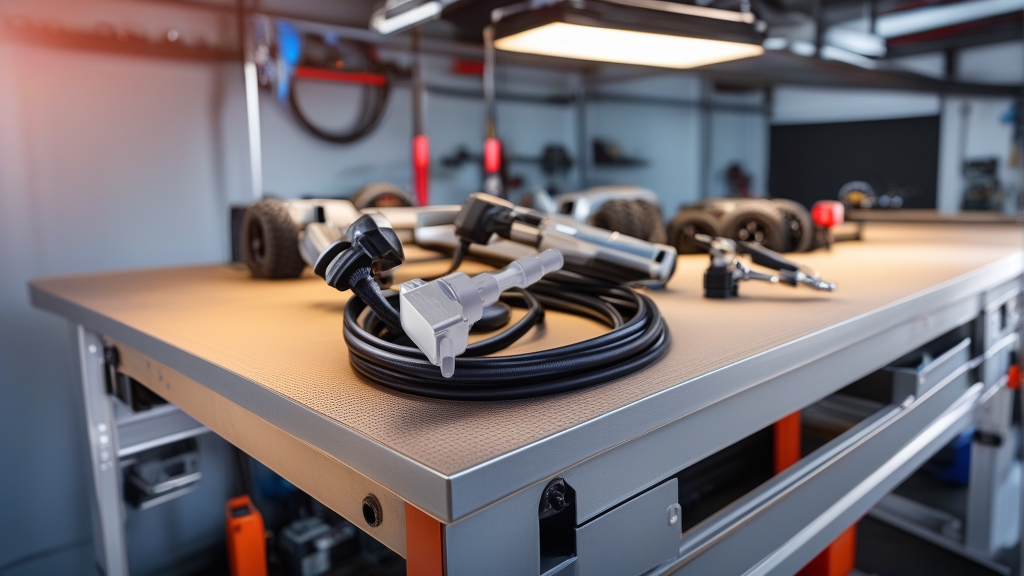
Walk into any modern Hyundai service bay — whether it’s a 2026 Sonata hybrid or a 2015 Genesis sedan — and you’re staring at a vehicle that processes more data per second than the Apollo guidance computer did during the entire moon landing. The humble ignition coil, like the OS1029 from OSRAM, sits at the end of a long chain of electronic decision-making. But to truly appreciate why a coil fails, or why a sensor reading sends your check-engine light into a panic, you need to understand the unseen conversation happening beneath the hood.
This isn’t a physics lecture. It’s a look at how Hyundai’s sensor network — pressure, temperature, height, radar — feeds the engine control unit (ECU), and why the OS1029 coil is the final link in that chain. If you’re a shop owner diagnosing a misfire or a DIY owner chasing a phantom code, this is the context you’re missing.
The Sensor Stack: How Hyundai’s Brain Reads the Road
Hyundai’s engine management architecture relies on a hierarchy of sensors, each speaking a different electrical language. The manifold absolute pressure (MAP) sensor, for instance, is a piezoelectric device. It contains a silicon diaphragm that flexes with intake vacuum. That flex changes resistance, which alters a voltage signal — typically 0.5V at idle to 4.5V at wide-open throttle. The ECU reads that analog voltage, converts it to a pressure value via a lookup table, and calculates air density. From there, it determines fuel trim and ignition timing.
Temperature sensors are simpler but no less critical. The engine coolant temperature (ECT) sensor uses a thermistor — a resistor whose resistance drops as temperature rises. At 20°C, it might read 2.5kΩ. At 90°C, that drops to 200Ω. The ECU sends a reference voltage (usually 5V) and measures the voltage drop across the thermistor. This isn’t just for the dashboard gauge. The ECU uses ECT to command cold-start enrichment, adjust idle speed, and — crucially — retard ignition timing when the engine is cold. That’s where the OS1029 coil comes into play: a weak coil on a cold engine produces a weak spark, and the ECU’s timing corrections can’t compensate for raw electrical insufficiency.
Height sensors, found on Hyundai’s self-leveling suspension systems (like the Genesis G80), work on a completely different principle. They’re typically hall-effect or inductive sensors mounted on the control arms. As the suspension compresses, a magnet moves past a coil, generating a voltage proportional to speed and position. These sensors output a pulse-width-modulated (PWM) signal — a square wave where the duty cycle (percentage of time the signal is high) encodes the height. The suspension control module reads this PWM signal at roughly 50Hz, then adjusts air springs or dampers accordingly.
Radar sensors — the ones powering Hyundai’s Smart Cruise Control and Forward Collision Avoidance — are the most complex. They operate in the 77GHz frequency band, emitting a frequency-modulated continuous wave (FMCW). The radar module transmits a chirp signal that sweeps frequency over time. When that signal bounces off a vehicle ahead, the reflected wave arrives with a frequency shift. The module mixes the transmitted and received signals to produce a beat frequency, which is directly proportional to distance. Velocity is derived from the Doppler shift on top of that. The result is a target list — objects with range, speed, and angle — sent over CAN bus to the ECU at 20Hz or faster.
Signal Types: The Language Problem
Here’s where it gets interesting for technicians. Hyundai’s sensors speak three different protocols, and mixing them up is a diagnostic trap.
Analog sensors (MAP, TPS, ECT) output continuous voltage. You can measure these with a multimeter, but you need to know the expected voltage range at specific conditions. A MAP sensor reading 1.2V at idle might be fine — or it might be 0.5V too high, indicating a vacuum leak.
Digital frequency sensors (crankshaft position, wheel speed) output a square wave. The frequency changes with speed — a crankshaft sensor might output 20Hz at idle and 200Hz at 6000rpm. You need an oscilloscope or a frequency-capable multimeter to diagnose these. A missing tooth on the trigger wheel creates a characteristic gap in the waveform.
Then there are LIN bus and CAN bus sensors. Many of Hyundai’s newer sensors — including some pressure sensors in the fuel system — are digital nodes that communicate over a serial bus. They don’t output a simple voltage; they transmit data packets. You need a scan tool that can read live data from specific modules. If a sensor fails, it often drops off the bus entirely, which sets a “communication error” code rather than a “signal out of range” code.
This is why the OS1029 coil is a common misdiagnosis. A failing coil causes a misfire code (P0301, P0302, etc.). But a failing crankshaft sensor can also cause a misfire code, because the ECU loses its timing reference and fires the coils erratically. The symptoms are identical: rough idle, loss of power, flashing check-engine light. The difference is that the crank sensor failure is a signal timing issue, while the coil failure is an energy delivery issue.
| Sensor Type | Signal Output | Measurement Principle | Typical Hyundai Application |
|---|---|---|---|
| MAP | Analog voltage (0.5-4.5V) | Piezoresistive diaphragm flex | Intake manifold pressure |
| ECT | Analog voltage (via thermistor) | Resistance change vs. temperature | Engine coolant temperature |
| Height | PWM square wave | Hall-effect magnetic field detection | Air suspension ride height |
| Radar | FMCW digital (77GHz) | Frequency shift from reflected wave | Adaptive cruise control |
| Crankshaft | AC sine wave / digital square | Inductive or hall-effect trigger wheel | Engine speed and position |
Why the OS1029 Matters in This Ecosystem
Now, the coil. The OS1029 is OSRAM’s ignition coil for Hyundai applications — specifically the 273012B140 and 2730128010 OE numbers, which covers a range of 2.0L and 2.4L four-cylinder engines used across the Sonata, Optima, and Sportage platforms. It’s a pencil-style coil-on-plug (COP) design, which means it sits directly on the spark plug, eliminating the need for spark plug wires.
Here’s what’s happening electrically: The ECU sends a 12V signal to the coil’s primary winding, which charges the coil’s magnetic field. When that signal is cut, the field collapses, inducing a high voltage in the secondary winding. The OS1029 is designed to step up the primary voltage to roughly 35,000-40,000 volts at the spark plug gap. That voltage is delivered in a specific waveform — a capacitive discharge spike followed by an inductive burn phase that lasts several milliseconds.
The burn phase is what ignites the air-fuel mixture. A weak coil delivers a short, low-energy burn. This causes incomplete combustion, which raises hydrocarbon emissions, increases fuel consumption, and — over time — fouls the spark plug. The ECU detects this via the oxygen sensors and misfire monitoring, but it can’t always pinpoint which cylinder is weak. That’s why a scope on the secondary ignition waveform is the definitive diagnostic tool.
What makes the OS1029 worth considering is its construction quality. OSRAM uses a fully encapsulated epoxy primary winding and a high-temperature-grade secondary bobbin. This matters because Hyundai’s 2.4L engines run hot — the coil sits near the exhaust manifold, and under sustained load, underhood temperatures can exceed 100°C. Cheap coils use lower-grade epoxy that cracks over time, allowing moisture ingress and causing internal arcing. The OS1029’s housing is also laser-welded, not crimped, which prevents the two-piece failure mode common on budget coils.
Real-World Diagnostic Scenarios
Let’s be practical. You’ve got a 2018 Hyundai Sonata with a P0302 code — cylinder 2 misfire. You swap the OS1029 coil to cylinder 2 and move the old coil to cylinder 1. If the misfire moves, the coil is bad. If it stays on cylinder 2, you’re looking at a spark plug, injector, or compression issue. This is standard practice, but here’s the nuance: on Hyundai’s GDI engines, a leaking fuel injector can cause a coil to fail prematurely. The fuel washes the spark plug, requiring a higher firing voltage, which overheats the coil. If you replace the coil without checking the injector, you’ll be doing this job again in six months.
Pro Tip: Always check the spark plug gap and condition before condemning a coil. A worn plug with a 0.090″ gap (instead of the spec 0.045″) forces the coil to work at its maximum voltage output. This shortens coil life by a third or more. If you’re replacing a coil on a Hyundai with over 60,000 miles, replace the plugs too — they’re cheap insurance.
Another scenario: you’re seeing a P0011 code (camshaft position timing over-advanced). This isn’t a coil issue at all — it’s a variable valve timing (VVT) system problem, often caused by a clogged oil control valve. But because the VVT solenoid and the crank sensor share the same electrical harness, a chafed wire can cause both a timing code and a random misfire. The ECU commands a coil firing at the wrong time because it’s receiving a corrupted crank signal. This is where a scope on the crank sensor waveform pays for itself. The OS1029 coil is fine; the wire is the culprit.
Market Outlook and Buyer Takeaways
The aftermarket for Hyundai ignition coils has matured significantly over the last five years. OE coils from Mobis (Hyundai’s parts division) are reliable but expensive — often $80-$120 per coil. Budget aftermarket coils run $25-$40 but have a failure rate that will cost you more in labor than you saved in parts. The OS1029 sits in the middle — typically $45-$60 — with build quality that matches or exceeds OE in some respects.
For a shop, the calculation is simple: warranty claims eat margins. If you install a $30 coil and it fails in three months, you’re eating the replacement labor. A coil that costs $15 more but lasts 50,000 miles is a better business decision. For a DIY owner, the OS1029 is the right choice if you plan on keeping the car for more than two years.
The sensor ecosystem under your Hyundai’s hood is a marvel of engineering — pressure sensors that flex a micron-thin diaphragm, radar chips processing gigahertz frequencies, thermistors tracking temperature to within a degree. But all that data converges on one physical act: the spark. The OS1029 coil delivers that spark with the energy and consistency that the ECU’s calculations demand. When you’re chasing a misfire or a rough idle, start with the sensors — check fuel pressure, verify crank signal, scope the MAP output. But when the diagnosis points to ignition, you want a coil that won’t become your next diagnostic headache.
Product Recommendation: The OS1029 OSRAM Ignition Coil fits Hyundai applications with OE part numbers 273012B140 and 2730128010. It’s a direct replacement with no modification required. If you’re replacing one coil on a high-mileage Hyundai, consider replacing all four — the labor is the same, and you’ll avoid a second visit.

Recommended Part: OS1029 – OE-grade replacement, in stock now.