
If you’ve been wrenching on late-model BYD vehicles for any length of time, you already know the QIN L EV doesn’t behave like a typical TPMS platform. The 2025 refresh introduced a new sensor protocol that tripped up more than a few independent shops during the first wave of tire rotations. The good news? The relearn procedure is actually simpler than most German systems — once you understand the three distinct paths available.
Here’s what you need to know about programming and relearning TPMS on the QIN L EV, including the specific tooling requirements and the one mistake that’ll cost you a comeback.
Why the QIN L EV Relearn Process Confuses First-Timers
The QIN L EV uses a 433MHz direct TPMS system, but unlike many Asian-market vehicles that rely on a proprietary scan tool handshake, BYD engineered three separate relearn methods. That’s unusual — most manufacturers give you one option and one option only. The trade-off is that each method has different hardware requirements, and the stationary procedure has a hidden time window that isn’t documented clearly in the owner’s manual.
The most common failure we see in the field isn’t a bad sensor. It’s a tech who attempts an OBD relearn with a generic tool that doesn’t support BYD’s specific PID set, then blames the sensor. The sensor is usually fine. The tool isn’t the right one for the job.
Method 1: OBD Relearn (Fastest for Shops)
The OBD path is your go-to if you’re running a professional-grade scan tool like Autel’s MaxiSys series or a dedicated TPMS tool with BYD coverage. Here’s the sequence:
- Connect your tool to the OBD-II port under the driver’s side dash.
- Select TPMS service → QIN L EV → 2025+ → Relearn.
- Trigger each sensor in the correct order: LF → RF → RR → LR, using the tool’s LF (low-frequency) activation function placed within 6 inches of the valve stem.
- Wait for the horn chirp after each sensor is registered — it’s short, maybe half a second, so keep your hand ready.
- Once all four are triggered, the tool will automatically write the new IDs to the BCM.
- Verify with a quick live-data check that all four positions show valid pressure readings.
Total time: under five minutes if you’ve done it before. The key gotcha? The QIN L EV’s BCM will reject IDs if you trigger sensors out of order. There’s no warning — it just silently fails and you have to start over.
Method 2: Auto Relearn (The “Set It and Forget It” Path)
BYD also built in an auto-relearn mode that works without any activation tool. This is what DIY owners stumble onto when they search forums. The procedure:
- Park the vehicle on a level surface, set the parking brake.
- Turn the ignition to ON (don’t start the engine).
- Press and hold the TPMS reset button (located below the steering column, left side) for 3 seconds until the tire pressure warning light blinks twice.
- Drive the vehicle above 15 mph (25 km/h) continuously. The system will automatically detect each sensor’s signal as the tires rotate.
Here’s the catch: the auto relearn requires a continuous drive of 5–10 minutes at steady speed. Stop-and-go traffic resets the timer. This method is reliable, but it’s not practical for a shop environment — you’re not taking a customer’s car for a 10-minute joyride on a busy day.
Method 3: Stationary Relearn (The Hidden Gem)
The stationary method is the one most techs don’t know about. It was added in a mid-2025 BCM firmware update, and it’s the fastest way to do a relearn without a high-end scan tool — provided you have a basic TPMS activator.
- Put the vehicle in accessory mode (press start button once, no brake pedal).
- Navigate to the vehicle settings menu on the infotainment screen.
- Select Tire Pressure → Sensor Learn Mode.
- The infotymatic will display “Learning Mode Active” and highlight the LF position.
- Use your TPMS tool to trigger the LF sensor. The display will advance to RF automatically.
- Repeat for RF, RR, LR.
- Exit the menu. The system confirms with a checkmark on each position.
Pro Tip: The stationary relearn only works on vehicles with infotainment software version 4.2.3 or newer. Check the software version in Settings → System → About before wasting time. Older firmware requires OBD or auto relearn. Also, don’t use a 125kHz activation tool for this — the QIN L EV’s sensors respond to LF activation, but the signal must be a clean 125kHz burst, not the combined 433MHz transmit/receive cycle some cheap tools use.
Common Mistakes That Cause Relearn Failures
After watching dozens of techs work through this, here are the recurring problems we see:
- Using the wrong sensor frequency: The QIN L EV requires 433MHz sensors. Some parts suppliers push 315MHz units as “universal” — they won’t communicate with the BCM at all.
- Mixed sensor brands: If the vehicle has one aftermarket sensor and three OE units, the relearn can fail intermittently. The BCM’s validation logic doesn’t like inconsistent signal timing.
- Ignoring the battery: Low sensor battery voltage (below 2.3V under load) causes intermittent signal dropouts that mimic a relearn failure. Test battery health before starting the procedure.
- Forgetting to clear old IDs: On the OBD method, if you don’t clear existing IDs before writing new ones, the BCM may hold onto stale data and throw a false “duplicate ID” fault.
The Right Sensor Makes the Job Easier
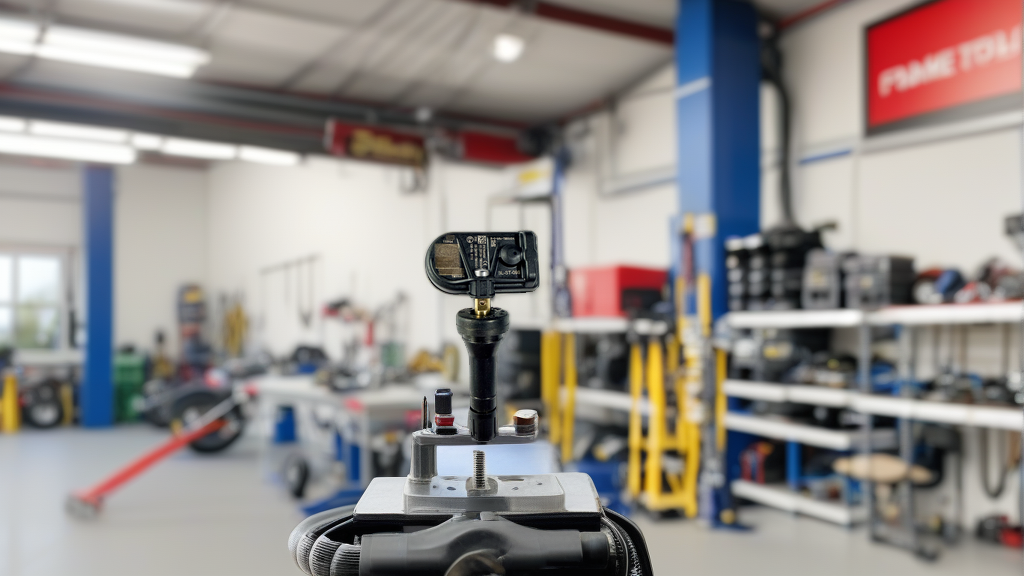
When you’re replacing sensors on a QIN L EV, don’t overthink the hardware. The BH-Sens 433MHz TPMS Tire Pressure Sensor (BL-ST-096) from Baolong Technology is a direct OE replacement that comes pre-programmed with the correct BYD IDs — no cloning required. It’s a clamp-in design, frequency-matched at 433MHz, and fits the 2025+ QIN L EV without any modification.
The pre-programmed aspect is the bigger deal than most people realize. It means you can skip the sensor-programming step entirely and go straight to the relearn procedure. In a shop environment, that saves roughly 10–15 minutes per vehicle compared to programming blank sensors with a tool.
Bottom Line for Shops
The QIN L EV’s TPMS system isn’t difficult — it’s just different. The OBD method is your most reliable production-line approach, but the stationary relearn is perfect for quick fixes when you’re not rolling a fully loaded scan cart out to the bay. Pair that workflow knowledge with a pre-programmed sensor like the BL-ST-096, and you’ll turn a job that trips up most independents into a 20-minute flat-rate win.
For DIY owners: use the auto relearn method, be patient with the drive cycle, and if you’re replacing sensors, buy the pre-programmed units. Cloning tools and blank sensors are a learning curve you don’t need on a car that already handles its own relearn logic.

Recommended Part: BL-ST-096 – OE-grade replacement, in stock now.