
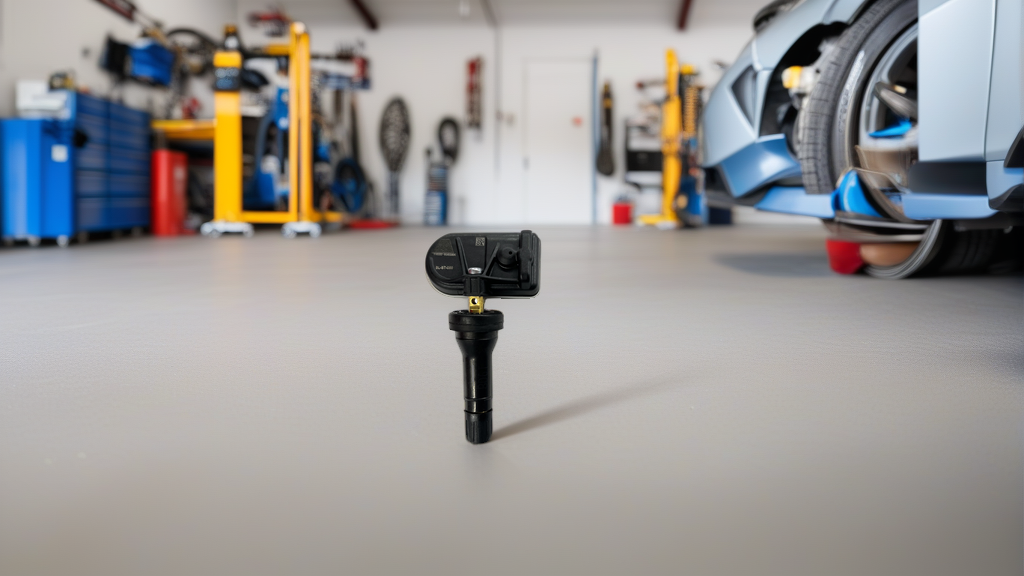
If you run a workshop that services compact crossovers, you’ve seen it: the dreaded blinking TPMS light on a Renault Captur. The customer swears they just filled the tires. You pull out your diagnostic tool, and the sensor is dead—battery flat, cracked stem, or just plain missing a signal. The fix is straightforward, but the ordering process can be a minefield, especially when you’re buying for a fleet or stocking for a busy season.
We’ve been selling TPMS sensors out of our China-sourced warehouse for years, and the most common phone call we get is not about a faulty part. It’s about a wrong part. Here is the practical checklist we walk our B2B clients through, specifically for the Captur, before they hit “submit” on a bulk order.
1. Frequency Isn’t a Suggestion
The Captur, depending on the market and model year, runs either 433MHz or 315MHz. If you’re ordering for a European-spec vehicle, you’re almost certainly on 433MHz. But here is where it gets tricky: some Asian-market Captur variants (sold as Samsung or Renault badges) use a different protocol.
The Check: Look at the old sensor’s shell. If it’s stamped with 433MHz, you are locked in. Do not assume. We stock the BL-ST-066 specifically because it is a 433MHz clamp-in unit, which covers the vast majority of Captur models sold in Europe and the UK. If you have a grey import, double-check the frequency before you order fifty of them.
2. Clamp-In vs. Snap-In Is Non-Negotiable
This is the easiest part to get wrong. The Captur uses a metal clamp-in valve stem, not a rubber snap-in. If you order a snap-in sensor, it will fit the hole, but it won’t seal correctly, and the torque spec on the nut will be wrong, leading to slow leaks.
The Check: The BL-ST-066 is a clamp-in design, matching the OEM spec for the Captur. When you’re comparing parts from other suppliers, verify this isn’t a “universal” rubber valve that claims to fit all. It doesn’t. It will fail.
3. The 3641050RD01 Conundrum
The OE part number for the Captur sensor is often listed as 3641050RD01. But here’s the nuance—that number changed over the production run. Early models (pre-2016) sometimes used a different internal chipset that is notoriously picky about aftermarket replacements.
The Check: When ordering, verify the sensor is pre-programmed to mimic the OEM signal. You do not want to deal with a sensor that requires a separate programming tool to clone the ID. The BH-Sens unit we carry is pre-programmed, meaning it will auto-learn on most Captur models during a standard re-learn procedure (driving for 10 minutes at speed). This saves you labor time and the cost of a dedicated TPMS tool.
4. Where Are You Buying From? The “Ghost” Supplier
If you are sourcing from a third-party marketplace, you might get a sensor that looks right but has an incompatible antenna design. We see this constantly. A cheap sensor might broadcast at the right frequency but fail to transmit when the car is moving at speed due to a weak internal battery.
The Check: For B2B bulk buying, ask for the sensor’s datasheet. Look for the battery type (usually a Panasonic or Murata) and the transmission power. If they can’t provide a datasheet, walk away. The BL-ST-066 is sourced directly from the Baolong Technology production line, so the QC is consistent, unlike white-label sensors that could be from any of a dozen factories.
5. Vehicle Application vs. “Compatible With”
We list the BL-ST-066 as fitting “Fengon, Ineos, Infiniti, Mitsubishi, Nammi & 4 More” alongside the Captur. That is a broad net. But “compatible” does not always mean “plug-and-play” for every single model year.
The Check: Before ordering, filter the list. The BL-ST-066 covers 53 dedicated OE fitments. If you have a 2019 Captur, you are covered. If you have a 2022 Captur, you are covered. If you have a Captur that has been sitting in a salvage yard and you are retrofitting the TPMS system… you are on your own, and you need to check the system wiring first.
6. The Cost of a “Wrong” Order
Let’s do the math on a bulk order. You buy 20 sensors at $8 each to save on shipping. One of them is a bad batch, or you accidentally ordered 315MHz. You now have 20 useless pieces of plastic and metal, plus the shipping cost to return them (which is often more than the part cost), plus the downtime.
The Check: Look at the return policy. We offer a standard warranty, but more importantly, we pre-check the stock. If you are ordering a pallet, ask for a pre-shipment sample. We’ve had clients order a single unit first, test it on a Captur in their bay, and then order the bulk quantity. It’s a 24-hour delay that saves you a week of headaches.
Pro Tip for Shop Owners: When you get the sensor, check the torque on the valve core. Aftermarket sensors often ship with the core loose. Crank it down to 5 in-lbs. This is the number one cause of “new sensor, still leaking” complaints.
7. The “Programmed” Illusion
Some suppliers sell sensors that are “programmed” but actually just come with a blank ID that you must write to. The Captur system requires the sensor ID to be registered in the BCM (Body Control Module).
The Check: The BL-ST-066 is pre-programmed with an ID that is unique but doesn’t conflict with the vehicle’s existing system. On most Captur models, you can trigger a re-learn by deflating the tire to 20 PSI and inflating it back to 38 PSI. If you have to use an OBD tool to force the ID, that’s fine, but the sensor shouldn’t require a bench programmer to activate it.
—
The Verdict for Bulk Buyers
When you are ordering TPMS sensors for a fleet of Capturs, you are not just buying a piece of hardware. You are buying the guarantee that the car will pass inspection and the customer won’t return complaining about a light on the dash.
For the vast majority of Captur applications, the BL-ST-066 | BH-Sens 433MHz TPMS Tire Pressure Sensor | Fits Fengon, Ineos, Infiniti, Mitsubishi, Nammi & 4 More | OE# 3641050RD01, 407002GL0A, 407002GN0A is the safest bet on the market right now. It’s a 433MHz clamp-in, pre-programmed, and built by Baolong—a name that supplies the OE market. It eliminates the variables of frequency and programming, leaving you with just a simple install.
Bottom Line: Don’t gamble on the cheapest sensor. Check the frequency, verify the valve type, and ensure it’s pre-programmed. If you tick those boxes, you’ll have a happy customer and a Captur out of your bay in under an hour.

Recommended Part: BL-ST-066 – OE-grade replacement, in stock now.