
The Volkswagen Touareg has always been the brand’s tech showcase. From its debut with the W12 engine option to the current third-generation model with its 48V active anti-roll bars, the Touareg leans hard on electronics. But here’s what most owners don’t realize: the car’s entire driving character—from parking assist to suspension damping—hinges on a handful of small sensors that translate physical changes into electrical signals.
Let’s break down how these systems actually work, because when they fail, the diagnosis usually starts with understanding the signal type.
Pressure and Temperature Sensors: The Resistive and Capacitive Workhorses
Tire pressure monitoring on the Touareg uses direct TPMS sensors mounted inside each wheel. These are typically piezoresistive devices: a silicon diaphragm flexes under pressure, changing the resistance of embedded strain gauges. The sensor conditions this resistance change into a 0.5V to 4.5V analog output, which the tire pressure module reads and converts into PSI. Temperature compensation is baked in—the signal drifts less than 1% across -40°C to 125°C.
Temperature sensors, like those in the Touareg’s intake manifold, use a negative temperature coefficient thermistor. Resistance drops as heat rises. Simple, reliable, and cheap. But here’s the catch: the signal is non-linear. The ECU uses a lookup table to linearize the output, which is why an aftermarket sensor with slightly different internal resistance curves can send the ECU into limp mode.
Height Sensors: The Touareg’s Air Suspension Nervous System
The Touareg’s adaptive air suspension relies on ride-height sensors at each corner. These are rotary potentiometers—a wiper arm sweeps across a resistive track as the suspension arm moves. The resulting voltage divider output (typically 0.5V to 4.5V) tells the control module exactly where the chassis sits relative to the control arm.
The problem? These sensors sit in the worst possible location—right where road grime and salt accumulate. The resistive track wears unevenly, producing a noisy signal. The ECU interprets this as a rapid height change and begins adjusting the air springs, causing the classic “hunting” ride height issue. A scan tool showing voltage output that jumps more than 0.1V while the car sits stationary is your smoking gun.
Radar and Ultrasonic Sensors: Time-of-Flight Physics
For parking assistance, the Touareg uses ultrasonic sensors mounted in the bumpers. These work on time-of-flight: a 40kHz acoustic pulse is emitted, bounces off an obstacle, and the sensor measures the return time. The internal piezoelectric crystal converts the mechanical echo into a voltage spike. The control module calculates distance from the speed of sound in air (approximately 343 m/s at 20°C).
Radar sensors, used for adaptive cruise control, operate on similar principles but with 77GHz radio waves. They use frequency-modulated continuous wave (FMCW) technology—the transmitter sweeps frequency continuously, and the reflected signal is compared to the transmitted one. The frequency difference is directly proportional to distance, while the Doppler shift reveals relative speed.
When Signals Go Bad: The Aftermarket Reality
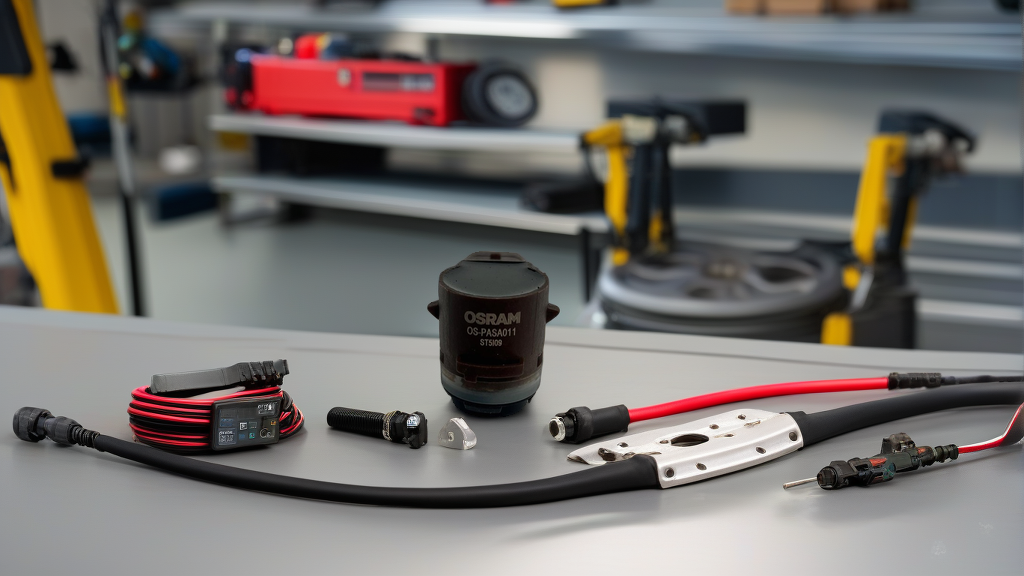
Here’s where the Touareg owner hits a wall. Genuine VW sensors carry a premium, and the dealer diagnostic fee alone is often $150. But the aftermarket landscape has improved dramatically. A solid ultrasonic parking sensor like the OSRAM unit (OE# 5Q1919297) matches the OEM’s frequency and beam pattern—critical because the Touareg’s parking module is picky about signal timing.
What matters most is that the replacement sensor produces the same resonant frequency and voltage threshold. A mismatched sensor might work initially but trigger intermittent faults once the module recalibrates. That’s why when we see Touaregs coming through the shop with “Parking Assist Unavailable” messages, the first check is always the sensor’s oscilloscope output—not just a visual inspection.
The Takeaway for Parts Buyers
Sensor technology isn’t magic—it’s physics translated into voltage and time measurements. For the Touareg, that means understanding whether you’re dealing with a resistive, capacitive, or ultrasonic principle before you swap parts. When you do replace, stick with brands that publish their signal specs.
For the parking sensor replacement on your Touareg or its VW platform siblings (Golf, Tiguan, Passat), the OS-PASA011 from OSRAM is a solid choice—it’s built to match the OEM’s 40kHz operating frequency and offers plug-and-play fitment without adapter harnesses. Given the Touareg’s complex networked modules, you don’t want to gamble on a no-name unit that might throw false echoes. Your parking module will thank you.

Recommended Part: OS-PASA011 – OE-grade replacement, in stock now.