
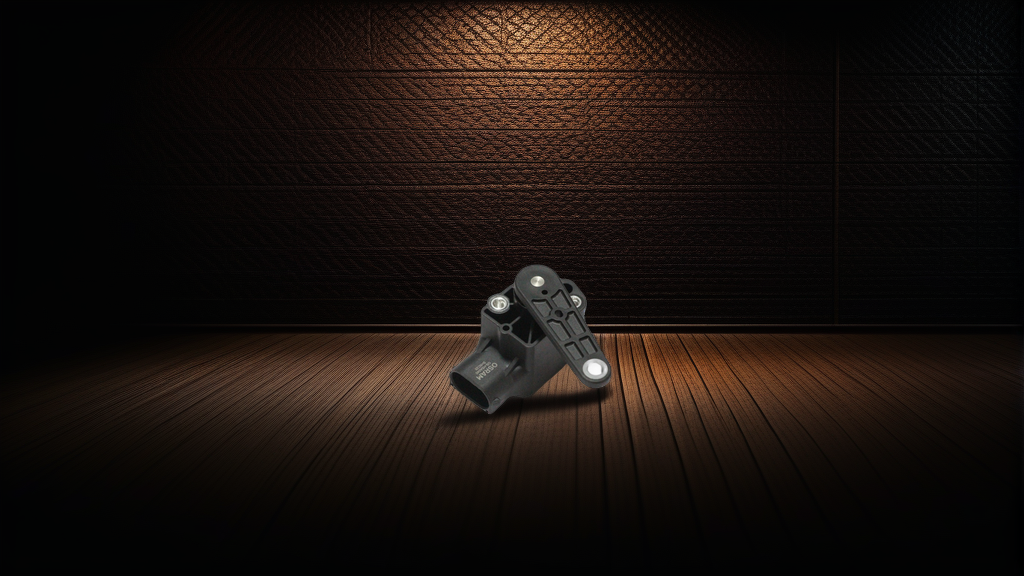
Walk into any European specialty shop and you’ll hear the same complaint: late-model Audis with adaptive air suspension don’t fail gracefully. They fail dramatically. One minute the car sits level at a stoplight, the next you’re staring at a dash lit up like a Christmas tree—suspension warning, ESC fault, headlight range error—all from a $40 plastic sensor bolted to the control arm.
The Audi ride height sensor is one of the most misunderstood components in the brand’s chassis ecosystem. It’s not a wear item like a brake pad or a filter. It’s a precision transducer that tells the suspension control module exactly where the body sits relative to the wheels. When it drifts, the car doesn’t just feel off—it thinks it’s dragging its belly across the pavement.
Here’s what most owners and even some shops get wrong: fitment isn’t just about the connector plugging in. It’s about matching the OE calibration curve, the arm length, and the mounting geometry. And for anyone chasing the 4B0907503 crossover, the aftermarket has quietly gotten very good at this—if you know what to look for.
The OE Number That Spans a Decade
The 4B0907503 is one of those rare part numbers that refuses to die. Originally deployed on the C5-generation A6 (1998–2005) and the first-gen Allroad, it carried over into the D2 A8 and even found its way into some early 2000s Volkswagen Phaeton builds. That’s a 15-year production window with essentially one sensor design doing multiple jobs.
The reason it survived so long is simple: Audi’s suspension architecture stayed remarkably consistent through that period. The front and rear level sensors share the same Hall-effect internals, the same three-pin connector, and the same 4.5V to 0.5V output sweep. What changed between applications is the lever arm length and the mounting tab orientation.
That’s where the aftermarket gets interesting. A direct replacement like the OSRAM-branded OS-HSA040 doesn’t just copy the electrical specs—it matches the physical geometry so the sensor sweeps through the correct arc as the suspension cycles. Get that wrong and you’ll have a sensor that reads voltage fine but tells the module the car is 20mm lower than it actually is. The result? Headlights aimed at the pavement and a compressor that cycles more often than it should.
Why “Compatible” Gets Thrown Around Too Loosely
Here’s the problem with shopping for these sensors online: every listing claims compatibility with “Audi A6, Allroad, A8” and leaves it at that. That’s like saying a wheel fits a “BMW 3 Series” without specifying whether it clears the M3’s brake calipers.
The 4B0907503 application list breaks down like this:
- A6 C5 (4B): 1998–2005, front and rear positions
- Allroad (4B): 2000–2005, front and rear positions
- A8 D2 (4D): 1999–2002, rear only (fronts used a different part number)
- S6 C5 (4B): 2002–2004, front and rear
The sensor arm length measured from the pivot center to the ball joint center determines the output scaling. A front sensor on an A6 will physically bolt to a rear position, but the voltage-to-height relationship will be off by roughly 12%. That’s enough to trigger a fault code after 10 minutes of driving, because the module detects the implausible rate of change.
So when you see a listing that says “Fits Audi” without breaking out positions and years, run the other way. You need a supplier that lists the OE cross-reference and the specific vehicle applications—not just a broad compatibility umbrella.
The Real-World Failure Pattern
Most ride height sensor failures don’t happen inside the sensor itself. The Hall-effect IC is sealed and rarely fails. What fails is the connector, the wiring pigtail, or the plastic lever arm where it attaches to the suspension link.
I’ve pulled dozens of these off C5 A6s with 150,000 miles. The typical story: the car sits unevenly in the driveway, the leveling compressor runs longer than usual, and the dash shows a suspension fault after a few minutes of driving. Pull the sensor and you’ll often find cracked solder joints inside the connector housing, or the lever arm’s ball socket worn enough to introduce slop.
The aftermarket fix is straightforward. A fresh sensor with a sealed connector and a new lever arm eliminates the two most common failure points. The OS-HSA040 from OSRAM uses a glass-filled nylon housing and a stainless steel pivot pin. It’s not the cheapest option on the market—you can find no-name sensors for half the price—but it’s built to survive the salty, muddy environment under an Allroad that’s actually been off-road.
Verifying Fitment Before You Buy
Let’s be practical. You’re looking at a sensor for a 2003 Allroad 2.7T. You’ve got the part number off the old unit—it says 4B0907503. Here’s what you do before you click buy:
Check the position. Crawl under the car and look at the sensor mounting. If it’s bolted to the upper control arm with the lever pointing down, it’s a front unit. If it’s mounted to the trailing arm with the lever pointing forward, it’s rear. The OS-HSA040 covers both positions on the C5 platform, but confirm the listing says so.
Count the pins. All 4B0907503 sensors use a three-pin connector. If you see a four-pin unit, that’s the later C6 A6 sensor (4F0616001), which won’t work without rewiring the harness.
Verify the output sweep. With the sensor unplugged and powered at 5V, the output should sweep from about 0.5V (fully compressed) to 4.5V (fully extended) as you rotate the lever arm by hand. If the listing doesn’t mention this spec, email the supplier. Any reputable seller will provide it.
Check the lever arm length. Measure from the center of the mounting bolt to the center of the ball joint socket on your old sensor. It should be 85mm for front applications and 95mm for rear. The OS-HSA040 matches these exactly, which is why it’s a drop-in replacement rather than a “universal fit” that requires bending brackets.
This last point is where most DIY buyers get burned. A universal sensor with adjustable linkage sounds great until you realize the suspension module expects a linear output across a specific range. Any deviation from that curve—even 5%—will cause intermittent faults that are a nightmare to diagnose.
What Shops Should Be Stocking
If you run a shop that services German vehicles, you should have at least two of these sensors on the shelf at all times. The failure rate on the C5 platform is high enough that you’ll see one every couple of months, and the markup on a $45 sensor is substantial. But more importantly, the diagnostic time you save by having the part in stock means the difference between a same-day fix and a car sitting for a week waiting on a shipment.
The OS-HSA040 is the part I’d recommend for stock because it covers the most applications with a single SKU. It’s made by OSRAM, which owns the original Siemens VDO sensor business—meaning it’s not a reverse-engineered knockoff. It’s manufactured on the same tooling as the OE part, just with fresh electronics and updated connector sealing.
That matters because the original sensors from the early 2000s had a known issue with moisture ingress through the connector gasket. The updated version uses a dual-lip seal that keeps water out even when the harness is routed through deep puddles. It’s a small change, but it extends the service life from the typical 80,000 miles to well over 150,000.
The Bottom Line on Audi Fitment
Here’s the honest take: buying a ride height sensor for an Audi isn’t complicated, but it requires attention to detail that most listings don’t provide. You need to know the position (front vs. rear), the production year range, and the lever arm length. If a seller can’t tell you those three things, they’re drop-shipping from a catalog and you’re gambling.
The | OE# 4B0907503](https://longweiparts.com/product/os-hsa040-osram-ride-height-sensor-fits-audi-oe-4b0907503/”>OS-HSA040 from OSRAM) is a solid choice because it’s built to the original Siemens VDO spec, covers the full 4B0907503 application range, and comes from a brand that’s been making lighting and sensors for over a century. It’s not a premium-priced boutique part—it’s the OE replacement that Audi should have been installing from the factory.
If you’re chasing a suspension fault on a C5 A6 or Allroad, start by scanning the sensor output with a proper diagnostic tool. If the voltage is erratic or stuck at one end of the range, you’ve found your culprit. Replace it with a quality unit, clear the codes, and let the suspension do its self-leveling dance. The car will sit level, the headlights will point straight, and the compressor will shut off when it’s supposed to.
That’s what a properly fitted sensor gets you: not just a cleared fault code, but a car that behaves the way its engineers intended. And in the world of German air suspension, that’s worth every penny of the $45 you’ll spend on the part.

Recommended Part: OS-HSA040 – OE-grade replacement, in stock now.