
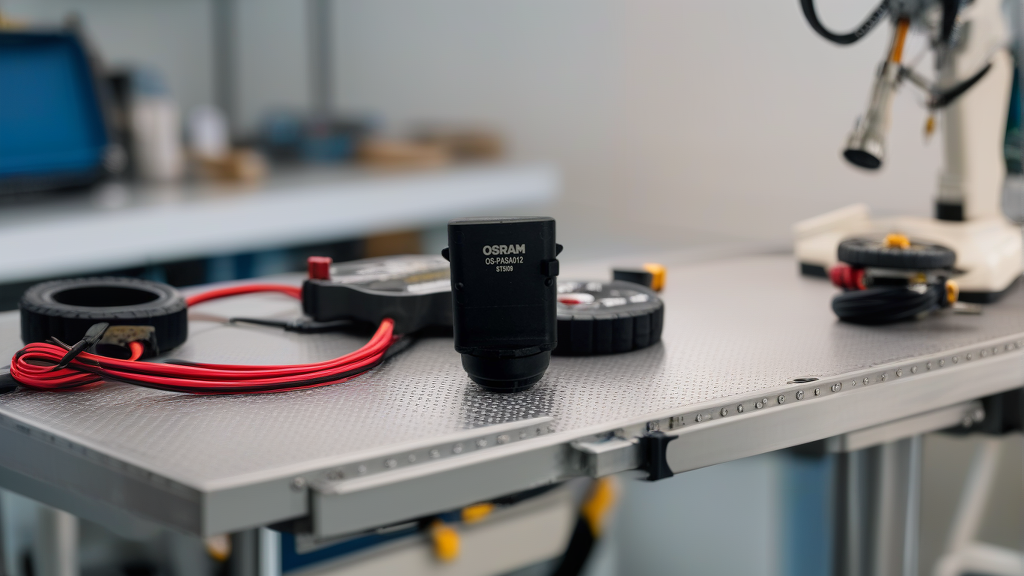
The next time a VW Golf nudges into a parallel spot hands-free, remember this: the bumper isn’t just plastic. It’s a sensor array running a continuous sonar sweep, and the technology behind it is more straightforward than most drivers realize—and more fragile than most parts catalogs suggest.
Volkswagen’s parking sensor system, including the widely used OE number 3D0919275D, operates on ultrasonic pulse-echo measurement. Each sensor houses a piezoelectric ceramic disc that vibrates at roughly 40 kHz when energized. That vibration pushes a pressure wave into the air. When the wave hits an obstacle—a concrete wall, a shopping cart, a rogue cone—it reflects back. The sensor’s membrane then acts as a microphone, converting the returning pressure variation into a millivolt-level electrical signal. The control module measures the round-trip time. At 343 meters per second in air, a 50-centimeter gap takes about 2.9 milliseconds to echo. That’s the entire magic trick.
But not all echoes are equal. Temperature shifts air density, which changes the speed of sound by roughly 0.6 m/s per degree Celsius. A sensor calibrated for a 20°C workshop will read slightly long in a -10°C Berlin winter. Modern VW modules compensate using the ambient temperature sensor already in the bumper harness, but cheaper aftermarket units often skip that input. The result: intermittent false alarms or late warnings when seasons change.
What separates a genuine OSRAM unit from a no-name replacement is not just the piezo disc quality—it’s the signal conditioning. The OS-PASA012 houses a dedicated preamplifier and bandpass filter tuned to reject harmonics from engine noise and tire whine. Without that filtering, the module can trigger on road spray turbulence at highway speeds. That’s why you’ll see VW owners report phantom beeps in heavy rain with cheap sensors, while the OSRAM-equipped cars stay quiet.
Signal type matters, too. VW moved from analog amplitude-based detection in early 2000s models to digital pulse-width output in later generations. The OS-PASA012 is built for the digital bus architecture used across the Passat, Touareg, and Phaeton lines—3D0919275D supersedes the older analog variants. If you’re diagnosing a dead sensor, check the connector pinout. A five-pin housing with two power, two ground, and one signal line indicates digital. Three pins typically means analog. Mixing them up won’t just fail—it can backfeed voltage into the gateway and trigger a cascade of module faults.
Key Specs — OS-PASA012
- Operating frequency: 40 kHz ± 2 kHz
- Detection range: 20 cm to 250 cm
- Response time: < 10 ms per pulse cycle
- Operating temperature: -40°C to +85°C
- Output: Digital PWM, compatible with VW CAN-bus modules
For shop owners, the practical takeaway is this: when a VW comes in with “parking sensor malfunction” on the dash, don’t shotgun all four sensors. Use a diagnostic tool to read which one returns a short-to-ground or open-circuit code. Then bench-test the suspect unit with a 9V battery and an oscilloscope. A healthy sensor will produce a clear 40 kHz burst and a decaying echo waveform. If you see clipped peaks or a muddy sine wave, the piezo has delaminated—replace it with a sensor like the OS-PASA012 that carries the OSRAM stamp for consistent output, not a generic clone.
Pro Tip: After replacing a sensor, wait 30 seconds with the ignition on before testing. The VW control module runs a self-calibration routine on startup, and interrupting it with rapid key cycles can store a false fault code that lingers even after the fix.
The aftermarket for VW parking sensors has matured. OE-quality units from OSRAM now cover the vast majority of applications at roughly half the dealership price. For a 2010 Touareg or a 2006 Phaeton, that’s the difference between a €180 per-sensor dealer quote and a €45 part that bolts in with the same retention clip and connector seal. If you’re doing the job once, do it with the sensor that filters the noise and tells the truth—your bumper will thank you at the next tight squeeze.

Recommended Part: OS-PASA012 – OE-grade replacement, in stock now.
