
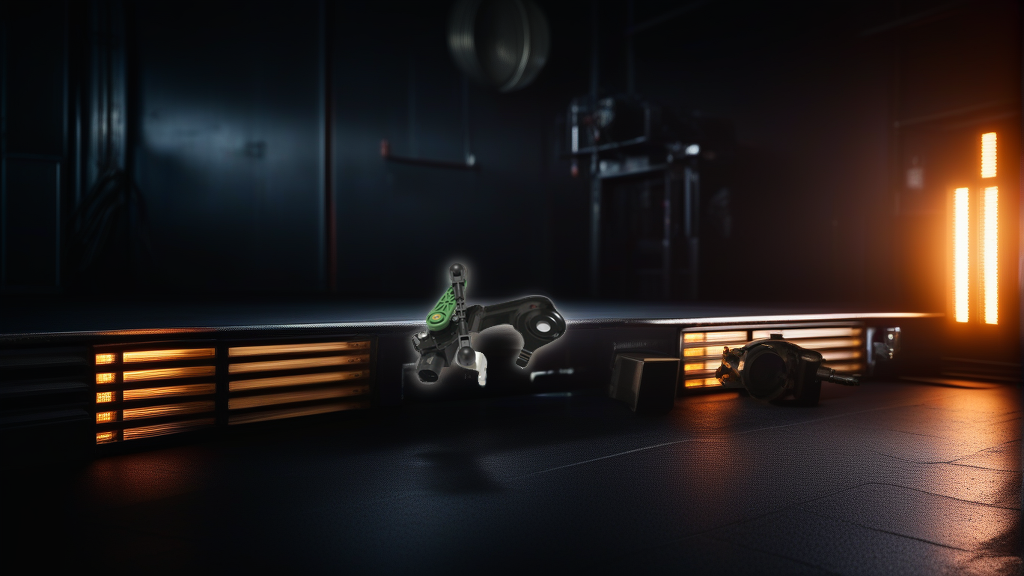
Audi owners tend to discover their ride height sensor the same way: a yellow warning light on the dash, a car sitting lopsided in the driveway, or the unmistakable groan of an air compressor running far too long. The 4H0941310C — used across the A6, A7, A8, and Q7 with adaptive air suspension — has become one of the most commonly replaced electronic components on modern Audi platforms. And for good reason: it sits in one of the harshest environments on the vehicle, exposed to road salt, gravel, and constant articulation.
What most owners don’t realize is that a failing ride height sensor rarely announces itself with a single, obvious symptom. It mimics other faults. It triggers codes that point elsewhere. And in some cases, it doesn’t trigger a code at all — just a slow, creeping misbehavior that eats tires and ruins alignment specs.
The Warning Light That Lies
The most common complaint we hear from Audi owners is the air suspension warning light appearing intermittently — usually after driving through standing water or after a cold snap. The system reports “Chassis: Fault! Vehicle Too Low” or simply displays the amber suspension icon without explanation. Many owners assume the air springs are leaking. Some replace the compressor. A few even sell the car.
Here’s what actually happens: the ride height sensor contains a Hall-effect integrated circuit and a magnet mounted on a rotating arm. When the sensor’s internal components degrade — typically from moisture ingress or micro-cracks in the solder joints from thermal cycling — the signal becomes erratic. The suspension control module sees a sudden jump in voltage that doesn’t correspond to vehicle movement. It interprets this as a sensor failure and commands the system into a safe mode. The car drops to its lowest setting, or refuses to raise at all.
The frustrating part? The fault code often reads as “Implausible Signal” or “Suspension Level Sensor — No Signal.” A technician unfamiliar with Audi’s adaptive suspension system might chase wiring faults, check the control module, or replace the air strut. Meanwhile, the actual problem is a $60 sensor that takes 20 minutes to replace.
Dead Battery Symptoms and the Cascade Effect
There’s another failure mode that catches Audi owners off guard. A failing ride height sensor can drain the battery. Here’s the chain reaction: when the sensor sends erratic signals, the suspension control module keeps waking up to process and reject the data. This prevents the vehicle from entering its proper sleep mode. The module stays partially active, drawing constant current.
We’ve had customers report dead batteries after leaving the car parked for three or four days. They jump-start the car, the suspension warning appears, and they assume the two events are connected but unrelated. In reality, the sensor caused both.
A quick diagnostic check: if your Audi sits for more than 48 hours and struggles to crank, and you’ve also noticed the suspension settling unevenly, test the ride height sensors before replacing the battery. A parasitic drain test will show around 0.5 to 0.8 amps with everything locked — that’s your smoking gun.
Signal Interference and the 4H0941310C
The 4H0941310C is a dual-function sensor — it monitors both the front-left and front-right suspension positions on certain models, or the rear positions depending on application. It outputs a PWM signal to the control module. This signal is sensitive to electrical noise, particularly from aftermarket accessories.
We’ve seen cases where installing LED headlight ballasts, dash cameras, or phone chargers into the 12V socket created enough electromagnetic interference to corrupt the sensor signal. The suspension module would intermittently report faults, especially at idle when the alternator output fluctuates.
If you’re chasing intermittent ride height faults and you’ve added any electrical accessories recently, disconnect them and clear the codes before replacing parts. It sounds overly simple, but we’ve seen it fix issues that dozens of forum threads blamed on the air struts.
Common Fault Codes and What They Actually Mean
Here’s a breakdown of the codes you’re most likely to encounter with a failing ride height sensor:
| Code | Description | What It Usually Means |
|---|---|---|
| 01772 | Signal from Level Control System Sensor (G78) implausible | Sensor internal failure or wiring damage |
| 00776 | Level Control System Sensor (G76) — no signal | Connector corrosion or broken wire |
| 01577 | Shut-off due to excessive temperature | Compressor overheating from overwork — often caused by sensor keeping the system active |
| 02645 | Level Control System — vehicle too low | Sensor arm out of calibration or mechanical binding |
Note that codes referencing G76, G78, G84, and G85 all point to ride height sensors. If you see any of these, check the sensor arm’s mechanical range first — sometimes a seized ball joint on the sensor link arm prevents proper rotation. WD-40 and a manual push of the arm can confirm whether the sensor itself responds. If the voltage reading doesn’t change smoothly when you move the arm, the sensor is dead.
Pro Tip: Before condemning the sensor, use VCDS or OBDeleven to check the live readings from each height sensor. With the car on level ground, all four sensors should read within 2mm of each other. A reading that jumps around by 10mm or more while the car sits still indicates a failing sensor. Also check the sensor link arm — they corrode and seize, which mechanically prevents the sensor from reading correctly.
The OSRAM Replacement: What You Should Know
When it comes time to replace the sensor, you have options. The dealer will sell you the OE part for around $180-240. You can find no-name aftermarket units for $25-40, but those carry real risk — cheap Hall-effect sensors with poor sealing fail within months, especially in winter climates.
The OSRAM OS-HSA014 sits between those extremes and offers something the OE part doesn’t: better environmental sealing. OSRAM has extensively tested this sensor against moisture ingress, which is the primary cause of early failure in the original design. The connector pins are gold-plated, and the housing uses a two-part ultrasonic weld that holds up significantly better than the original’s snap-together case.
Fitment is straightforward for anyone who’s done basic suspension work. The sensor mounts to the upper control arm and connects to a link arm that reaches down to the lower arm. The electrical connector is located on the sensor body itself — accessible without removing the wheel well liner, though removing the liner makes the job far easier.
Key specs for the OS-HSA014:
- OE Reference: 4H0941310C
- Sensor Type: Hall Effect, PWM output
- Operating Voltage: 5V reference from control module
- Temperature Range: -40°C to +85°C
- Housing Material: PBT-GF30 (glass-reinforced plastic)
- Connector: 3-pin, weather-sealed
Replacement time is roughly 20-40 minutes per corner on a lift, or about an hour on jack stands. You’ll need a 10mm socket, a Torx T20 for the sensor mounting screws, and possibly a trim removal tool for the wheel well liner clips. After installation, you’ll need to perform a basic calibration using VCDS or a compatible scan tool — the system needs to relearn the sensor’s zero point. This takes about five minutes and requires the car to be on level ground with the suspension in its normal ride height.
The Bottom Line
If you’re dealing with intermittent air suspension faults, a slow-draining battery, or a car that sits unevenly overnight, test your ride height sensors before spending money on compressors or struts. The diagnostic time is minimal, and the replacement is one of the easier jobs on the Audi platform.
The OSRAM OS-HSA014 is our recommended replacement for the 4H0941310C. It matches the OE fit and function while addressing the known moisture ingress weakness of the original design. At roughly half the dealer price, it’s a sensible upgrade for owners planning to keep their Audi for the long haul — and for shops, it’s a part you can install with confidence knowing it won’t come back on warranty.
Check the sensor arm for free movement, verify your wiring harness isn’t chafed against the subframe, and replace the sensor with a quality unit. Your Audi’s air suspension is a well-engineered system when its inputs are clean. Give it a sensor that reports accurately, and the entire system behaves like it should.

Recommended Part: OS-HSA014 – OE-grade replacement, in stock now.