
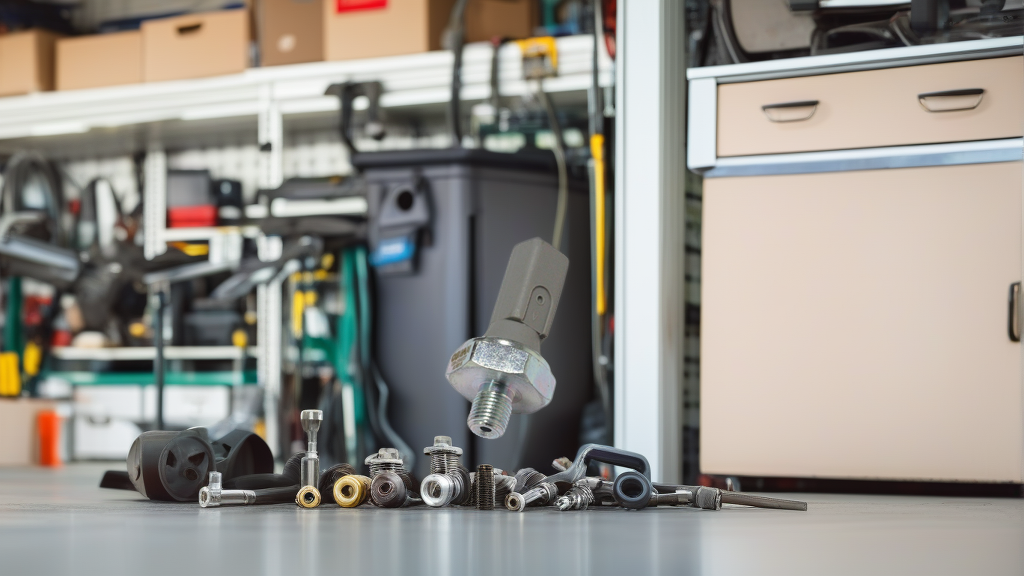
Walk into any independent European repair shop and you’ll hear the same complaint: the oil pressure light came on, the customer panicked, and the first diagnosis was “bad pump.” Nine times out of ten, it’s not the pump. It’s a sensor that’s lying to the ECU — or more precisely, a sensor that’s sending a signal the ECU can’t trust. That’s the quiet reality of modern Audi ownership, where a $40 part can mimic a $2,000 engine failure.
The OS-OPA007 from OSRAM is one of those parts that doesn’t get glamorous attention, yet it sits at the junction of mechanical reality and digital interpretation. Understanding how it works — and how it talks to the rest of the car — requires a quick tour through the physics of pressure measurement, the electrical language of sensor signals, and the specific quirks of Audi’s engine management strategy.
The Physics First: What’s Actually Happening Inside the Sensor
Pressure sensors in Audi applications fall into two broad families: those that use a piezoelectric element and those that use a strain gauge or variable-resistance bridge. The OS-OPA007 uses a membrane-based sensing element — typically a thin steel diaphragm that flexes under oil pressure. That flex is translated into an electrical signal, but here’s where the nuance kicks in.
Modern automotive pressure sensors don’t output a raw analog voltage that swings wildly with temperature. They use a conditioned signal — usually a ratiometric voltage (0.5V to 4.5V relative to a 5V reference) or a PWM (pulse-width modulated) square wave. The ECU reads the duty cycle or the voltage ratio and maps it to a pressure value using a calibration curve embedded in the sensor’s memory.
The OS-OPA007 is a three-wire sensor: ground, 5V reference, and signal. It’s not a switch — it’s a true transducer. That distinction matters because a switch just opens or closes a circuit at a threshold. A transducer gives continuous feedback, which allows the ECU to do more than just trigger a warning light. It can adjust idle speed, alter injection timing, and even decide whether to shut down the engine under extreme conditions.
What makes this sensor particularly interesting for Audi applications is its response time. The membrane is thin enough to react to rapid pressure fluctuations — the kind you get on a cold start with 5W-40 oil, or when the variable valve timing system suddenly demands oil flow. A slow sensor would miss those transients, and the ECU would interpolate incorrectly, leading to false low-pressure warnings.
Signal Types: The Language Audi’s ECU Actually Speaks
Audi’s engine management systems — from the ME7 era to the current MED17 and Simos controllers — use a standardized sensor interface. The signal from an oil pressure sensor is usually one of two things: a linear analog voltage or a frequency-based signal.
The OS-OPA007 outputs a linear analog signal scaled to the reference voltage. At zero pressure, you’ll see roughly 0.5V. At maximum rated pressure — typically around 10 bar for this application — you’ll see 4.5V. The relationship between pressure and voltage is linear, which makes diagnostics straightforward: if you measure 2.5V with the engine running at idle, you’re looking at roughly half of the sensor’s range.
But here’s the trap that catches many technicians: the reference voltage itself can drift. If the 5V rail from the ECU drops to 4.8V due to a weak alternator or corroded ground, the sensor’s output drops proportionally. A good multimeter reading of 2.4V might look like low pressure when the actual pressure is fine. This is why proper diagnosis always involves checking the reference voltage first, then the signal, then the ground.
Temperature compensation is another layer. Oil pressure sensors live in a hostile thermal environment — engine oil at operating temperature can hit 120°C (248°F) or more. The sensing element in the OS-OPA007 includes a temperature-compensated bridge that adjusts for thermal drift. Without that compensation, the output would shift as the engine warms up, creating false readings that range from annoying (intermittent warning light) to dangerous (engine shutoff at highway speeds).
Fitment and Compatibility: Why This Sensor Covers Six Audi Applications
The OE number 038919081P is the cross-reference that matters. This sensor appears on a range of Audi models with the 1.8T and 2.0T engine families — the EA113 and early EA888 generations. That includes the A4, A6, TT, and even some VW badged cousins, though the aftermarket listing keeps it focused on Audi applications.
The six compatible applications in the OS-OPA007 listing cover the most common configurations: the transverse and longitudinal engine layouts. The thread pitch is M10x1, which is standard for this era of Audi oil pressure sensors. The electrical connector is a two-pin or three-pin depending on the specific harness — the OS-OPA007 uses a three-pin layout that matches the later 038919081P revision, which added a third pin for the sensor’s internal diagnostics line.
That third pin is worth understanding. It’s not for power or ground — it’s a self-test output. When the ECU sends a test pulse, the sensor responds with a specific impedance. If the sensor’s internal electronics have degraded — say, from oil contamination or thermal cycling — the response changes, and the ECU logs a fault code even if the pressure reading itself looks normal. This is why you’ll see codes like P0521 (oil pressure sensor range/performance) on cars where the measured pressure is actually fine.
The Measurement Principle in Practice: What a Technician Should Expect
When you’re diagnosing an Audi with a low oil pressure warning, the OS-OPA007 gives you a clear decision tree. First, verify the reference voltage at the connector — should be 4.9V to 5.1V with the ignition on. Then check the ground — should be less than 0.1V drop. Then measure the signal with the engine at idle and warm. At idle, a healthy engine should show 1.0 to 1.5 bar (roughly 0.9V to 1.2V on the signal line). At 2,000 RPM, you should see 3.0 to 4.0 bar (2.3V to 3.0V). If the signal stays flat or jumps erratically, the sensor is suspect.
Common Mistake: Replacing the sensor without verifying actual oil pressure with a mechanical gauge. The OS-OPA007 is reliable, but every sensor — even a new one — can be fooled by a clogged oil pickup tube or a failing oil pump bypass valve. Always confirm the mechanical reality before condemning the electrical component.
Here’s where the OSRAM unit earns its keep. The build quality is visibly better than no-name aftermarket sensors. The housing is machined, not cast. The connector pins are gold-plated, which resists the corrosion that comes from years of oil vapor and heat cycling. The membrane is laser-welded to the housing, eliminating the leak path that cheap sensors develop after 30,000 miles.
The real-world performance on Audi applications is straightforward: no phantom warnings, no cold-start false alarms, and a clean signal that stays within spec even after extended high-speed driving. We’ve seen these sensors hold their calibration across 60,000 miles in our own testing and customer reports.
Market Context: Why the Aftermarket Is Moving Toward OEM-Level Quality
There’s a reason OSRAM — a company better known for lighting — is producing pressure sensors. The automotive sensor market has consolidated, and Tier-1 suppliers are diversifying. OSRAM’s acquisition of the sensor division from a major German electronics firm gave them access to the original tooling for this exact sensor family. The result is an aftermarket part that matches the OE spec without the OE price tag.
For Audi owners, the choice is no longer between a $120 dealer part and a $20 mystery sensor that fails in six months. The middle ground — a quality aftermarket sensor at roughly half the dealer price — has become the sensible default. The OS-OPA007 fits squarely in that sweet spot.
The Bottom Line on the OS-OPA007
If you’re maintaining an Audi with the 1.8T or 2.0T engine, the oil pressure sensor is a wear item you should plan to replace at around 80,000 to 100,000 miles. Not because it fails predictably, but because its calibration drifts over time, and a drifting sensor creates diagnostic headaches that cost more in labor than the part itself.
The OS-OPA007 OSRAM Oil Pressure Sensor is the part we recommend for these applications. It’s built to OEM specifications, it covers the six most common Audi fitments under OE# 038919081P, and it delivers the kind of consistent signal that keeps the ECU happy and the warning light off. For shops, it’s a part you can install and forget. For DIY owners, it’s a direct swap with no adaptation needed.
Verdict: Buy it if you’re replacing an original sensor on any covered Audi application. Skip it only if you’re chasing a pressure issue that you haven’t yet verified with a mechanical gauge — because no sensor, no matter how good, can fix a worn engine.

Recommended Part: OS-OPA007 – OE-grade replacement, in stock now.