
The average 2024 Toyota Camry rolling off the line carries more computing power than the Apollo 11 guidance computer, and most of that processing is devoted to one task: interpreting sensor data. While drivers fixate on horsepower numbers and infotainment screen sizes, the quiet revolution in modern Toyota vehicles is happening in millivolts and microfarads — tiny electrical signals from a network of pressure sensors, thermistors, and radar emitters that decide everything from when the transmission shifts to whether the airbags deploy.
For the aftermarket parts buyer, understanding this sensor ecosystem isn’t academic trivia. It’s the difference between a five-minute diagnostic and a three-day wild goose chase. And it directly impacts which ignition components — like the OSRAM coil — actually deliver their rated performance.
The Pressure Sensor: Your Engine’s Blood Pressure Monitor
Toyota has used manifold absolute pressure (MAP) sensors since the 1980s, but the current generation is a marvel of solid-state engineering. Inside the sensor housing sits a silicon diaphragm etched with piezoresistive elements. When intake manifold pressure changes, the diaphragm flexes, altering the resistance across those elements. A Wheatstone bridge circuit converts that resistance change into a voltage signal — typically 0.5V at idle (around 30 kPa) to 4.5V at wide-open throttle (near 100 kPa).
What makes Toyota’s implementation interesting is the signal processing. The engine control module (ECM) doesn’t just read raw voltage; it samples the MAP signal at a rate of roughly 100 Hz and compares it against the crankshaft position sensor’s RPM reading. This cross-referencing allows the ECM to calculate engine load with an accuracy of ±2 percent — which directly informs ignition timing and fuel delivery.
Here’s where the aftermarket connection matters: a failing MAP sensor sends erroneous load data, and the ECM responds by retarding ignition timing as a safety measure. That retarded timing creates excessive heat in the exhaust stream and forces the ignition coil to work harder to fire a mixture that’s burning later than optimal. If you’re running an OEM-spec Toyota coil nearing its service life, this added stress can push it over the edge. The fix often isn’t just the sensor — it’s the entire ignition chain.
Key Specs — Toyota MAP Sensor (Gen 5):
- Output: 0.5–4.5V analog
- Response time: <2 ms
- Operating range: 10–115 kPa absolute
- Accuracy: ±1.5% full scale
- Supply voltage: 5V regulated
Temperature Sensors: The Thermistor Trio
Toyota vehicles use three primary temperature sensors, each relying on the same fundamental principle: a negative temperature coefficient (NTC) thermistor whose resistance drops as temperature rises. The engine coolant temperature (ECT) sensor, intake air temperature (IAT) sensor, and transmission fluid temperature (TFT) sensor all operate on this principle, but their signal conditioning differs significantly.
The ECT sensor is the workhorse. Its resistance ranges from roughly 2.5 kΩ at 20°C down to about 200 Ω at 100°C. The ECM sends a 5V reference through a fixed resistor and measures the voltage drop across the thermistor. Because the relationship between resistance and temperature is nonlinear, the ECM uses a lookup table with polynomial interpolation to convert the voltage reading into an actual temperature value with ±1°C accuracy.
What most DIYers miss is the self-diagnostic behavior. A Toyota ECM will flag a P0115 code if the ECT signal doesn’t change more than 0.5°C over a 60-second window while the engine is warming up. That’s not a sensor failure — it’s often a stuck-open thermostat. The sensor is fine; the coolant is just bypassing the radiator. Replacing the sensor without checking the thermostat is the single most common misdiagnosis in Toyota cooling system repairs.
The Height Sensor: Leveling the Ride
Toyota’s Adaptive Variable Suspension (AVS) system, available on Avalon Limited and certain Highlander trims, uses height sensors at each corner to maintain chassis leveling. These aren’t simple potentiometers — they’re Hall-effect sensors coupled to a linkage arm.
A magnet mounted on the sensor rotor creates a magnetic field that varies as the suspension arm moves. The Hall-effect element detects the field strength and outputs a digital PWM signal with a duty cycle proportional to height. The suspension control module reads this signal at 50 Hz and adjusts the dampers accordingly.
The critical diagnostic detail: these sensors produce a voltage that sweeps from 0.5V at full compression to 4.5V at full extension, but the mid-point (2.5V) corresponds to design ride height. A sensor that drifts even 0.2V off center won’t trigger a warning light, but it will cause the suspension to constantly hunt for “level” — leading to premature damper wear and a rough ride. On a vehicle with 80,000 miles, this subtle drift is more common than outright sensor failure.
Radar Sensors: The Millimeter-Wave Sentinel
Toyota’s Pre-Collision System (PCS) uses a 77 GHz millimeter-wave radar mounted behind the front grille emblem. Unlike the acoustic sensors used in parking assist, this radar emits frequency-modulated continuous waves (FMCW) and analyzes the reflected signal’s frequency shift to calculate distance and relative velocity.
The physics is straightforward: the radar transmits a signal whose frequency sweeps linearly from 76.5 to 77.5 GHz over a few milliseconds. The reflected signal from a vehicle ahead returns with a time delay that translates to a frequency difference — the “beat frequency.” Range is proportional to the beat frequency, while the Doppler shift component reveals closing speed.
What impresses — and frustrates — aftermarket technicians is the calibration requirement. Toyota specifies that the radar sensor’s vertical alignment must be within ±1 degree of spec, checked using a specialized reflector target placed exactly 3 meters in front of the vehicle. Any misalignment, even from a minor front-end collision, degrades the system’s ability to distinguish between a stopped vehicle and an overhead bridge. The system doesn’t just fail; it gives false positives, which is arguably worse.
Signal Types: The Language of the ECM
Toyota’s sensor portfolio speaks three distinct signal dialects, and understanding them is essential when diagnosing any electrical issue:
Analog voltage signals (MAP, ECT, TPS) — Linear or nonlinear voltage ranges that require the ECM’s analog-to-digital converter to translate. These are susceptible to voltage drops in wiring, which is why Toyota specifies a maximum 0.1V drop across the sensor ground circuit.
Frequency-based signals (crankshaft position, wheel speed) — These use variable reluctance or Hall-effect generators that output an AC or digital square wave whose frequency correlates to rotational speed. The ECM measures time between pulses, not voltage amplitude, making them largely immune to wiring resistance.
Digital serial data (radar, some newer pressure sensors) — These use CAN bus or LIN bus protocols to transmit calibrated data packets. They carry self-diagnostic information and are the easiest to troubleshoot, provided you have a scan tool that can read live data.
The Ignition Connection: Why Sensor Health Dictates Coil Life
Here’s the practical takeaway for the Toyota owner or shop operator: every sensor signal ultimately influences ignition timing, and ignition timing determines the stress placed on the coil. A dirty MAF sensor, a lazy ECT sensor, or a failing knock sensor all cause the ECM to adjust timing — and the coil has to deliver the same energy regardless of when the ECM commands the spark.
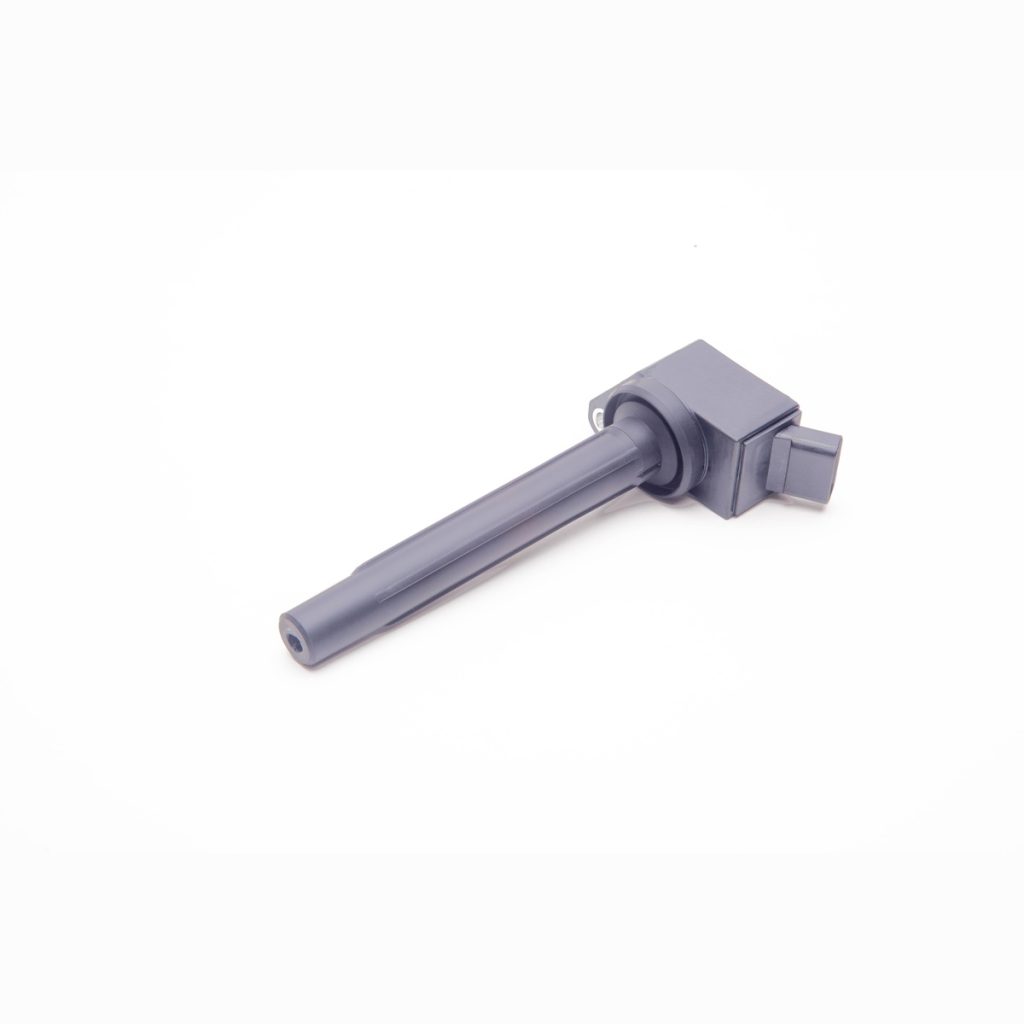
This is why we recommend pairing sensor diagnostics with a quality coil replacement. The OS1042 OSRAM ignition coil, which fits Toyota applications under OE number 90919-C2008, is designed with a laminated steel core and epoxy-encapsulated windings that handle the extended dwell times Toyota’s ECMs use during cold starts and high-load conditions. When the rest of the sensor network is reading clean, this coil delivers consistent 35 kV output at the spark plug gap — no more, no less.
With Toyota pushing hybrid powertrains across most of its lineup, the traditional ignition system is becoming a smaller part of the vehicle’s overall architecture. But for the millions of Camrys, Corollas, and RAV4s with conventional engines still on the road — and the many more with Atkinson-cycle hybrids that still need ignition at cold start — the interplay between sensor data and coil performance remains the backbone of reliable operation.
Bottom line: When you’re chasing a Toyota driveability complaint, don’t start with the coil. Start with the sensors. Read live data, verify signal integrity, and only then consider the ignition components. The sensors are the brains; the coil is just the muscle. Keep the brains healthy, and the muscle lasts twice as long.

Recommended Part: OS1042 – OE-grade replacement, in stock now.