
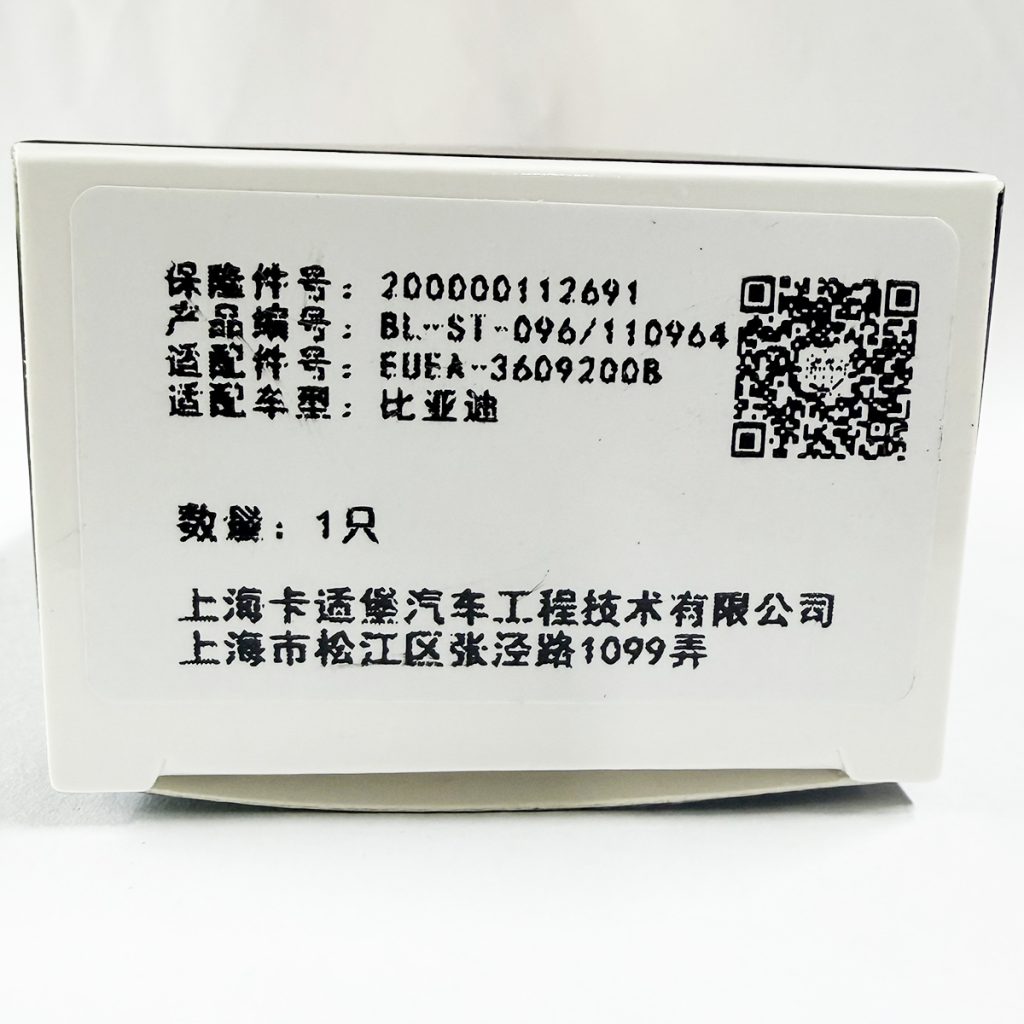
A BYD Qin Plus EV rolls into your bay with the TPMS light staring at you from the cluster. Customer says “it just came on yesterday.” Your first instinct? Grab the scan tool, read the sensor IDs, maybe order a replacement. Hold up. On these 2025+ BYD platforms, the TPMS fault tree is simpler than most techs think — and more than half the time, the sensor itself is fine. Here’s how to diagnose the Qin Plus EV TPMS warning light systematically before you throw parts at it.

Start With the Obvious: Tire Pressure and Physical Inspection
I know — this sounds like “did you try turning it off and on again.” But the direct TPMS on the Qin Plus EV reads real-time kPa from each wheel. A slow leak that dropped one tire from 250 kPa to 195 kPa will trigger the light long before the driver notices a pull. BYD’s threshold on this platform is typically 25% below the recommended cold pressure (sticker on the driver’s door jamb — usually 250 kPa for the Qin Plus EV).
What to do: inflate all four tires to spec cold, including the spare if equipped with a sensor. Then take the car for a short drive above 25 km/h — the Qin Plus EV’s TPMS ECU needs vehicle speed to wake the sensors and re-evaluate. If the light clears after 2–3 minutes of driving, you just saved yourself a diag hour. If it stays on, move to step two.
While you’re at the wheels, check for physical damage. A cracked valve stem, bead leak, or rim corrosion at the sensor mounting point can cause intermittent pressure loss that mimics a sensor fault. The clamp-in sensors on the Qin Plus EV sit inside the wheel — if someone did a tire change recently and overtightened the nut, the sensor body can crack at the base. Look for corrosion trails around the valve stem; that’s telltale.
Sensor Signal: Wake-Up, Battery, and Interference
The Qin Plus EV uses 433MHz TPMS sensors — the BL-ST-096 | BH-Sens 433MHz TPMS | OE# EUEA3609200B is the direct OE replacement. Each sensor has an internal battery rated for roughly 5–7 years under normal driving. On a 2025 model year, battery failure is unlikely but not impossible — especially if the car sat on a lot for months, or if the sensor took a hard impact.
Grab your TPMS activation tool (Autel, ATEQ, Bartec — anything that can trigger 433MHz). Walk around the vehicle and activate each sensor one at a time. A healthy sensor should respond within seconds with pressure, temperature, and its 8-digit ID. If one sensor doesn’t wake, reposition the tool closer to the valve stem and try again — the Qin Plus EV’s aluminum wheels can attenuate the signal if you’re standing at the wrong angle.
If a sensor still won’t wake, you’ve got two likely scenarios: dead battery (replace the sensor), or the sensor lost its programming after a 12V battery disconnect. BYD vehicles store sensor IDs in the TPMS ECU. A prolonged 12V battery disconnect — common after body work or extended storage — can occasionally wipe the learned IDs. In that case, the sensors themselves are fine; they just need to be re-learned to the vehicle. Don’t replace a sensor until you’ve confirmed it’s actually transmitting and the ECU still refuses to see it.
Another thing: aftermarket LED lighting, dash cams hardwired near the rearview mirror, or even a cheap phone charger plugged into the 12V socket can generate RF noise in the 433MHz band. If all four sensors suddenly dropped out at once, unplug every aftermarket accessory, clear the TPMS codes, and road-test. I’ve seen a $15 USB adapter cause a four-sensor ghost fault on a BYD Han — same platform family, same TPMS architecture.
Receiver Module, CAN Communication, and Learn Procedure
If all four sensors wake normally on your tool but the cluster still shows the warning light, the problem is downstream: the TPMS receiver module, the CAN bus, or the ECU’s learned ID table.
The Qin Plus EV’s TPMS receiver is integrated into the Body Control Module or a dedicated RF receiver module (location varies by trim — usually behind the glovebox or in the right C-pillar). The receiver processes the 433MHz signals from all four sensors and pushes pressure/temperature data onto the CAN bus. If the CAN gateway isn’t getting valid TPMS messages, the cluster lights up.
What you need: a scan tool that can read BYD chassis CAN (think X431, Autel MaxiSYS, or BYD’s own VDS). Go into the TPMS module and check live data. If you see “–” or “No Signal” for one or more positions despite the sensor waking on your tool, the receiver may have a fault, or the sensor ID was never properly registered in the ECU.
The learn procedure on the 2025 Qin Plus EV is OBD-based — there’s no magnet or deflation sequence required. Connect your scan tool, enter the TPMS relearn menu, read each sensor’s ID via the activation tool, and write those IDs into the ECU positions (FL/FR/RL/RR). Some aftermarket scan tools will auto-detect the sensor positions via RSSI signal strength; others require you to manually assign each ID to its corner. After writing, clear all TPMS DTCs and test-drive above 25 km/h for at least 5 minutes. The light should extinguish.
If the IDs write successfully but the light returns within a drive cycle, suspect an intermittent CAN fault — check the receiver module’s power and ground, look for corroded pins at the connector, and scope the CAN-H/CAN-L lines for signal integrity. Water intrusion at the C-pillar receiver location is a known issue on earlier BYD sedans; the Qin Plus EV’s sealed connector design is better, but not immune.
Bottom Line: Diagnose Before You Replace
The Qin Plus EV TPMS system isn’t complicated — it’s a straightforward direct-TPMS architecture that’s been refined across BYD’s lineup. If you follow this three-step diagnostic flow (pressure → sensor signal → receiver/CAN), you’ll catch the real fault on the first visit. Jumping straight to sensor replacement wastes your time and the customer’s money — and on this platform, the sensor is rarely the actual culprit.
Recommended Part
If diagnostics confirm a failed sensor on a 2025+ BYD Qin Plus EV, the correct OE replacement is the BL-ST-096 | BH-Sens 433MHz TPMS | OE# EUEA3609200B. Pre-programmed, clamp-in design, 433MHz — direct fit, no cloning required. Covers the entire 2025 BYD passenger vehicle lineup including Qin Plus EV, Han, Tang, Song, Seal, Dolphin, and Sealion platforms.