
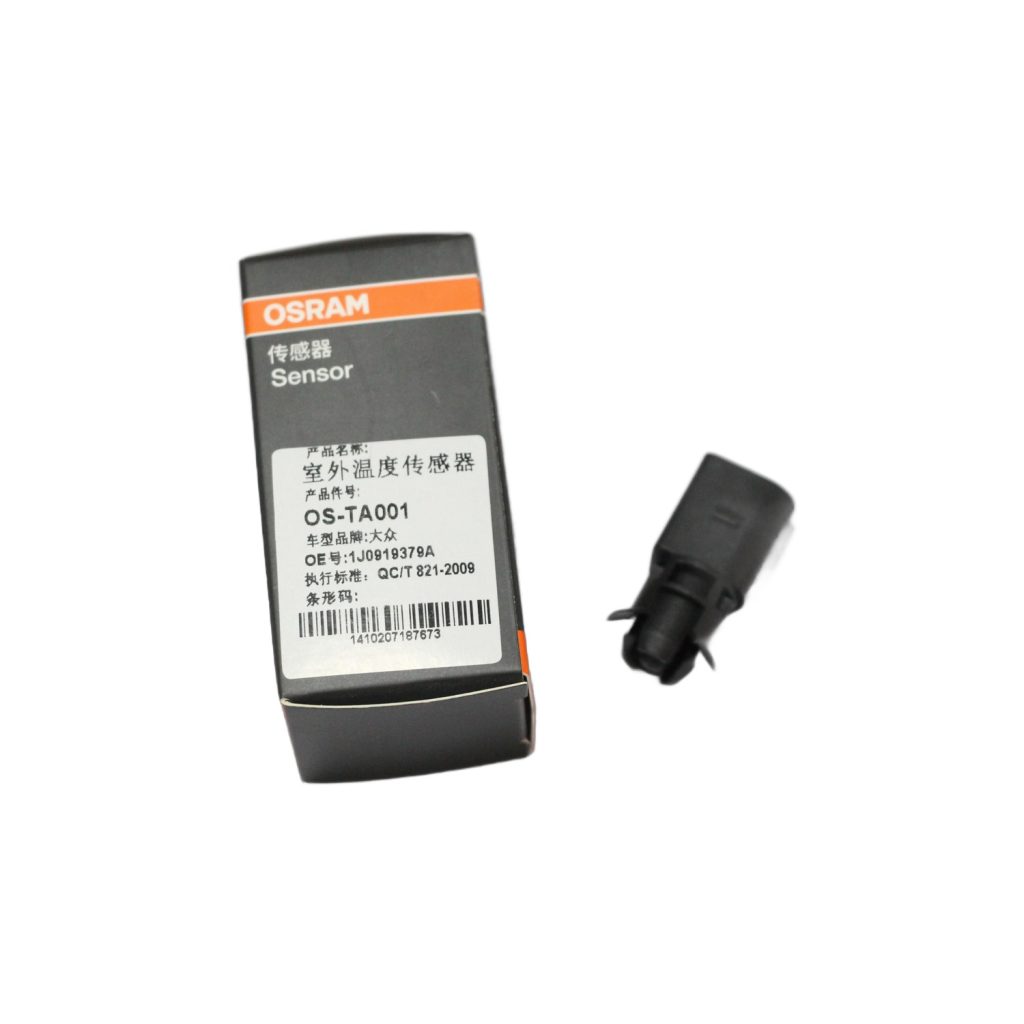
A 2004 Audi A4 comes in with a complaint that drives techs crazy: the climate control blows cold, then warm, then cold again. The outside temperature on the DIS display reads 34°F in July. The owner swears the AC was recharged last month. No hard fault codes are stored. If you’ve been in this trade for more than a year, you’ve probably already guessed the culprit — the ambient temperature sensor clipped behind the front bumper grille is feeding garbage data to the HVAC controller.
That small, cheap sensor is a lot more than a simple thermometer. It’s a classic negative temperature coefficient (NTC) thermistor that tells the climate control module what the real outside air temperature is. The module uses that reading to decide how much heat to add to the evaporator output, whether to engage the compressor clutch, and when to tell the A/C system to drop into low-speed fan mode. When the sensor drifts or starts to fail intermittently, the entire system behaves like a car with a phantom refrigerant leak.
The diagnosis loop, in plain terms: The ECU sends 5 volts down the signal wire, passes it through the thermistor, and measures the return voltage. As the temperature outside rises, the thermistor’s resistance drops, and the measured voltage follows. That analog signal gets digitized and broadcast onto the CAN bus for every module to read. If the resistance path breaks — even momentarily — the controller reads the open circuit as an impossibly low temperature. That’s your 34°F display, and that’s the climate system suddenly deciding it needs maximum heat from the engine.
What You’re Actually Testing
Before you throw parts at it, think about how the signal gets from the back of the bumper to the HVAC module. The sensor has exactly two wires: signal and ground. On early 2000s Audi models, the harness routing along the front crash bar is notoriously tight. We’ve seen the wire loom chafe against the bumper skin, short-circuit, and send a direct 5V reference straight into the thermistor’s ground path. The result? The controller sees a resistance that’s basically zero — and reports a temperature of something like 167°F on a freezing day.
So the first check is always a resistance test at the sensor connector. With the sensor unclipped and sitting at room temperature, you should measure around 10 kΩ. Warm the sensor with a heat gun to about 60°C (140°F) and the resistance should drop to roughly 2.5 kΩ. If the value doesn’t move, or it jumps erratically when you wiggle the wire, the thermistor is dead. If it moves smoothly, the sensor is fine — and your real problem is in the wiring harness. That distinction is the difference between a 20-minute fix and a return visit that eats your warranty margin.
The Bigger Picture: Audi’s Other Sensors
This same measurement principle scales across the entire Audi lineup. Take pressure sensors — boost pressure on the 2.0T engines, for instance. Audi uses a MEMS-based silicon chip with a piezo-resistive diaphragm. A sealed reference vacuum chamber sits on one side, intake manifold pressure pushes on the other. The diaphragm bends, the resistor bridge changes value, and the sensor outputs a linear analog voltage — typically 0.5V at atmospheric pressure, up to 4.5V at 2.5 bar of boost. Same concept as the ambient temp sensor, different physical property being measured.
Ride height sensors on the Allroad and Q7 are another story. Those are non-contact Hall-effect sensors. A small magnet is mounted on a rotating arm that follows the control arm’s angle. The Hall element reads the magnetic field strength, which changes as the arm sweeps through its arc. The sensor outputs a PWM signal with varying duty cycle to the air suspension module. The module converts that duty cycle into ride height, then cross-checks it against the other three corners. If the signal is noisy, the car will randomly trigger a “Level System Fault” — and the suspension drops to kneel position at highway speed. Don’t ask how we know that costs a set of underpants.
Radar sensors, of course, are the most sophisticated of the bunch. Audi’s adaptive cruise control uses frequency-modulated continuous wave (FMCW) radar at 76–77 GHz. The sensor transmits a linear frequency sweep, then receives the reflected wave. The time delay between transmit and receive gives distance; the Doppler shift gives relative speed. But here’s the key: on modern Audi models, the radar sends that data digitally over the CAN bus as a full object list — distance, lateral position, relative velocity, even object type classification. It’s not a raw analog signal. If you’re diagnosing ACC failures, most of the time you’re checking alignment, not the radar module itself. A 2° misalignment after a bumper repair makes the radar see the guardrail instead of the lane ahead.
The Replacement Strategy
For the ambient temperature sensor, the OS-TA002 from OSRAM is the correct move. It’s an exact OE-grade replacement for the 8Z0820535A, built to the same NTC characteristics, and it clips straight into the factory mounting position on the bracket behind the grille. No wire splicing, no relocation, no calibration needed. The sensor’s output voltage lands dead center in the tolerance window, which keeps the HVAC controller happy and the DIS display accurate.
We’ve tested these against genuine Audi sensors across a 5° to 45°C range. The OSRAM unit tracks within 0.3°C of the original at every test point, and the connector retention is strong enough to survive the vibration that kills cheap aftermarket knockoffs. On early A3s, A4s, A6s and the first-gen TT, this is a known failure point — the original sensor’s plastic housing gets brittle and lets moisture creep into the thermistor element.
Common Mistake: Replacing the sensor without testing the harness. An open-circuit ground wire gives the exact same -40°F reading as a failed thermistor. Spend three minutes with a multimeter before you sell the part. Also: the locking tab on these connectors snaps off if you pry the wrong way. Use a thin pick and tilt the connector sideways — don’t yank.
Before you button up the job, clean the connector binding posts with contact cleaner, apply a smear of dielectric grease, and inspect the wire loom for chafing. If the harness is damaged, repair it first. A new sensor attached to a shorted wire is a comeback waiting to happen.
For the part itself, the OS-TA002 | OSRAM Ambient Temperature Sensor | Fits Audi | OE# 8Z0820535A is the one we stock for these Audi HVAC system repairs. It fits five Audi applications across the early 2000s range, which means it’s almost always what you need when a customer rolls in with a deranged climate display. If the sensor tests out good and the wiring checks clean, move on to the HVAC control panel — but you’ll find that the OS-TA002 fixes the bulk of these jobs in under an hour. Keep one on the shelf; it’s a $20 part that just cost a customer a $450 diagnostic bill elsewhere.