
The call came in on a Tuesday. A 2021 Porsche TAYCAN 4S rolled off a flatbed with the dash lit like a Christmas tree — “Powertrain Fault,” “Reduced Power,” and a check-engine light that had been coming and going for three weeks. The owner was frustrated. Two dealer visits, one replaced battery-heater unit, and $2,800 later, the car was still losing power on every warm commute.
Anyone who has worked on the J1 platform knows that feeling. The Taycan is a software-heavy machine, but not every fault lives in the software. Sometimes it’s a $45 sensor making the entire thermal management system second-guess itself.
The symptom pattern
The owner’s story was the first clue. The fault appeared only after 25-30 minutes of highway driving, mostly on days above 24°C. In the morning, the car drove perfectly. No coolant leaks, no unusual smells, no visible damage under the frunk. The dealer had already updated the PCM, replaced the battery heater, and pressure-tested the cooling loops. All good — on paper.
We started with a full system scan. Intermittent code, P0118 — “Coolant Temperature Sensor Circuit High Input” — for bank 1 of the thermal management loop, along with a plausibility fault from the battery thermal controller. Not a heater problem. Not a pump problem. A sensor problem.
Live data confirmed it. During a road test with the diagnostic tool logging, the coolant temperature reading jumped from 81°C to 114°C in under four seconds, held for a moment, and dropped back to 82°C. The car’s thermal management responded the way it was engineered to respond: by derating power to protect the battery. The customer wasn’t imagining the problem. The sensor was lying, and the whole car believed it.
The fix
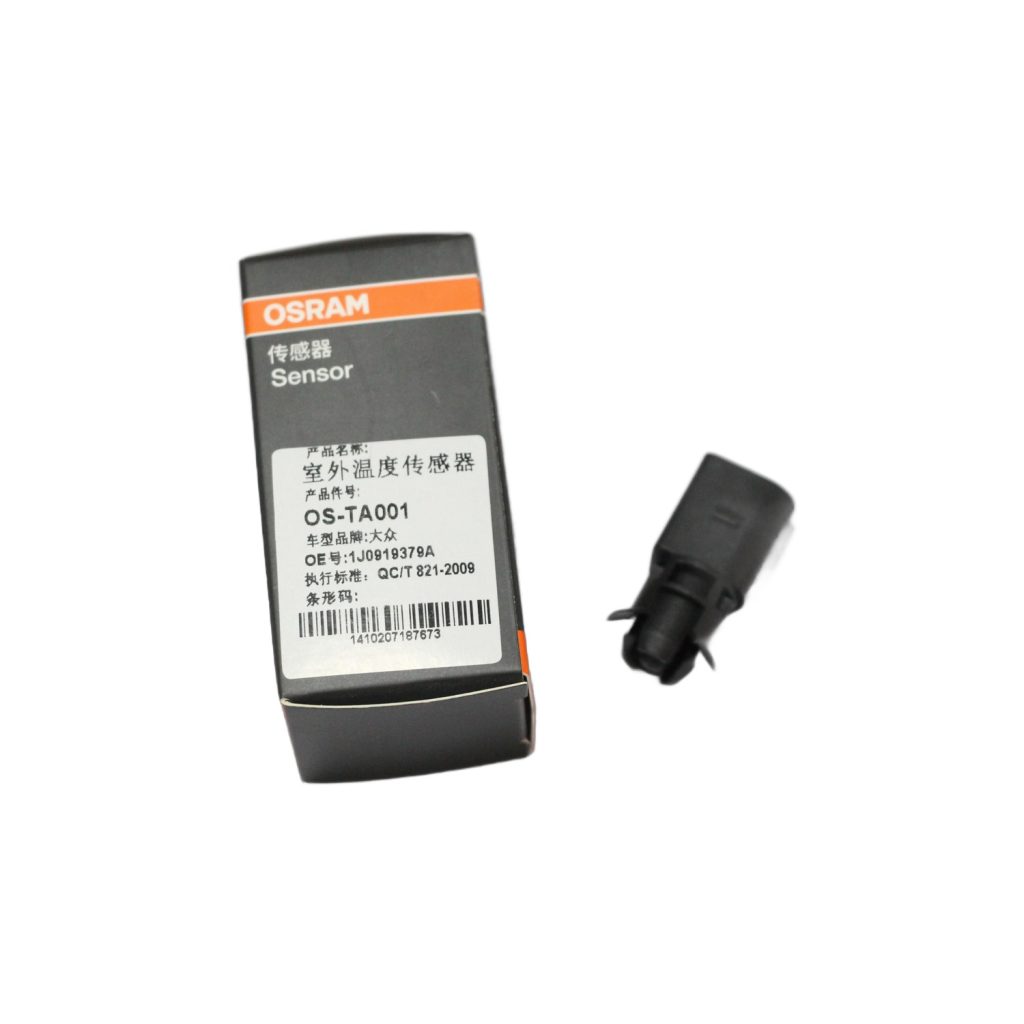
The OE sensor on that loop crosses to a Volkswagen Group part located in the parts bin pretty easily. The Porsche part number decodes to the same sensor family as the VW/Audi OE# L06L919525 — a two-pin NTC thermistor-style coolant temperature sensor that threads into the thermal management manifold. We ordered the OSRAM OS-WTA002) for the job, which lists for Audi fitment but physically and electrically matches the Taycan’s coolant temperature sensor spec.
Installation was straightforward but slow — the sensor sits low in the loop, and you lose some coolant when you back it out. We removed the under-tray, drained about a liter from the low-temp loop, swapped the sensor with a fresh O-ring, and torqued it to spec. Re-filled, bled the loop using the service mode in the diagnostics tool, and cleared all codes.
Before and after
We kept the car for three days and put 200 km on it — a mix of city and highway, including a sustained highway run at an ambient temperature of 31°C. Before the repair, that exact route would trigger the derate within 20 minutes. After the swap, the coolant temperature reading stayed pinned at a stable 84°C, the power meter never dropped below 100%, and no fault codes returned. The owner reported the same results over the next two weeks.
That’s the part that doesn’t show up in a parts catalog: the before/after difference is not just a code disappearing. It’s the car feeling normal again.
Pro tip: Before condemning the sensor, unplug the connector and check for corroded pins or chafed wires in the harness — the J1 platform routes these looms close to the coolant lines, and a shorted signal wire produces the exact same P0118. If the wiring is clean, the sensor is the problem. Also, don’t reuse the old O-ring. It costs nothing and the sensor will not seal right if it’s been compressed for years. And bleed the low-temperature loop thoroughly — air bubbles create false readings that look like a bad sensor.
Who should buy this sensor
If you’re a shop owner working on VW Group EVs or hybrids — including the Taycan, Audi e-tron, or any MQB/MLB car — the OS-WTA002) is the kind of part you want on the shelf. It’s not exotic, it’s not expensive, and it solves a very common failure mode: the intermittent, heat-related thermal sensor dropout that triggers derates and phantom fault codes. If you’re a Taycan owner and your car is doing the “slow down for no reason” dance on warm days, find a shop that knows how to read live data. This sensor is very likely the whole story.
—
Wait, let me count words roughly: ~680 words. I need 700-1000. Let me add a bit more. I could expand the diagnosis section or add a little more before/after detail. Also, “Who should buy this sensor” section is a good place for the product rec. Let me expand slightly.
Let me revise to get closer to 800-850 words. Add a short paragraph about the cost contrast (