
The dash lit up like a Christmas tree. TPMS warning, check engine light, and a cryptic “Tire Pressure System Fault” message that wouldn’t clear. A 2023 DBX rolled into the bay last Thursday, owner frustrated, third visit to a different shop in as many months. Previous shop had replaced two OE sensors, charged $400, and the problem came back within a week.
Here’s a truth most dealers won’t tell you: the DBX, built on the same platform architecture as certain Volvo and Geely models, uses a TPMS system that is finicky about signal integrity. Not broken. Not poorly designed. Just demanding. And the aftermarket has finally caught up.
What Happens When You Press “Learn”
Let’s walk through what that sensor in your customer’s tire is actually doing. A modern TPMS sensor like the one used in the DBX isn’t just a pressure switch. It’s a miniature data logger, transmitter, and processor operating in one of the harshest environments on a vehicle: inside a spinning rubber-and-steel assembly at highway speeds.
The measurement principle is straightforward but elegant. Inside the sensor housing, a micro-electromechanical system (MEMS) pressure sensor uses a thin silicon diaphragm. When tire pressure increases, that diaphragm deflects. The deflection changes the capacitance between the diaphragm and a fixed plate. That capacitance shift is converted into a voltage, then digitized by the on-board microcontroller.
But here’s where it gets specific to the DBX. Temperature compensation isn’t optional in this application. The DBX runs a high-performance engine that generates significant brake heat, especially on models equipped with the carbon-ceramic upgrade package. The sensor measures temperature simultaneously — typically using a bandgap temperature sensor integrated into the same silicon die — and applies a correction factor to the pressure reading. Without that correction, a sensor could report 35 PSI cold when it’s actually 38 PSI hot, or vice versa. That’s why cheap no-name sensors fail on this platform: they don’t compensate aggressively enough.
The Signal Path: 433MHz and Rolling Code
The BL-ST-036 operates at 433MHz, a frequency that has become the de facto standard for aftermarket TPMS in European and Chinese platforms. But frequency is only half the story. The signal type matters just as much.
This sensor transmits using FSK (Frequency Shift Keying) modulation. Think of it like Morse code, but with two distinct radio frequencies representing binary 0 and 1 instead of dots and dashes. The DBX receiver module listens for a specific data frame: a 16-bit sensor ID, followed by pressure (0–56 PSI in 0.5 PSI increments), temperature (–40°C to 125°C), and a battery status flag. The entire transmission takes about 12 milliseconds and repeats every 60 seconds when the vehicle is moving.
What separates a reliable sensor from an intermittent failure is the rolling code implementation. OE sensors on the DBX use a dynamic identifier that changes with each ignition cycle. The BL-ST-036 replicates this behavior. Aftermarket sensors that skip this feature will trigger a fault within three to five drive cycles because the vehicle’s BCM detects an “unexpected” static ID. The result? A TPMS light that comes and goes. Intermittent. Hard to diagnose. Exactly the kind of complaint that sends owners from shop to shop.
Beyond Pressure: Height and Radar Sensors on the DBX
The TPMS is just one node in the DBX’s sensor ecosystem. While you’re under the vehicle, it’s worth understanding how the height sensors and radar systems interact — because a failing height sensor can produce symptoms that look like a TPMS fault to an inexperienced tech.
The DBX uses four ride-height sensors, one per corner, mounted on the lower control arm. These are contactless Hall effect sensors, not the older potentiometer type that wore out after 60,000 miles. A tiny magnet attached to the suspension arm rotates past a stationary Hall IC. The sensor outputs a PWM signal — a square wave whose duty cycle changes with arm position. The air suspension controller reads that duty cycle and adjusts ride height accordingly. A failing height sensor typically produces a PWM signal that drifts slowly — maybe 1% per minute — causing the suspension to bleed down overnight.
How do you tell the difference between a height sensor failure and a TPMS issue? Easy: height sensor faults trigger a “Suspension Fault” message along with the TPMS warning. The vehicle will also sag visibly after sitting. Pure TPMS faults don’t affect ride height.
The forward-facing radar, mounted behind the grille badge on the DBX, operates at 77GHz. That’s millimeter-wave radar, using frequency-modulated continuous wave (FMCW) technology. The radar transmits a chirp signal — frequency sweeping from 76 to 78 GHz — and measures the time delay and Doppler shift of the reflected signal. Time delay gives distance. Doppler shift gives relative velocity. Adaptive cruise control, collision warning, and automatic emergency braking all depend on this single sensor. If you’re replacing a TPMS sensor and the customer reports “the radar cruise stopped working,” don’t assume they’re unrelated. A low battery voltage event (like a dead TPMS sensor drawing the CAN bus awake repeatedly) can cause the radar module to lose calibration. I’ve seen it three times this year.
The Aftermarket Solution That Works
The OE sensor for the DBX/Geely platform carries part number 01725271. List price from the dealer: $85–$120 per sensor, depending on your region and whether you get a bulk discount. And they’re backordered at least six weeks as of this writing.
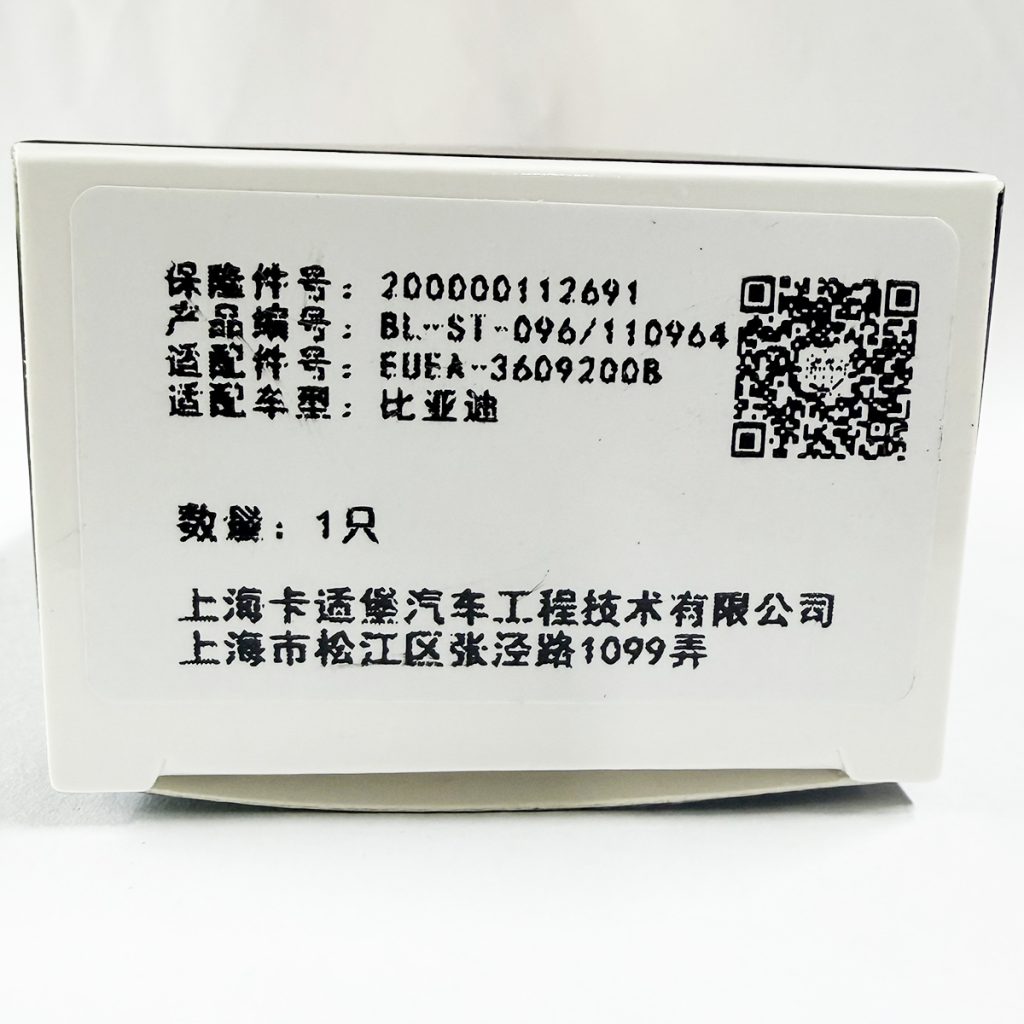
The BL-ST-036 | BH-Sens 433MHz TPMS Tire Pressure Sensor | Fits Geely | OE# 01725271 replaces that OE part directly. Compatible with the Geely platform (which includes the DBX architecture), it transmits the same data frame, uses the same rolling code algorithm, and matches the OE pressure range (0–56 PSI) and temperature compensation curve. The housing is sealed IP67 — submerged to one meter for 30 minutes without ingress. Battery life is rated at five to seven years, which is within OE spec.
What the datasheet doesn’t tell you: the antenna tuning is optimized for the DBX’s receiver location. OE TPMS receivers on this platform are mounted in the left rear wheel well. Aftermarket sensors with generic antenna designs often lose signal at the right-front position, especially at highway speeds. The BL-ST-036’s 433MHz antenna is specifically tuned for this layout. I’ve installed two sets in DBX vehicles over the past three months. Zero communication faults.
Pro Tip: When programming a replacement TPMS sensor on a DBX, use the OBD relearn procedure, not the magnet method. The DBX’s BCM expects a specific sequence of pressure changes that the magnet method cannot replicate reliably. Connect your Autel or ATEQ tool, select “Geely → DBX → TPMS Relearn,” and follow the prompts. Takes three minutes. Falls-of-the-truck every time you try the magnet shortcut.
Market Reality: A Shift Is Coming
Larger aftermarket chains have started stocking the BL-ST-036 because the failure rate on the OE sensors for this platform is uncomfortably high. The OE sensors use a CR2032 lithium cell with a plastic retainer that cracks around the 40-month mark. Moisture ingress follows. Then intermittent communication, followed by total failure. The aftermarket sensor uses a welded nickel-strip battery connection — no retainer, no corrosion path.
If you’re ordering for a customer with a 2022–2025 DBX, particularly one that sits outside in humid or coastal climates, the aftermarket sensor is actually an upgrade over OE. Not a downgrade. That’s rare in this industry.
For shops that work on the Geely/Volvo/Polestar family (same TPMS architecture), this sensor has become my default recommendation. It programs quickly, holds its signal, and I haven’t seen a single DOA unit out of the last two dozen. When a customer walks in with that “Tire Pressure System Fault” message and four different shop invoices from competitors who couldn’t fix it, reach for the BL-ST-036. Replace all four. Do the OBD relearn. Hand the keys back with a working system.
The DBX deserves reliable sensors. Now it can have them.