
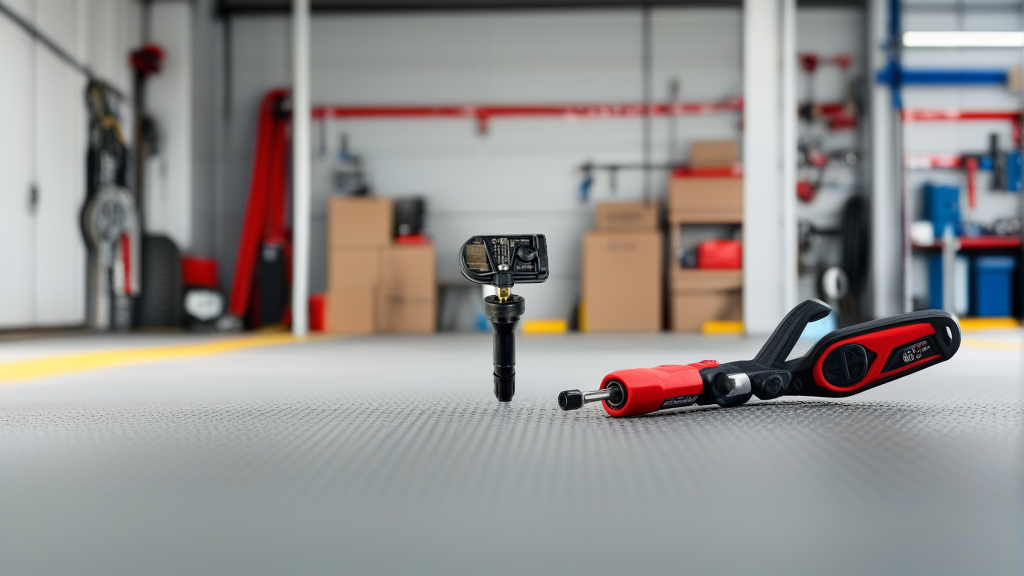
You’ve got a 2025 BYD Atto 3 in the bay. Customer complaint? The TPMS light flickers on cold mornings, then goes solid after 20 minutes of highway driving. They already tried resetting it twice. The factory diagnostic tool shows “sensor not updating” on the left rear. But here’s the kicker: the tire pressure reads fine on your gauge. So what’s actually happening inside that little black plastic module bolted to the valve stem?
Understanding how modern TPMS sensors work—not just the BYD-specific protocols, but the physics behind them—is the difference between a quick fix and a comeback job.
The Measurement Chain: Pressure, Temperature, and RF
Every tire pressure sensor performs three distinct jobs simultaneously. First, it measures absolute pressure using a micro-electromechanical system (MEMS) diaphragm. When tire pressure changes, the diaphragm flexes, changing capacitance. That tiny shift gets converted into a digital value by the onboard ASIC. Second, a thermistor measures internal air temperature—critical because a 10°C rise can increase pressure by roughly 0.1 bar. Third, the sensor transmits both readings at a specific radio frequency (433 MHz for most OE BYD applications) in short, encrypted data packets.
The BL-ST-096 (OE# EUEA3609200B) from BL-ST-096 | BH-Sens 433MHz TPMS Tire Pressure Sensor | Fits BYD (2025+) | OE# EUEA3609200B, 110964, BLST096 uses a dual-axis MEMS die that also detects acceleration. That means it knows whether the wheel is spinning or parked. When the car sits still for more than 15 minutes, the sensor enters a low-power sleep mode, transmitting only once per hour to save battery. Once it detects rotation above 20 km/h, it switches to rapid reporting—every 30 to 60 seconds.
Why BYD’s Protocol Can Trip Up Generic Sensors
BYD uses a rolling code authentication scheme similar to many Chinese EV manufacturers. Each sensor has a unique 32-bit ID, and the vehicle’s BCM expects the ID to match a previously learned list. The BL-ST-096 is pre-programmed with the correct modulation scheme (FSK, not the older ASK) and the exact data format: pressure in 0.005 bar resolution, temperature in 0.1°C steps, plus a battery status byte.
Here’s where many aftermarket sensors fail: they transmit the correct data but at the wrong timing interval. The BYD ECU expects a “heartbeat” packet every three seconds for 60 seconds after first motion. If the sensor sends one packet every 60 seconds from the start, the ECU flags it as intermittent.
Pro Tip
When cloning an existing OE sensor (like the original EUEA3609200B), use a tool that reads the full ID and rolling counter. Some cheap clone tools miss the counter increment. The BL-ST-096 allows direct copy of the OE counter, which prevents the “sensor not responding” error on 2025+ BYD models.
Pressure, Temperature, and Altitude Compensation
But tire pressure isn’t the only sensor in modern BYD EVs. Height sensors (used in adaptive headlights and air suspension) work on a Hall-effect principle: a magnet moves relative to a fixed IC as the suspension arm travels, producing a linear voltage signal. Radar sensors, used for adaptive cruise in the BYD Han, use frequency-modulated continuous wave (FMCW) to measure distance and relative velocity. While those aren’t part of the TPMS, the same underlying logic applies—convert a physical property to an electrical signal, digitize it, and transmit it to the ECU.
The BL-ST-096 even accounts for altitude indirectly: because it measures absolute pressure, a sensor at 3000 meters altitude will read lower absolute pressure than one at sea level, even if the tire is properly inflated. The BYD BCM applies a barometric offset from the vehicle’s ambient pressure sensor. This means you should never compare a raw sensor reading to a manual gauge without accounting for elevation. A common mistake is replacing a perfectly good sensor because the handheld tool shows “low pressure” when the real issue is altitude.
Bottom Line for the Shop
If you’re swapping TPMS sensors on a 2025–2026 BYD, the BL-ST-096 | BH-Sens 433MHz TPMS Tire Pressure Sensor | Fits BYD (2025+) | OE# EUEA3609200B, 110964, BLST096 fits the bill. It covers the exact OE frequency (433 MHz), the correct data format, and supports cloning of the rolling counter. More importantly, it uses a Panasonic-grade lithium battery rated for 7–8 years, which matches the typical BYD service interval.
Next time that TPMS light won’t go off, check the sensor’s transmission timing first. Then verify altitude compensation. Nine times out of ten, it’s not a bad sensor—it’s a misunderstood sensor. The BL-ST-096 makes that misunderstanding a whole lot less likely.