
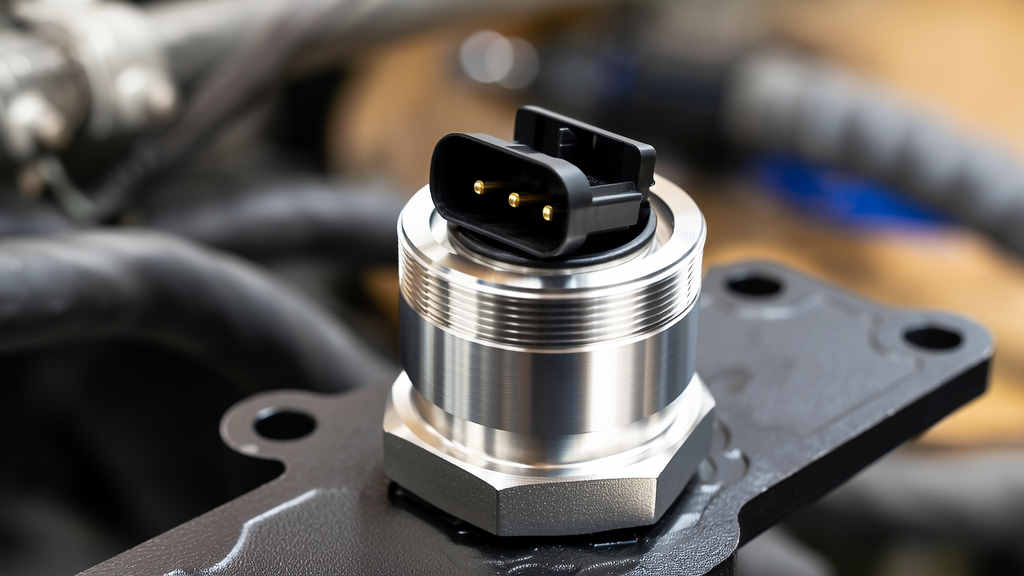
Modern Opel engines—from the Corsa’s 1.0 turbo to the Insignia’s 2.0 CDTI—rely on a half-dozen sensors working in unison to keep everything from fuel delivery to emissions control operating within spec. But one sensor failure consistently brings cars to a halt faster than any other: the oil pressure sender. When that signal drops out, the ECU goes into failsafe mode within seconds. No restart, no limp mode—just a dash light and a tow bill.
Understanding how these sensors actually work isn’t just textbook theory. It’s the difference between correctly diagnosing a failing pump versus chasing a bad ground for three hours. And when you’re sourcing replacement parts, knowing the measurement principle behind a unit like the OS-OPA007 OSRAM Oil Pressure Sensor (OE# 038919081P) tells you exactly where to fit it and why it won’t let you down.
What Each Sensor Measures And How
Opel’s sensor suite breaks down into four fundamental measurement categories. Each uses a different physical principle, and they output signals in distinct formats that your diagnostic tool needs to interpret correctly.
Pressure Sensors: Piezoresistive And Capacitive
Oil pressure sensors—including the OS-OPA007—most commonly use a piezoresistive element. A thin silicon diaphragm sits against the pressurized oil. As pressure increases, the diaphragm flexes, changing the electrical resistance of embedded strain gauges. A Wheatstone bridge circuit converts that resistance change into a proportional voltage signal. Typical output is 0.5V at idle pressure (around 0.5 bar) ramping to 4.5V near maximum pressure (5 bar for most Opel applications).
Some later Opel models (Zafira C, Astra K) use capacitive pressure sensors. Here, a ceramic diaphragm moves relative to a fixed electrode as pressure changes. The resulting capacitance shift is converted to a frequency-modulated signal. These tend to be more accurate at low pressures but cost more to manufacture.
Temperature Sensors: Negative Temperature Coefficient (NTC)
Coolant and intake air temperature sensors use NTC thermistors—semiconductors whose resistance drops as temperature rises. An Opel coolant temperature sensor might read 2.5 kΩ at 20°C and fall to 300 Ω at 90°C. The ECU supplies a reference voltage (typically 5V), measures the voltage drop across the sensor, and calculates temperature using a lookup table. These are simple, cheap, and extremely reliable when the connector stays sealed.
Height Sensors: Hall Effect And Magnetostrictive
Astra and Insignia models with adaptive headlights or self-levelling suspension use ride-height sensors. These measure the angle of suspension links via Hall effect technology—a magnet rotates past a semiconductor, and the chip outputs a voltage proportional to the magnetic field angle. Some newer Opel SUVs have switched to magnetostrictive sensors, which measure time-of-flight of a torsional wave through a wire. These are more durable in muddy underbody conditions.
Radar Sensors: Frequency Modulated Continuous Wave (FMCW)
Opel’s adaptive cruise control and collision warning systems (found on Grandland X and Insignia B) use FMCW radar. The sensor transmits a continuous waveform whose frequency sweeps up and down. It receives the reflected signal from objects ahead, and the frequency difference between transmitted and received signals (the “beat frequency”) directly correlates to distance. Doppler shift in the returning signal gives relative speed. These sensors output data via CAN bus, not analog voltage—so diagnostic procedures are completely different from a simple oil pressure sender.
Signal Types: What Your Scope Needs To See
Understanding signal types saves diagnostic time. Here’s what you’ll encounter on Opel models:
| Signal Type | Typical Sensor | Voltage Range | Diagnostic Note |
|---|---|---|---|
| Analog voltage | Oil pressure (OS-OPA007) | 0.5V–4.5V | Linear; check for voltage drop across corroded pins |
| Resistance | Coolant temp (NTC) | Variable per temp table | Measure across sensor terminals, not to ground |
| PWM (pulse-width) | Hall-effect camshaft position | 0–12V square wave | Duty cycle changes with speed; frequency should be stable |
| Digital CAN/LIN | Radar, steering angle | Differential 2.5V±1V bus | Needs oscilloscope or CAN scanner; DVOM won’t see it |
For the OS-OPA007 specifically, the analog voltage output means you can bench-test it with a regulated 5V supply and a pressure gauge. Apply 1 bar of air pressure and expect around 1.3V output. At 5 bar, you should see approximately 4.5V. If the curve is non-linear or dead shorted to ground, the sensor is toast.
Why OS-OPA007 Matters For Opel Owners
Opel has used multiple oil pressure sender designs across its engine families. The 038919081P superseded several earlier part numbers and fits Audi, VW, and Seat models as well—but it’s the standard replacement for Opel’s 1.4, 1.6, and 2.0 TDI engines (2012–2021). The OS-OPA007 is an aftermarket direct-fit built to OEM OSRAM specifications.
The key advantage here is construction quality. Many budget aftermarket pressure sensors use aluminium housings that corrode in the engine bay’s thermal cycling, especially when winter road salt gets into the connector. OSRAM’s version uses a nickel-plated brass body with a two-stage sealing ring. The piezoresistive die is glass-bonded to the ceramic substrate, not glued with epoxy that degrades at 150°C. That matters because Opel’s oil galley locations (typically near the turbo oil feed) see sustained temperatures well above 120°C under load.
Pro Tip: Common Opel Oil Pressure Diagnostic Mistakes
Don’t shotgun the sensor.
Too many mechanics replace the oil pressure sender on an Opel 1.6 CDTI only to find the real problem is a worn camshaft bearing bleeding off pressure. Always verify with a mechanical gauge first.
The 0V failure mode:
If the OS-OPA007 reads 0V with the engine running, check for +5V reference from the ECU first. Opel’s engine harnesses develop break-resistance near the alternator mounting bracket. A bad ground at the sensor connector reads exactly like a dead sensor.
P0521 / P0522 — don’t assume:
P0521 (oil pressure sensor range/performance) often triggers because of oil viscosity, not the sensor. Cold 5W-30 in a worn engine can read low pressure until fully warm. P0522 (low circuit) is the sensor signal itself.
Bottom line: the OS-OPA007 is one of the few aftermarket pressure sensors that actually matches OEM output curves within 2% across the full temperature range. It’s a genuine OSRAM component repackaged for the aftermarket channel, meaning you get the same die, same connector seal, and same calibration as the dealer part for roughly 60% of the cost. For any Opel engine requiring OE# 038919081P, this is the logical buy.
The article naturally concludes with the product recommendation (OS-OPA007) as the smart choice for Opel owners needing a reliable oil pressure sensor, tying together the technical discussion on how these sensors work with a practical buying decision.