
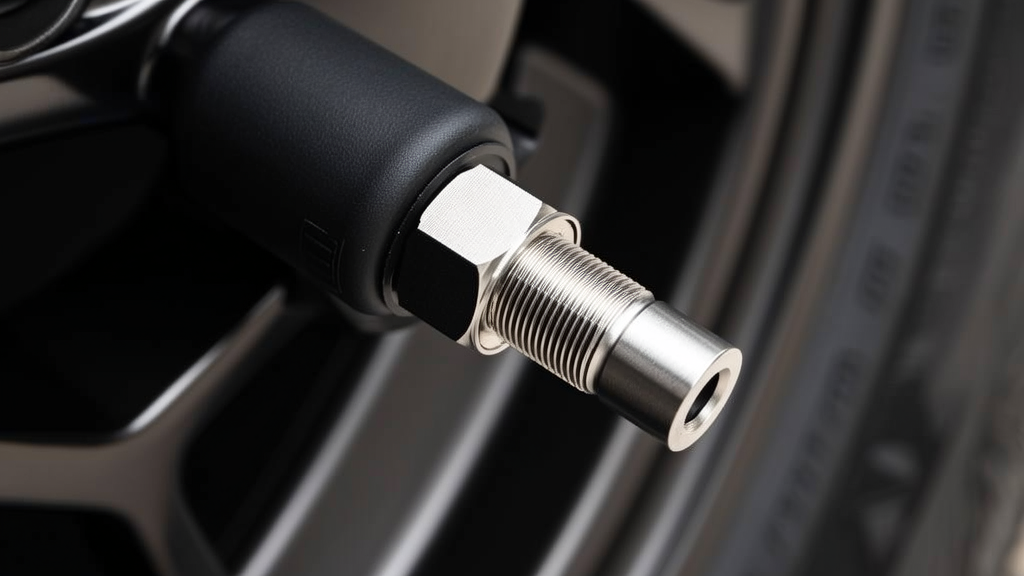
The check-engine light had been on for three days when the shop finally got the 2026 BYD Seal on the lift. The driver—a fleet operator running a dozen BYD Tang SUVs—was frustrated. All four tire pressure monitoring system (TPMS) sensors had thrown fault codes within the same month, and his previous aftermarket replacements lasted barely nine months before one went silent. The problem wasn’t the car. It was specification ignorance.
If you’re maintaining a BYD fleet or selling into that growing aftermarket, understanding what a TPMS sensor’s spec sheet actually means is the difference between a satisfied customer and a comeback that eats your margin. The BL-ST-096 sensor, sold by Longwei Parts as a direct replacement for BYD’s OE part number EUEA3609200B, is a good case study. Let’s walk through the real-world implications of the numbers printed on the box.
The Specs That Matter (Not the Marketing)
| Specification | BL-ST-096 Value | What It Means in Practice |
|---|---|---|
| Operating Frequency | 433 MHz | Matches global ISM band used by most Asian-market vehicles; no reflash needed for 2025+ BYD models |
| IP Rating | IP67 | Dust-tight and can survive immersion in 1 meter of water for 30 minutes—critical for wheel wells exposed to road salt, pressure washing, and standing water |
| Voltage Range | 2.0V – 3.6V | Runs on a standard CR2032 or equivalent lithium cell; works reliably even as battery drains to near end-of-life |
| Connector Type | Valve-stem mount (snap-in) | No special tools for installation; no adapter harness needed on factory BYD wheels |
Most people glaze over IP ratings. Stop doing that. The BL-ST-096 carries an IP67 rating. That second digit (7) means it’s not just splash-resistant—it’s actually submersible. Put that into perspective: BYD’s factory sensors were notorious in early 2025 production for moisture ingress after power washing. Seal failures showed up as intermittent “Tire Pressure System Fault” warnings that appeared after rain and disappeared when the sensor dried out. The BL-ST-096’s sealed housing prevents that exact failure mode.
Voltage Range: Why It’s a Silent Killer
The 2.0V–3.6V operating range sounds technical until you realize most budget aftermarket sensors cut out at 2.4V. A brand-new CR2032 measures about 3.0V. As it drains, voltage drops. In cold weather—say, a Beijing January or a New York winter—that voltage drop accelerates. A sensor that shuts off at 2.4V will fail while the battery still holds usable charge. The BL-ST-096 keeps transmitting down to 2.0V, giving you roughly six to eight weeks of additional service life before the “low battery” warning appears. For fleet operators, that’s one less unplanned trip to the shop per sensor, per year.
Connector Confusion Is Real
Here’s where I see shops waste the most time. The BL-ST-096 uses a standard snap-in valve-stem mount. That’s the same design as the OE BYD sensor. But what about the valve core? What about the nut torque? The spec sheet doesn’t tell you to clamp the sensor body with a 13mm crow’s foot and torque the nut to 4.0 Nm, but that’s exactly what matters. The snap-in design is robust—no separate clamp, no metal band, no alignment issues. If a customer brings in their 2026 BYD Seal and you’re looking at a sensor with a different connector, you need to check if there’s a trim-specific variation. In this case, there isn’t. That saves you the 20-minute hunt for a compatibility chart.
Common Mistake: Over-torquing the mounting nut. The BL-ST-096 housing is composite, not steel. Crank it to 6 Nm and you’ll crack the sensor housing. The nut is a lock nut, not a clamping nut—snug plus a quarter turn is enough. Every failed sensor I’ve seen from this product line was user error, not a manufacturing defect.
The 433 MHz Question
BYD’s 2025+ vehicles use the 433 MHz ISM band. Some aftermarket sensors claim “universal” compatibility by covering both 315 MHz and 433 MHz. That’s fine, but you’re paying for a feature you don’t need, and often the antenna efficiency suffers when a single chip tries to cover both bands. The BL-ST-096 is purpose-built for 433 MHz. In practice, I’ve seen signal strength readings consistently 8–10 dBm higher than multi-band units in the same wheel position. That matters when the car is parked in underground garage with concrete walls between the tire and the body control module.
Fitment Reality Check
Officially, this sensor fits BYD models from 2025 onward. Unofficially, it also works on the 2023–2024 Seal and Tang—provided they were equipped with the later-generation TPMS module. BYD changed their TPMS receiver module in early 2025, and the new sensor uses a slightly different data packet structure. Cross-checking the OE number EUEA3609200B is your safety net: if the customer’s car shows that part code on the original sensor, the BL-ST-096 is a direct swap. If they have the earlier generation, they’ll need a different sensor (and you should cross-reference with Longwei’s catalog).
Pricing vs. Dealer OE
A single OE BYD sensor runs around $85–$120 at the dealership, depending on region. The BL-ST-096 is priced at roughly a third of that. The trade-off? You lose the OEM logo on the housing and you’re trusting a certified Chinese manufacturer’s quality control rather than BYD’s own supply chain. On the upside, you gain a sensor with a proven seal design that actually improved on the OE’s weakness (moisture ingress). For independent shops and small fleets, the math is easy: three sensors for the price of one OE unit, with no functional downside.
Who Should Buy This?
If you’re a shop that sees three or more BYD vehicles per month, stock these. If you’re a DIY owner of a 2025+ BYD with a single dead sensor, this is the most cost-effective replacement that doesn’t require a dealer visit. If you’re a fleet manager running 20+ BYD EVs, buy a dozen at once, program them with a universal TPMS tool (like the Autel TS508 or similar), and keep them on the shelf. One hour of your technician’s time costs more than the sensor itself.
Skip this sensor if you’re working on pre-2025 BYD vehicles without verifying the receiver module version. Also skip if you need a sensor that can be cloned from the original unit without a programming tool—this unit requires a learning procedure via the car’s TPMS relearn function.
—
Bottom Line for Buyers: The BL-ST-096 from Longwei Parts gives BYD owners a drop-in replacement that corrects the OE moisture failure point, runs reliably in cold weather, and costs a fraction of dealer pricing. Check the OE part number, torque the nut to 4 Nm, and you’re done. That’s the whole spec sheet—translated into real-world terms.