
The Corolla That Fooled Two Shops
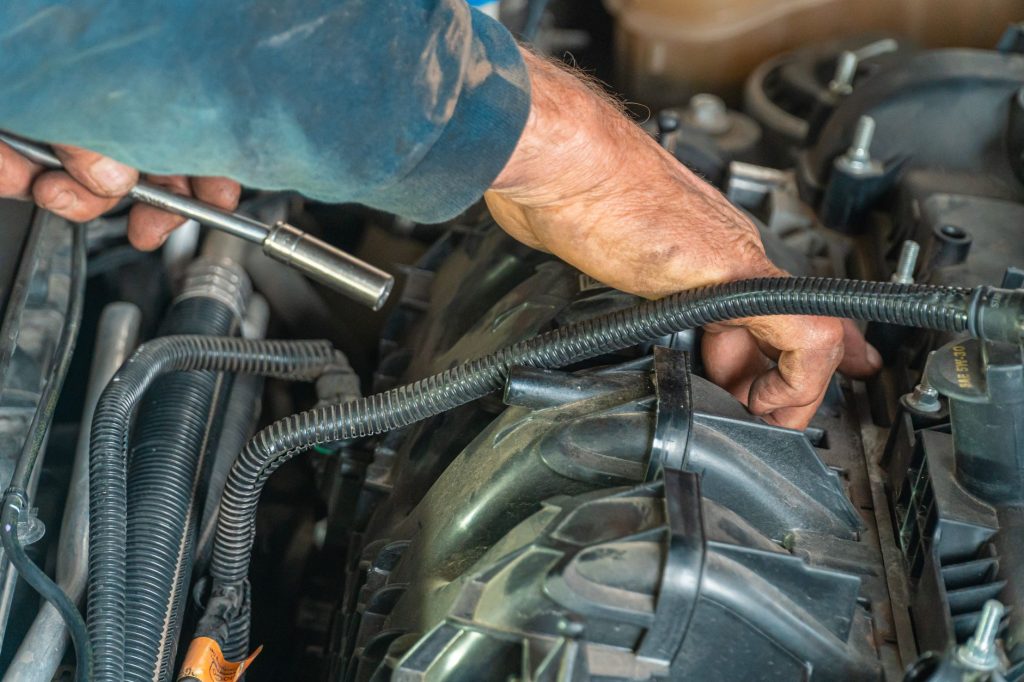
A customer’s 2014 Corolla arrived last week with a P0301 and a service history worth reading twice: new plugs, cleaned throttle body, still stumbling on cold starts. Fine once warm. Instead of swapping a third round of parts, I scoped the crankshaft position sensor and the number-one coil primary. Ten minutes of waveform reading settled what two shops’ guesswork couldn’t.
Modern ignition isn’t a standalone system. It’s the last link in a chain that begins with sensors measuring crank angle, air density, temperature, even combustion vibration. Understand the chain and misfires stop being mysteries.
How the Sensors Do Their Measuring
Four sensor families carry most of the load on a Toyota engine:
Pressure. The MAP sensor uses a piezoresistive silicon diaphragm. Manifold vacuum flexes the diaphragm, strain shifts embedded resistor values, and a Wheatstone bridge converts that into a 0–5V analog signal the ECU reads as engine load.
Temperature. Coolant and intake temp sensors are NTC thermistors — resistance falls as heat rises. Feed them a reference voltage and the ECU infers temperature from the voltage drop. Simple, cheap, nearly bulletproof.
Position. Crank and cam sensors come in two flavors: variable reluctance units producing an AC sine wave, and Hall-effect units putting out a clean digital square wave. The ECU counts teeth on the reluctor wheel to place crank angle within roughly a degree — that precision is what makes coil-on-plug timing possible at all.
Vibration. The knock sensor is a piezoelectric crystal tuned to resonate around 6–8 kHz. Detonation rings that bell, the crystal spits out AC voltage, and the ECU pulls timing before the pistons pay for it.
Same principle everywhere: measure a physical phenomenon, convert it to an electrical signal, let the ECU decide. Even the millimeter-wave radar behind Toyota Safety Sense works this way — transmit at 77 GHz, read the Doppler shift, know exactly how far off that truck ahead really is.
Where the Coil Earns Its Keep
Back to the Corolla. Crank signal clean, knock activity normal, fuel trims sane. But the coil’s primary ramp showed a soft collapse — internal insulation breaking down only when cold. The sensors were telling the truth; the actuator was lying.
Coils die more often than sensors because they live harder lives: 40,000-plus volts, heat soak, constant vibration. For that repair I fitted the OS1048 | OSRAM Ignition Coil | Fits Toyota | OE# 19070B1020, OSRAM’s replacement covering OE# 19070B1020. Cold-start stumble gone, waveform back to factory shape.
Pro Tip: Never chase a misfire with parts. Scope crank and cam first. If both signals are clean and trims look right, the coil is your prime suspect — especially on high-mileage fours where heat cycling cracks the windings.
Before You Blame the Coil
- Verify spark with an adjustable gap tester, not just a fresh plug
- Check plug tubes for oil contamination — it kills coils slowly and quietly
- Move the suspect coil to another cylinder: misfire follows, it’s the coil; misfire stays, look at injectors or compression
- Install new plugs with any coil replacement; worn electrodes force higher firing voltage and cook the winding
Shops turning regular Toyota volume should keep a spare on the shelf. The OS1048 | OSRAM Ignition Coil | Fits Toyota | OE# 19070B1020 drops straight into the OE location with no bracket bending or connector adapters, and at typical labor rates, one avoided comeback pays for the part twice over.

Recommended Part: OS1048 – In stock – a direct-fit OE-grade replacement.