
The Call That Started With a Stiff Ride
The 2015 Audi RS7 arrived at the shop with a complaint that sounded expensive. The owner described a suspension that had gone hard, a car that sat visibly low on one front corner, and a warning cluster that refused to clear: “height control limited.” It had all the hallmarks of an air suspension failure. Most shops would have reached for the compressor, then the air springs, working their way down a parts cannon that runs into the thousands.
The technician did not. Before touching anything under the car, he noticed something the owner had barely registered: the low beams were aimed wrong. Both headlights pointed slightly downward and off to one side, as if the car itself were confused about how high it was standing.
That single observation changed the entire diagnosis.
Why Headlights and Air Suspension Talk to Each Other
On an Audi RS7 with adaptive air suspension, the low-beam aim is not fixed. The car continuously adjusts headlight leveling so the beam stays flat on the road whether the car is loaded, climbing, or squatting under acceleration. To do that, the headlight control module needs to know the vehicle’s ride height — and it gets that data from the exact same sensors the air suspension uses.
There is not a separate set of components for the lights and another for the suspension. Both systems drink from one shared input: the ride height sensor at each corner, which reports position to the chassis control module. When that shared signal goes bad, the suspension misbehaves and the headlights lose their aim at the same time.
This is what makes the headlights such a powerful diagnostic clue. A stiff, sagging suspension alone could mean many things. A stiff, sagging suspension *plus misaligned headlights* narrows the field dramatically. Only a fault upstream of both symptoms — a shared sensor — explains the pairing.
Reading the Signal: What a Healthy Sensor Looks Like
To confirm the suspicion, the technician pulled live data on the front axle height sensor. On a healthy VAG-platform car, the sensor reads a steady voltage that rises and falls smoothly as the suspension compresses and rebounds. The ECU supplies a 5-volt reference, and the sensor answers back with an analog signal that normally swings across a 0.5–4.5V range as the arm travels through its arc.
When the mechanic watched this RS7’s front sensor in action, the picture was wrong. The voltage did not track the suspension’s movement. It sat flat, then jumped erratically, returning values the chassis module could not trust. That untrustworthy input is precisely what triggers the “height control limited” warning — the control unit knows it cannot safely level the car on garbage data, so it goes into a protective, stiffened mode.
The rear sensors, by contrast, reported clean, predictable voltages. The problem was isolated to one corner, and it was not a corner with a bad air spring. It was a corner with a bad sensor.
The Swap That Fixed Everything at Once
For about $190, the defective front height sensor came out and a new one went in. No compressor, no air spring, no control module — none of the expensive parts the symptom list seemed to point toward.
The result was immediate. The warning cleared. The suspension softened back to its normal adaptive behavior, and the body leveled out. And then, almost as an afterthought, the mechanic aimed the headlights one more time — and found they now leveled themselves correctly, following the road the way they were designed to.
One sensor, one replacement, two systems restored. That is the shape of a correct diagnosis.
What This Teaches Every Audi Owner and Shop
The lesson here is not about parts; it is about pattern recognition. When you see suspension behavior and headlight aim failing together, resist the urge to treat them as two separate problems. They are one problem with a shared root.
That shared-input architecture is the entire point of the story. A compressor is expensive and rarely the culprit when the lights are also off. An air spring does not, by itself, misaim your headlights. Only a component upstream of both — the ride height sensor that feeds both systems — produces this exact combination of symptoms.
The headlights, in other words, are a free diagnostic voltmeter for your suspension. If they are wrong while the ride is wrong, look for the sensor they share.
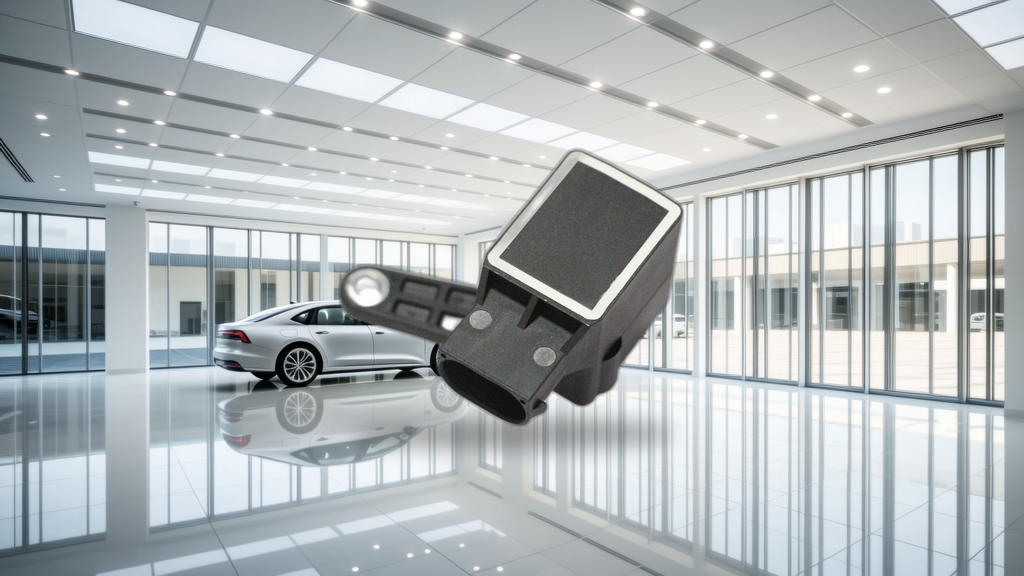
For Audi owners who have confirmed a failed front height sensor, the fix does not have to go through the dealership parts counter. An OE-grade direct-fit sensor is a straightforward way to bring both the suspension and the headlight leveling back online without paying for the badge twice. OS-HSA040 | OSRAM Ride Height Sensor | OE# 4B0907503
The Fix, in One Move
The 2015 RS7 story ends the way the best repair stories do: a simple, correct fix that undid a frightening symptom list. The takeaway is worth keeping in any Audi owner’s back pocket — when the suspension hardens and the headlights drift at the same time, you are almost certainly looking at a height sensor, not a compressor and not an air spring.
Diagnose the shared input first, and you will save the cost of the misdiagnosis every time.

Recommended Part
**OSRAM Ride Height Sensor** — OE# 4B0907503, fits Audi.
Get OS-HSA040 for this fix — order today, ships from our warehouse.