
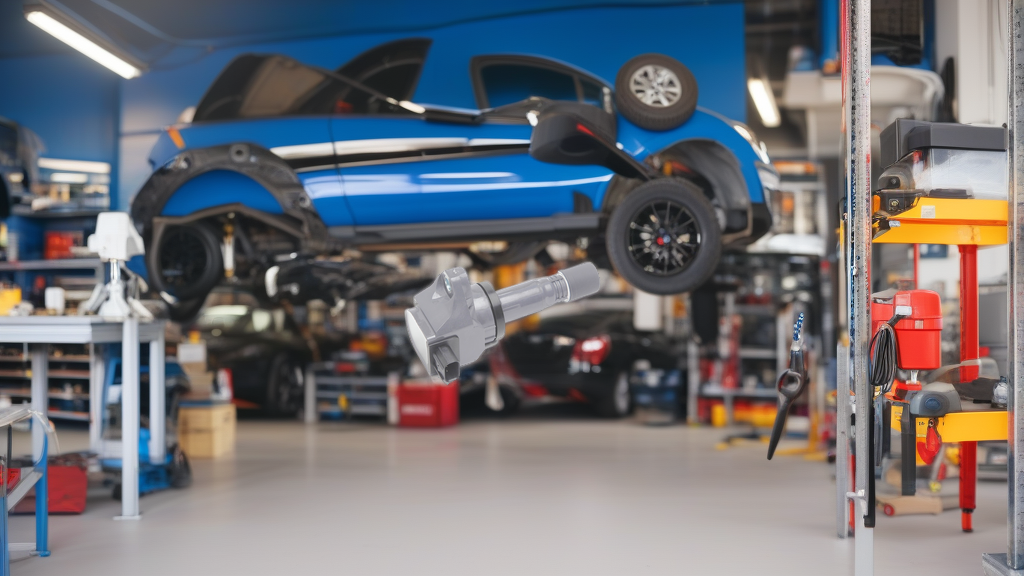
The check engine light flashes. Cylinder 3 misfires. For anyone working on a Honda K24 or R18 platform, this is a familiar Monday morning. Most techs immediately swap the spark plug, clear the code, and send the car down the road. Two days later, that same cylinder is back with a P0303 and a rough idle that feels like a massage chair you didn’t ask for.
The truth is, Honda’s coil-on-plug systems don’t fail dramatically. They degrade. And by the time the ECM counts enough misfire events to trip a code, the coil has often been struggling for hundreds of miles. Here’s how to actually diagnose the problem before throwing parts at it.
The Resistance Test That Lies to You
You’ve seen the spec sheet: primary resistance should read 0.2 to 0.5 ohms, secondary resistance 8,000 to 12,000 ohms. You meter it out, the numbers look fine, and you conclude the coil is good. That’s your first mistake.
A digital multimeter tests static resistance. It doesn’t tell you how the coil behaves under load, under heat, or at 12,000 RPM. I’ve pulled coils that met factory resistance specs cold but fell apart after five minutes of driving. The internal insulation breaks down, the secondary winding shorts intermittently, and the coil produces weak spark that only shows up on a scope.
Pro Tip: Before you trust a resistance reading, warm the engine to operating temperature, then test. A coil that passes cold and fails hot is a classic Honda failure mode.
Scope Waveform Analysis: The Only Real Test
If you have access to a lab scope, this is where the actual diagnosis happens. Connect a low-amp current probe around the coil’s primary feed wire, disable the injector for that cylinder, and crank the engine.
A healthy Honda coil pattern shows a consistent current ramp that rises smoothly, then a sharp vertical drop when the coil fires. The firing line should be tall and clean, with minimal ringing afterward. What you’re looking for on a failing coil is a short, weak spike, excessive oscillation after the event, or a pattern that changes between firing events. That inconsistency is the smoking gun.
No scope? You can still narrow it down. Swap the suspect coil with a known-good cylinder, clear the code, and drive. If the misfire moves, you’ve found your problem. If it stays, start looking at injectors, compression, or a vacuum leak.
When Replacement Makes Sense
Honda OEM coils are good, but they’re not immune to age. On vehicles past 80,000 miles, especially in hot climates, the epoxy around the secondary winding degrades. And here’s the thing about aftermarket coils: the quality spread is enormous.
That’s why the OSRAM OS1051 gets attention in the aftermarket space. It’s a direct replacement for Honda’s 30520-R1A-A01, which covers a surprising range of applications. The build quality—epoxy-sealed windings, brass terminals, proper heat dissipation—matters when you’re chasing a misfire that only appears after the car warms up.
For shop owners, stocking a coil that fits multiple Honda models reduces inventory bloat. For DIYers, it means you’re not rolling the dice on a no-name coil that fails in three months.
Common Mistakes to Avoid
Don’t replace coils in sets unless the others are failing. These aren’t spark plugs; a single failing coil doesn’t mean the rest are ready to go. Also, don’t skip checking the spark plug tube seals. Oil leaking into the tube will kill a new coil just as fast as the old one.
The Bottom Line on OS1051
If you’re diagnosed a confirmed coil failure on a compatible Honda, the OS1051 is a solid choice. It meets or exceeds the OE electrical specs, it’s priced competitively against dealer parts, and it carries the OSRAM name, which has more credibility than the average no-brand e-commerce coil. For the price of one trip to the dealer, you can fix the misfire properly and get back to driving.

Recommended Part: OS1051 – OE-grade replacement, in stock now.