
Parking assist has evolved from a luxury novelty to a near-essential feature on modern Audi vehicles, but most drivers never think about the engineering behind those ultrasonic pulses that guide them into tight spots. The system that Audi calls “Parking System Plus” or “Park Assist” relies on a network of sensors, a central control unit, and a sophisticated set of measurement principles that have matured significantly over the last decade.
For shop owners and fleet managers, understanding how these sensors actually work—and where they fail—is the difference between a ten-minute diagnosis and a multi-hour diagnostic headache. Here’s what’s happening behind that beeping.
The Physics: Ultrasonic Time-of-Flight
The sensors mounted in Audi bumpers are ultrasonic transducers. They don’t “see” in the optical sense; they emit high-frequency sound waves (typically 40–48 kHz) and listen for the echo. The control unit measures the time between emission and reception—the “time of flight”—and calculates distance using the speed of sound in air, which is roughly 343 meters per second at 20°C.
Temperature compensation is built into the algorithm. The speed of sound changes by about 0.6 meters per second per degree Celsius, so a cold morning in Chicago versus a hot afternoon in Phoenix will shift readings if not corrected. Audi’s control units reference ambient temperature data from the vehicle’s existing sensors to adjust the calculation in real time. It’s a minor detail, but it’s why an aftermarket sensor that ignores temperature correction can give false readings on a 90-degree day.
The signal itself is a burst of 8–16 sine wave pulses, fired in sequence across the bumper’s sensor array. The control unit processes the returning echo, filters out noise (rain, wind, other vehicles’ sensors), and assigns a distance value to each zone.
Signal Types: Analog Pulses to Digital Logic
The raw signal from an ultrasonic sensor is analog—a decaying waveform that represents the echo’s amplitude and timing. Inside the sensor head, a microcontroller digitizes this and sends a pulse-width modulated (PWM) signal or a LIN-bus digital packet to the parking assist control unit. Newer Audi models use LIN (Local Interconnect Network) for sensor communication—a single wire, low-cost protocol that’s slower than CAN but perfectly adequate for this application.
The control unit, typically mounted in the rear luggage compartment or under the front dash, processes these inputs, runs plausibility checks, and outputs to the display and acoustic warning system. If any sensor sends an implausible signal—say, a hard “always on” state indicating the transducer is stuck—the control unit flags a fault.
Height and Radar Sensors: The Other Side of the Story
Ultrasonic sensors have a range limitation of roughly 2.5 to 4 meters, and they struggle with soft or angled surfaces. That’s why newer Audi models, particularly the Q7, Q8, and e-tron series, augment the ultrasonic array with radar-based corner sensors. Radar sensors operate at 24 GHz or 77 GHz and use frequency-modulated continuous wave (FMCW) technology. Instead of burst-and-echo, they transmit a continuously varying frequency and measure the frequency shift between transmitted and reflected waves. This gives both distance and relative velocity—useful for cross-traffic alert and semi-autonomous parking maneuvers.
Height sensors, on the other hand, serve a different purpose. They’re part of the air suspension system (on models like the A6 Allroad or Q7 with adaptive air suspension), and they measure ride height using a rotary hall-effect sensor attached to the suspension link. The output is a variable voltage or PWM signal that the suspension control unit converts into a height reading. When paired with the parking assist system, the height data prevents the park assist from activating if the vehicle is too low or too high—an integration point that’s often overlooked when diagnosing parking system failures on air-suspension-equipped Audis.
When Sensors Fail: Signal Integrity and the Control Unit
The most common failure mode in Audi parking systems isn’t the sensor itself—it’s the wiring harness or the control unit’s ability to process degraded signals. Moisture ingress into the rear bumper connector is a frequent culprit, especially on vehicles from 2015–2019 era. Corrosion increases resistance on the LIN bus, causing marginal signals that the control unit interprets as sensor faults.
That’s where the control unit matters. A failing unit may still power up and communicate with the scan tool, but it may produce erratic readings or fail to initialize one or more sensors during the startup self-test cycle.
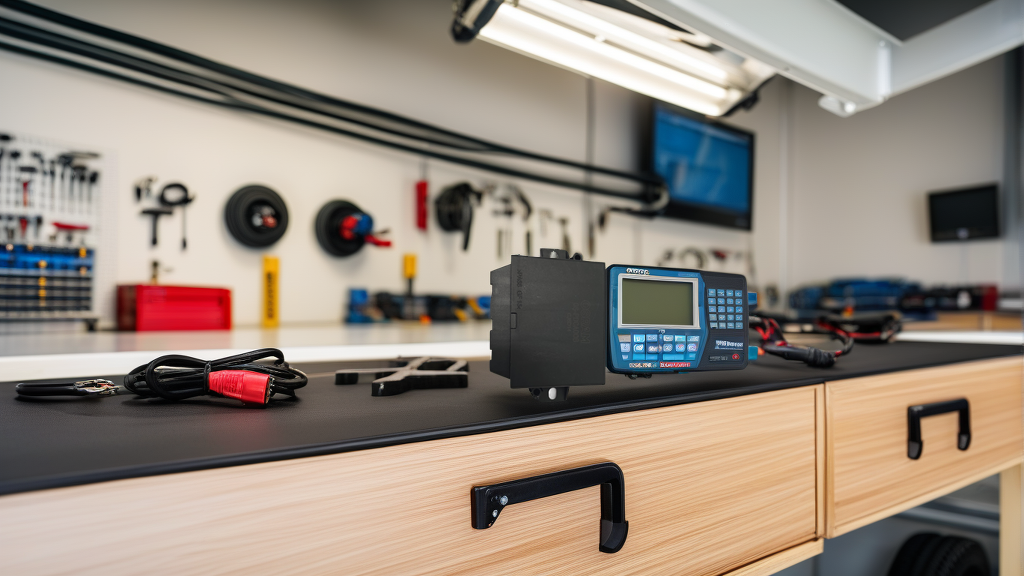
For shops looking for a reliable replacement, the OSRAM Parking Assist Control Unit (SKU: OS-PDCA008) is designed to match the OE Audi part 4GD 919 475A. It’s a direct-fit unit that mirrors the original’s signal processing logic, including the temperature compensation and LIN-bus timing parameters. OSRAM’s unit is built with automotive-grade components and is tested to handle the same voltage fluctuations and thermal cycling that the factory unit endures.
Pro Tip: Diagnose Before You Replace
Common Mistake: Replacing all four sensors because the control unit reports “sensor failure” on each one. More often than not, a single shorted sensor or a corroded connector pulls the entire LIN bus down. Use a scan tool to check whether the module can establish communication with each sensor individually before ordering parts.
Also, verify the vehicle’s battery voltage during diagnosis. A weak battery (below 12.2 volts during cranking) can cause the control unit to enter a low-voltage fault state that mimics sensor failures.
The Bottom Line for Shops
Sensor technology in modern Audi vehicles is a layered system—ultrasonic for close-range parking, radar for longer-range and dynamic scenarios, and height sensors for suspension integration. Understanding the signal types and measurement principles helps you diagnose faster and sell the correct part the first time.
When the control unit is the confirmed culprit, the OS-PDCA008 from OSRAM offers a dependable aftermarket alternative at a fraction of the dealer price. It’s a solid choice for independent shops serving Audi owners who want OE-equivalent performance without the dealership markup. Keep one in stock; you’ll likely need it more often than you expect.

Recommended Part: OS-PDCA008 – OE-grade replacement, in stock now.