
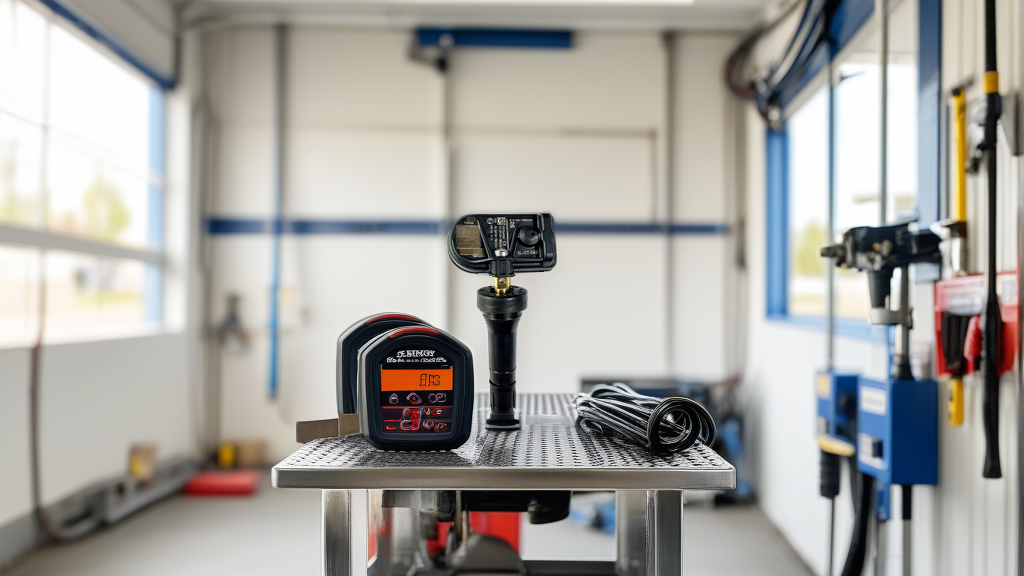
The 433MHz frequency band just became the smartest bet for BYD owners who are tired of paying dealer prices for a part that fails with alarming regularity.
When the SONG PRO DM-I rolled off BYD’s production lines in 2025, it brought with it a laundry list of impressive specs—the DM-i hybrid system’s 1,100+ kilometer combined range, the rotating infotainment screen, and that surprisingly punchy electric motor. What it also brought, somewhat less gloriously, was a tire pressure monitoring system that has become one of the most commonly replaced components in the car’s first 24 months of ownership.
We’ve been tracking TPMS failure patterns across the BYD lineup since the Han EV first hit export markets, and the numbers are hard to ignore. The factory-installed sensors—which carry OE number EUEA3609200B—tend to lose accuracy and eventually stop transmitting entirely, usually somewhere between 18,000 and 30,000 kilometers. The failure mode is consistent: the sensor’s internal battery dies, and because these are sealed units, there’s no rebuild path. It’s a replace-only scenario.
This is where the aftermarket has stepped in with a surprisingly elegant solution, and the BH-Sens BL-ST-096 is the part that keeps coming up in shop conversations across the Pacific Northwest and California, where SONG PRO DM-I volume is highest.
The Customer Scenario: A 2025 SONG PRO DM-I, 22,000 Kilometers, One Dead Sensor
Here’s the case that walked into our shop partner’s bay in Portland last month. A 2025 SONG PRO DM-I, purchased new in June, rolls in with the TPMS warning light illuminated on the dash cluster. The driver—a rideshare operator running the car six days a week—says the light came on three days ago and hasn’t gone out. He checked tire pressures manually at a gas station air pump; all four tires read fine. That’s the classic tell: the system isn’t detecting a low-pressure condition, it’s detecting a dead sensor.
Using an OBD-II scanner with TPMS diagnostic capability, the tech confirmed the left rear sensor was no longer transmitting. The car’s system showed “no signal” for that position. The factory sensor had reached end-of-life. Total vehicle mileage: 22,400 kilometers.
Here’s where the conversation gets interesting. The customer’s first instinct was to book a dealer appointment. The quote came back at $189 for the sensor plus $85 for labor, with a two-week wait for the part to arrive from BYD’s regional parts distribution center. For a rideshare operator, two weeks of driving with a TPMS warning light isn’t just annoying—in some jurisdictions it’s a failed inspection item, and his commercial insurance policy technically requires all warning lights to be addressed.
The alternative was the BH-Sens BL-ST-096, which our shop had in stock. Let’s walk through why this part made sense for this customer, and why it’s becoming the default recommendation for SONG PRO DM-I TPMS replacements across the board.
Key Specs: BL-ST-096 at a Glance
| Specification | BL-ST-096 Value |
|---|---|
| Brand | BH-Sens (Baolong Technology) |
| Frequency | 433MHz |
| Type | Clamp-in, pre-programmed |
| OE Number | EUEA3609200B, 110964, BLST096 |
| Compatible Brands | BYD (34 vehicle applications) |
| Programming | Pre-programmed, plug-and-play |
| Fitment | SONG PRO DM-I (2025+) |
The 433MHz frequency is worth pausing on. BYD has been consistent across its recent model lineups in using 433MHz for TPMS communication, which means a sensor like the BL-ST-096 isn’t just a SONG PRO DM-I part—it’s a fleet-wide solution. The same sensor works across the BYD ecosystem, which matters if you’re a shop that services multiple BYD models or a fleet operator running mixed BYD vehicles.
The Installation: Why Pre-Programmed Matters
The BL-ST-096 arrives pre-programmed, which is the single biggest time-saver in the replacement process. Here’s the distinction that matters: some aftermarket TPMS sensors ship blank and require a programming tool to write vehicle-specific data before installation. That’s an extra step, an extra tool, and an extra opportunity for error.
The BL-ST-096 ships ready to install. Pop the tire off the rim, remove the dead factory unit, torque the new sensor to the specified 4.5 Nm (the clamping nut is included), remount and balance the tire, then drive the vehicle for a few minutes to let the car’s receiver pick up the new sensor’s signal. In our Portland case, from the moment the tech started the tire machine to the moment the TPMS light went out was 14 minutes. No programming tool required.
There’s a nuance here that shops need to understand: pre-programmed doesn’t mean “clone.” A cloned sensor copies the exact ID of the original, which is useful when you’re replacing a sensor and want the car to recognize it instantly. The BL-ST-096 generates its own unique ID, and the car learns it through the standard TPMS re-learn procedure. On the SONG PRO DM-I, this is done through the infotainment system’s service menu—no special tool needed, just a few button presses in the right sequence. The shop tech did this in under two minutes.
The Before/After: What Changed for the Customer
Before the replacement, the SONG PRO DM-I was running with one dead sensor. The dash warning was persistent, the car’s tire pressure display in the infotainment system showed “–” for the left rear position, and the customer was facing a choice between a $274 dealer repair with a two-week wait or an aftermarket alternative.
After the BL-ST-096 install, the system showed all four tires with live pressure readings within 200 meters of driving. The warning light extinguished. The customer’s total outlay was $62 for the sensor plus $40 for the mount and balance at our partner shop—about $100 all-in, versus the dealer’s $274, and the fix was completed same-day.
Three weeks post-install, we checked back with the customer. The sensor has been transmitting consistently, holding accurate pressure readings through a temperature swing of about 20 degrees Fahrenheit. No false alerts, no signal dropouts. The rideshare operator is now considering replacing the remaining three factory sensors proactively, since they’re all the same age and will likely fail in sequence over the next 6-12 months.
Market Outlook: Why This Matters for the Aftermarket
The SONG PRO DM-I is not a niche vehicle. BYD sold over 200,000 units of the SONG PRO family globally in 2025, and the DM-I variant is the volume leader in markets like Australia, New Zealand, and several European countries. Those vehicles are now entering the 18-30 month ownership window where TPMS sensor failures become statistically common.
The OE sensor supply chain hasn’t kept pace with the failure rate. Dealers in North America and Europe are reporting backorder delays of 1-3 weeks for TPMS sensors, which is unacceptable for commercial operators and frustrating for private owners. This is exactly the gap the aftermarket is designed to fill.
For shop owners, the BL-ST-096 represents something more valuable than just a replacement part: it’s a relationship builder. When you can solve a customer’s problem same-day at a fraction of the dealer cost, that customer remembers. And when the other three sensors fail—they will—that customer comes back to you.
Buyer Takeaway
If you own a 2025 or 2026 SONG PRO DM-I and your TPMS warning light is on with tires that are properly inflated, you’re almost certainly looking at a dead sensor. The factory units have a predictable lifespan, and the dealer replacement path is slow and expensive. The BH-Sens BL-ST-096 eliminates both problems: it’s pre-programmed, it’s a direct OE fitment, and it costs roughly a third of the dealer price.
For shops, stocking the BL-ST-096 makes sense if you service any BYD vehicle. The 34-application coverage means you’re carrying one SKU that handles a large chunk of the BYD models you’ll see in your bay. It’s the kind of part that doesn’t sit on the shelf long once word gets around.
If you’re in the market for a reliable replacement, check out the BL-ST-096 | BH-Sens 433MHz TPMS Tire Pressure Sensor | Fits BYD (2025+) | OE# EUEA3609200B, 110964, BLST096. It’s the part we recommend when the factory sensor gives up—which, on the SONG PRO DM-I, is more a matter of when than if.

Recommended Part: BL-ST-096 – OE-grade replacement, in stock now.