
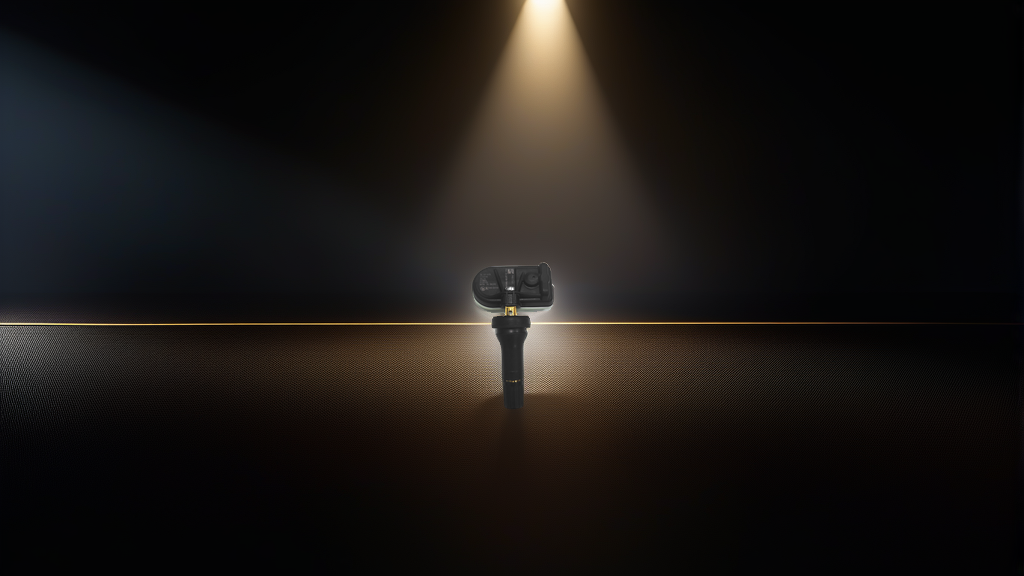
The 2006-2011 Buick Lucerne sits in that awkward generation of GM vehicles where tire pressure monitoring went from optional luxury to federal mandate. Owners who’ve replaced a sensor only to watch the dash light flicker back on within a week know the frustration. Most blame the sensor itself. More often, it’s a mismatch in signal protocol that gets overlooked.
Here’s what’s happening under the wheel well, and why a pre-programmed 315MHz unit like the BH-Sens BL-ST-072 has become the default recommendation in Lucerne-focused shops.
The Physics: Pressure, Temperature, and the Radio Link
Every TPMS sensor combines three distinct technologies into one valve-stem package. The pressure sensing element—typically a piezoresistive micro-electromechanical system (MEMS)—changes electrical resistance as tire pressure deforms a microscopic silicon diaphragm. That resistance change gets converted into a voltage signal, then digitized by an onboard application-specific integrated circuit (ASIC).
Temperature compensation is the less glamorous but equally critical half of the equation. Rubber and air behave differently at 0°F versus 110°F. The ASIC applies a temperature correction curve to the raw pressure reading, typically pulling data from a thermistor embedded in the sensor housing. Without that compensation, a cold morning could trigger false low-pressure warnings, or worse, mask a genuine leak on a hot day.
The Lucerne’s system expects this data at 315MHz—the frequency used by GM’s direct TPMS architecture through the 2012 model year. The sensor transmits a frame containing sensor ID, pressure, temperature, and battery status. The vehicle’s remote keyless entry module receives it, decodes it, and compares readings against thresholds programmed into the body control module.
Signal Types: What “Pre-Programmed” Actually Means
Here’s where aftermarket parts diverge from dealer stock. The BL-ST-072 operates at 314.9MHz, which falls within the 315MHz band GM receivers are tuned to accept. But frequency alone doesn’t guarantee compatibility. The signal modulation—how the data is encoded onto the radio wave—must match what the Lucerne’s receiver expects.
Baolong Technology, the manufacturer behind the BH-Sens brand, uses a fixed ID format that clones the original GM protocol. The sensor ships pre-programmed with a configurable ID that can be written using a TPMS programming tool, or it can be cloned from the original sensor if the OEM unit is still broadcasting. That’s the practical advantage over OE sensors: you don’t need to relearn the sensor to the car if you match the ID during programming.
The signal itself is amplitude-shift keyed (ASK) at a data rate of 19.2 kbps, which is the standard for GM’s 315MHz system. Some aftermarket sensors use frequency-shift keying (FSK) to extend battery life, but those won’t communicate with a Lucerne’s receiver without modification. The BL-ST-072 sticks to ASK for drop-in compatibility.
Installation Reality: Clamp-In Design and Valve Stem Fatigue
The clamp-in design means the sensor mounts to the wheel via a metal valve stem, secured by a nut from the outside. This is more robust than snap-in sensors, which press into the wheel hole and rely on rubber grommets. But clamp-in systems have their own failure point: the valve core and stem seal.
When installing the BL-ST-072 on a Lucerne, torque the retaining nut to 4.5-7.0 Nm—not more. Over-torquing distorts the sealing washer and creates an intermittent leak at the wheel-to-stem interface. That leak triggers a slow pressure drop, which the sensor reports accurately. The system isn’t failing; the installation is.
Also, check the wheel’s valve hole for corrosion. Lucerne owners in salt-belt states often have aluminum wheels with galvanic corrosion around the valve hole. Clean the area with a wire brush before seating the new sensor. A rough surface will compromise the seal regardless of sensor quality.
Why 315MHz Still Matters in 2026
The industry is slowly migrating to 433MHz for newer vehicles, but the Lucerne’s platform is locked into 315MHz. This creates a supply chain issue: many aftermarket brands have reduced 315MHz production in favor of dual-frequency or 433MHz-only units. That makes the BL-ST-072’s 314.9MHz frequency a deliberate choice—it’s manufactured specifically for the legacy GM/Chrysler/Ford band.
There’s also the battery question. The BL-ST-072 uses a lithium battery rated for 5-7 years of service. In a 2011 Lucerne, that means the original sensors are well past their expected lifespan. If you’re replacing one, the other three are likely close behind. Shops that quote a single-sensor replacement for a Lucerne are creating a comeback visit. Recommend a full set if the vehicle is over eight years old.
The Practical Takeaway
Replacing a Lucerne TPMS sensor isn’t complicated, but it does require understanding what the sensor actually transmits and how the car interprets it. The BL-ST-072 covers the essentials: correct frequency, matching modulation, clamp-in durability, and pre-programmed compatibility with 63 vehicles across GM and Chrysler platforms. For Lucerne owners, it’s the difference between a dash light that stays off and one that returns after every pothole.
Pro Tip: After installing a new sensor, drive the Lucerne at 25 mph for 10 minutes to trigger the relearn procedure. If the sensor ID was cloned, the car will acquire it automatically. If not, use a TPMS tool to write the new ID to the BCM. Skipping this step is the most common cause of “new sensor, same warning light” complaints.
Product Recommendation: For Lucerne owners needing a direct replacement, the BL-ST-072 | BH-Sens 314.9, 315MHz TPMS Tire Pressure Sensor | Fits Brilliance, Buick, Cadillac, Chevrolet, Gmc & 3 More | OE# 12768826, 13516164, 13540604 from BH-Sens offers the correct 314.9MHz frequency, clamp-in mounting, and pre-programmed compatibility with GM’s TPMS protocol. It’s a straightforward swap for DIYers and shops alike, with no additional programming hardware required if the ID is cloned from the original unit.

Recommended Part: BL-ST-072 – OE-grade replacement, in stock now.
