
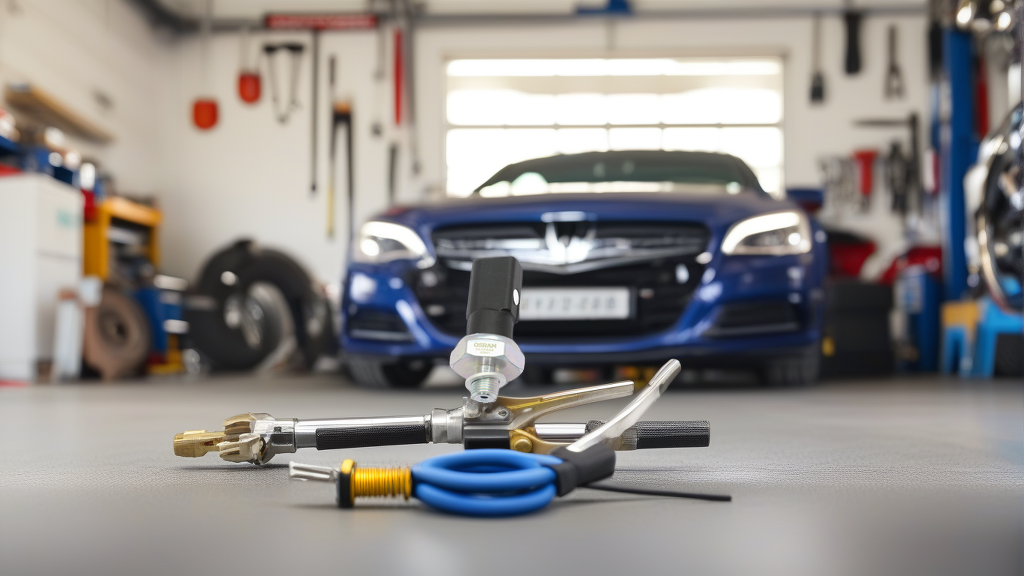
Audi’s 3.0T supercharged V6 and 4.0T twin-turbo V8 are engineering marvels—until they aren’t. When the low oil pressure warning chimes at 4,500 RPM on a warm summer day, most drivers panic. But any decent Euro specialist knows the culprit isn’t always the pump. More often than not, it’s a $30 sensor lying about what’s happening in the oil galleries.
The OS-OPA009 from OSRAM, an oil pressure sensor that crosses with OE# 06E919081C, has become the default replacement for Audi’s EA837 and EA824 engine families. But before you click “buy,” it’s worth understanding what this sensor actually does, how it communicates with the engine control unit (ECU), and why the measurement principle matters more than the part number.
The Physics Behind the Signal
Oil pressure sensors in modern Audi vehicles aren’t simple on/off switches like the ones in a 1990s Honda. They’re variable-resistance transducers that use a piezoresistive element—a thin silicon diaphragm that deforms under hydraulic pressure. As the diaphragm flexes, its electrical resistance changes proportionally to the applied force. The sensor’s internal circuitry converts that resistance change into a voltage signal, typically ranging from 0.5V at near-zero pressure to 4.5V at maximum rated pressure.
The ECU reads this analog voltage and maps it to a pressure value using a calibration curve stored in its firmware. Audi’s system uses a three-wire configuration: 5V reference, ground, and signal. The signal wire carries the analog voltage back to the ECU, which then decides whether to illuminate the warning light, log a fault code, or adjust fuel trims based on oil pressure data.
Here’s where it gets interesting: the OS-OPA009 uses a ceramic capacitive sensing element instead of the older piezoresistive design. Capacitive sensors measure pressure by detecting changes in capacitance between two plates—one fixed, one that moves with the diaphragm. This approach offers better long-term stability, lower hysteresis, and superior resistance to contamination from oil sludge. For a part that sits directly in the oil filter housing, that’s not a trivial advantage.
Signal Types: Analog vs. PWM
Most Audi pressure sensors output a linear analog signal. But some newer applications—particularly on the 4.0T with auxiliary oil pressure monitoring—use pulse-width modulation (PWM) to encode pressure data digitally. PWM signals switch between 0V and 5V at a fixed frequency, with the duty cycle (percentage of time the signal is high) representing the pressure value. A 10% duty cycle might indicate 0.5 bar, while 90% could represent 5.0 bar.
The OS-OPA009 is designed for the analog output configuration used in the 3.0T (supercharged) and early 4.0T engines. If you’re working on a 2016+ Audi S6 or A8 with the updated engine management, double-check your signal type before ordering. Swapping a PWM sensor into an analog circuit won’t just throw a code—it can damage the ECU input stage.
Temperature and Altitude: The Hidden Variables
Pressure sensors don’t work in isolation. Audi’s oil pressure monitoring system also factors in oil temperature, which the sensor itself measures via an integrated thermistor. The ECU uses this temperature data to compensate for oil viscosity changes. Cold oil at startup generates artificially high pressure readings; hot oil at idle generates artificially low ones. Without temperature compensation, the ECU would constantly trigger false warnings.
Height sensors—the ones in Audi’s air suspension—work on a completely different principle. They use a Hall-effect sensor paired with a magnet mounted on the control arm. As the suspension compresses, the magnet rotates relative to the Hall sensor, generating a voltage proportional to ride height. The OS-OPA009 doesn’t play in that arena, but it’s worth knowing the distinction: pressure sensors measure force per unit area; height sensors measure angular displacement. They’re both “sensors,” but the signal processing and diagnostic strategies are entirely different.
Why Aftermarket Makes Sense
Audi’s original sensor from the dealer runs anywhere from $80 to $140 depending on the model year. The OS-OPA009 from longweiparts.com comes in at a fraction of that cost, with OE-equivalent performance specs. The ceramic capacitive element actually outperforms the factory’s silicon-based sensor in thermal stability—a meaningful improvement for owners who track their cars or live in extreme climates.
For the OS-OPA009 specifically, fitment covers two Audi applications: the 3.0T (CJSC, CGWC, CRE) and the 4.0T (CEUA, CTFA). Both mount in the oil filter housing, use the same three-pin connector, and require the same 27mm deep socket for removal. Installation is straightforward: disconnect the electrical connector, unscrew the old sensor, apply a thin film of clean engine oil to the new O-ring, and torque to 25 Nm. Do not use thread sealant—it can contaminate the sensing element and cause erratic readings.
Common Mistakes and Pro Tips
Pro Tip: When replacing the oil pressure sensor on an Audi 3.0T, always check the wiring harness for oil contamination. The connector seal degrades over time, allowing oil to wick up the wires and corrode the pins. If you see oil inside the connector, replace the pigtail harness along with the sensor. Otherwise, you’ll be doing this job again in six months.
Common Mistake: Torquing the sensor to spec is critical. Over-tightening distorts the sensor body and shifts the calibration curve, causing the ECU to read 0.5 bar higher than actual pressure. Under-tightening allows oil to leak past the O-ring, which can trigger low-pressure warnings at idle.
Another thing many techs overlook: the OS-OPA009 should be bench-tested before installation. Connect a 5V power supply, apply air pressure with a hand pump, and verify the voltage output tracks the pressure curve. A dead-out-of-box sensor wastes a comeback trip and an unhappy customer. OSRAM’s quality control is solid, but no manufacturer ships 100% defect-free product.
The Verdict
If you’re an independent shop stocking parts for Euro vehicles, the OS-OPA009 is a no-brainer inventory addition. It covers two high-volume Audi engines, costs less than the dealer part, and uses a sensing technology that’s arguably more durable than the factory component. For DIY owners with a 3.0T or 4.0T, this is the sensor to buy when the “low oil pressure” warning starts appearing at hot idle or under hard cornering.
OS-OPA009 | OSRAM Oil Pressure Sensor | Fits Audi | OE# 06E919081C — the OSRAM OS-OPA009 oil pressure sensor — is available now at longweiparts.com. Pair it with an OEM-quality oil filter and fresh 5W-40, and you’ll have the oil pressure system sorted for another 60,000 miles. The market for aftermarket Audi sensors continues to expand, and OSRAM’s entry in the pressure sensing space is one of the stronger options for both performance and price.

Recommended Part: OS-OPA009 – OE-grade replacement, in stock now.