
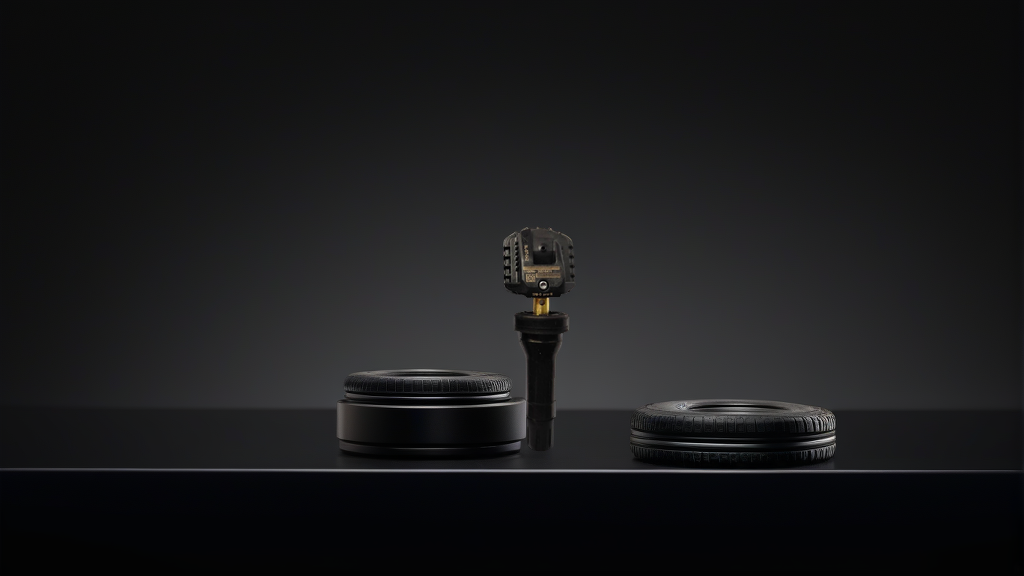
The average Changan driver presses the accelerator, turns the wheel, and never thinks about the 433MHz radio burst firing off from inside each tire roughly 9,000 times per hour. But for the shop owner who’s just watched a 2023 Oshan X7 roll in with a blinking TPMS light, understanding what’s happening inside that valve stem isn’t optional—it’s the difference between a five-minute fix and a come-back job.
Let’s talk about what’s actually going on inside the BL-ST-042 and why Changan’s sensor architecture keeps catching aftermarket technicians off guard.
The Physics First: Pressure, Temperature, and the Piezoresistive Trick
Changan’s TPMS system—whether on the BL-ST-042 | BH-Sens 433MHz TPMS Tire Pressure Sensor | Fits Changan, Kaicene, Oshan | OE# 3601010BK01, 3601010MK01, 3601010MK51 CS55 Plus or the Kaicene X70A commercial line—relies on the same fundamental principle across all 24 OE fitments: a piezoresistive diaphragm that flexes under pressure and changes its electrical resistance accordingly.
Inside the BL-ST-042, a micro-machined silicon diaphragm sits exposed to the tire’s internal air pressure. When pressure increases, the diaphragm deflects. That deflection alters the resistance of four strain gauges arranged in a Wheatstone bridge configuration. The voltage change across that bridge is proportional to the pressure change—typically in the range of 0 to 6.9 bar for passenger vehicle applications.
Temperature compensation is where cheap sensors fail. Rubber heats up, air expands, and if the sensor doesn’t separate “real” pressure changes from temperature-driven drift, you get false alerts. The BL-ST-042 uses an integrated thermistor that samples temperature at the sensor die itself, not the ambient air. This allows the onboard microcontroller to apply a compensation curve that keeps accuracy within ±0.1 bar across a -40°C to +125°C operating range.
Here’s the part most techs miss: Changan’s system doesn’t just monitor for low pressure. It calculates pressure rate of change—a slow leak versus a blowout scenario. The sensor transmits data packets every 10 seconds at rest and every 1 second when the vehicle exceeds 40 km/h. If the pressure drops more than 0.7 bar within 30 seconds, the ECU triggers the “tire failure” warning rather than the standard “check pressure” alert.
Signal Types: The 433MHz Question
The BL-ST-042 broadcasts on 433MHz—the European and Asian standard frequency, which covers Changan’s global production. The signal type is not a continuous stream; it’s a burst transmission using a frame structure that includes:
- Preamble (wake-up sync)
- Sensor ID (32-bit unique identifier)
- Pressure data (12-bit resolution)
- Temperature data (8-bit resolution)
- Battery status (4-bit)
- CRC checksum (8-bit)
Total packet size: 96 bits, transmitted at 19.2 kbps using FSK (Frequency Shift Keying) modulation. This is slower than the 315MHz North American standard’s typical 9.6 kbps, but Changan chose 433MHz for better wall penetration through the tire sidewall and wheel well—a critical factor on boxier Kaicene models where the receiver sits further from the wheels.
The pre-programmed nature of this sensor matters more than most buyers realize. OE sensors from Changan’s factory are “blank” until programming. The BL-ST-042 comes pre-loaded with Changan’s communication protocol, which means it talks to the BCM without needing an OBD-II programming tool. However—and this is critical—the sensor ID still needs to be learned to the vehicle’s receiver. That’s a 30-second process with an EL-50448 or Autel TPMS tool, and it’s the step that trips up techs who assume “pre-programmed” means “plug and play.”
Height and Radar: The Sensors People Forget
While TPMS gets the attention, Changan’s newer models (particularly the Uni-K and the 2025 Oshan Z6) use additional sensor types that work in concert with the tire pressure system:
Height sensors on the rear suspension use a hall-effect magnetic rotary encoder. A magnet rotates with the suspension arm, and a stationary chip measures the magnetic field angle. The voltage output varies between 0.5V and 4.5V, proportional to ride height. What’s interesting: Changan’s BCM cross-references this height data with the TPMS pressure readings. If the rear height sensor says the vehicle is squatting but the TPMS shows normal pressure, the system can flag a suspension issue rather than a tire issue—a diagnostic interaction that older aftermarket sensors simply can’t support.
Radar sensors here aren’t the adaptive cruise control units. Changan uses 77GHz millimeter-wave radar for blind-spot monitoring on the CS75 Plus, and the data fusion between radar objects and TPMS is subtle but real. The system uses tire pressure data to estimate rolling circumference changes (a low tire has a smaller effective radius), which then adjusts the radar’s velocity calculation for objects detected in the adjacent lane. It’s over-engineering, sure, but it means a faulty TPMS sensor can trigger a false blind-spot warning.
Why This Matters for Your Shop
The BL-ST-042 is a clamp-in unit—the sensor body mounts to the valve stem and seats against the wheel rim with a rubber grommet and metal nut. It weighs roughly one ounce, which matters for balancing. Techs who skip the moment-marking procedure during tire mounting often end up with a sensor that’s been rotated 90 degrees from the OE position, causing a slight wheel imbalance that vibrates at highway speed.
Pro Tip: Always replace the valve stem core and the sealing grommet when reinstalling a clamp-in sensor. The BL-ST-042’s housing is aluminum, and the grommet compresses over time. A reused grommet is the #1 cause of slow leaks that appear 2-3 weeks after tire service.
The battery is a lithium manganese dioxide cell rated for 5-7 years of service life, and the sensor is sealed—no battery replacement options. Changan’s factory recommendation is replacement at 5 years or 80,000 km, whichever comes first, regardless of whether the sensor is still transmitting.
The Market Reality for 2026
Changan has started transitioning some 2026 model year vehicles to a dual-frequency approach (433MHz for TPMS, 315MHz for a new remote keyless entry integration). This doesn’t affect the BL-ST-042’s compatibility with 2024 and earlier models, but it’s worth noting that the aftermarket is currently in a transition window. Stocking the 433MHz pre-programmed unit remains the safest bet for shops serving the existing Changan, Kaicene, and Oshan fleet—which still represents millions of vehicles globally.
For the independent shop, the BL-ST-042 covers the vast majority of Changan TPMS replacements with a single SKU. The pre-programmed protocol eliminates the need for multiple brand-specific programmers, and the clamp-in design works with both aluminum and steel OEM wheels.
Buyer takeaway: If you’re servicing Changan-family vehicles, this sensor covers 24 OE fitments out of the box. It won’t help you with older 315MHz Changan models (pre-2015), and it requires a TPMS tool for ID learning. But for the 2016-2025 model years that dominate the used market right now, it’s the one-sensor solution that keeps your inventory simple and your labor time predictable. The alternative—hunting down OE sensors at dealer pricing—costs more and takes longer. Those are the two things that kill margin in a tire shop.

Recommended Part: BL-ST-042 – OE-grade replacement, in stock now.