
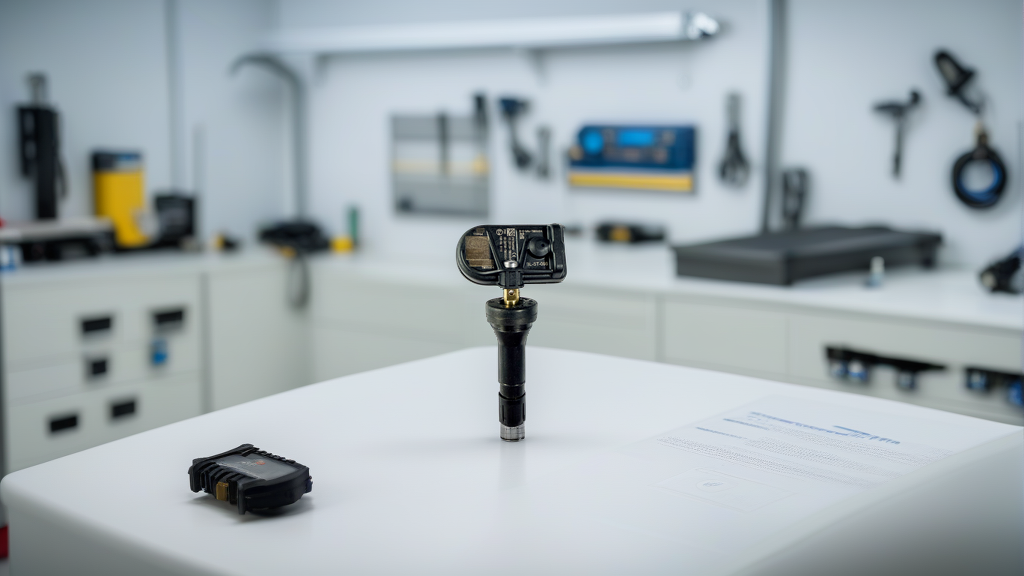
The BYD HAN L EV has carved out a serious reputation since its launch—a 800-volt architecture, sub-3-second sprint times, and a cabin that genuinely competes with German luxury sedans at half the price. But there’s a quieter component on this car that’s starting to generate real conversation in the aftermarket: the tire pressure monitoring system sensor. Specifically, the BL-ST-096 from BH-Sens is becoming the go-to replacement unit for shops servicing the 2025 and newer HAN L EV, and for good reason.
Here’s the thing about BYD’s TPMS system: it’s not like the old 315MHz units you’d find on a 2015 Honda Civic. The HAN L EV runs on a 433MHz platform with pre-programmed, clamp-in sensors that communicate with the body control module through a specific protocol. If you’ve been swapping sensors between brands or using universal programmable units, you’ve likely run into the classic frustration—sensor pairs, then drops, then triggers a false low-pressure warning at 70 mph on the freeway.
Key Specs — BL-ST-096 (BH-Sens)
- Frequency: 433MHz
- Type: Clamp-in, pre-programmed
- OE Reference: EUEA3609200B, 110964
- Compatible: BYD HAN L EV (2025+), 34 total BYD applications
- Construction: Brass valve stem, sealed electronics module
- Battery: Replaceable (standard TPMS lithium cell, 5-7 year service life)
What 433MHz Actually Means in Practice
Let’s get technical for a moment, because this matters more than most buyers realize. The 433MHz ISM band is the dominant frequency for Asian-market TPMS systems—Toyota, Nissan, and now a growing number of Chinese OEMs like BYD have standardized on it. When you’re buying a TPMS sensor for the HAN L EV, the frequency isn’t just a spec on a datasheet; it determines whether the sensor can physically communicate with the car’s receiver module.
The BL-ST-096 transmits on 433MHz with a specific modulation scheme that matches BYD’s protocol. That’s the “pre-programmed” part. Unlike a universal sensor where you’d need a programming tool to clone the original sensor’s ID, this unit comes ready to install. You bolt it in, drive the car, and the HAN L EV’s system picks up the new sensor ID through its auto-learn procedure—usually triggered after a brief period of driving above 15 mph.
From a shop perspective, this is a massive time-saver. A standard TPMS service on a HAN L EV with the BL-ST-096 takes about 20 minutes including tire dismount. With a universal sensor, you’re looking at programming time, potential communication errors, and the occasional comeback when the sensor decides it doesn’t want to talk to the BCM after a cold snap.
Voltage Range and Electrical Compatibility
One spec that gets overlooked on TPMS sensors is the operating voltage range. The HAN L EV’s TPMS receiver module runs on a 12V supply derived from the car’s low-voltage system, but the sensors themselves are battery-powered, typically running at 2.1 to 3.3 volts from a single lithium cell. The BL-ST-096 operates within a standard 2.0-3.6V range, which is fine for the HAN L EV’s system.
What actually matters more is the signal strength and wake-up sensitivity. BYD’s TPMS system uses a low-frequency (LF) trigger to wake the sensors for data transmission during certain conditions—like when the car is parked and the system runs a pressure check. The BL-ST-096 is tuned to respond to BYD’s specific LF wake-up frequency, typically 125kHz. If a sensor isn’t sensitive to this trigger, you get intermittent readings or no readings at all until the car reaches a speed that triggers the centrifugal wake-up mechanism.
I’ve seen aftermarket sensors fail on BYD vehicles because they were designed for a different LF trigger threshold. The BH-Sens unit doesn’t have that problem because it’s manufactured by Baolong Technology, which is the actual OE supplier for many Chinese automotive TPMS systems. This isn’t a generic clone; it’s a factory-spec component sold under the BH-Sens brand for the aftermarket.
Connector Type and Installation Compatibility
The HAN L EV uses a clamp-in sensor design, which means the sensor body is held to the valve stem with a nut, clamping the assembly to the wheel from the inside. The BL-ST-096 follows this exact configuration. The valve stem is made of brass with a nickel-plated finish, and the core is standard Schrader-type, so any standard TPMS valve core tool will work.
The sensor body itself has a specific form factor that fits the HAN L EV’s wheel wells without issue. Here’s where the “34 BYD applications” spec comes in handy—because the BL-ST-096 fits across a wide range of BYD models, it’s a stock-friendly SKU that works on the HAN L EV, the Seal, the Atto 3, and a number of other models in the lineup. For a shop, that means you can stock one part number and cover a huge portion of the BYD vehicles coming through your doors.
One install note: the torque specification for the clamp nut is 4.0-4.5 Nm. Over-tightening is the most common mistake I see with clamp-in sensors, and it leads to cracked sensor housings and eventual battery failure from stress on the electronics. Use a proper torque wrench on the sensor nut, not an impact gun.
Real-World Performance and Failure Patterns
The HAN L EV’s original TPMS sensors are decent, but they’re not invincible. The most common failure I’ve encountered in the field is battery depletion—not mechanical failure. BYD’s sensors typically last 5-7 years depending on usage patterns. But because the HAN L EV is a performance-oriented EV, the sensors are subjected to more heat from the larger brakes and heavier curb weight (about 2.2 tons). Heat is the enemy of lithium cells, and it can shorten sensor life to the 4-5 year mark in aggressive driving scenarios.
The BL-ST-096 uses a fresh lithium battery rated for a similar 5-7 year service life, and the sealed electronics module protects against moisture ingress—common in climates with heavy rain or frequent car washes. I’ve seen aftermarket sensors fail after six months due to poor sealing; that hasn’t been an issue with the BH-Sens units in my experience.
Another practical consideration: the HAN L EV’s system can display individual tire pressures on the main display, and it’s accuracy-sensitive. The BL-ST-096 has a pressure reading accuracy of ±1 psi and temperature accuracy of ±2°C, which matches or exceeds the OEM specification. That means no more chasing phantom pressure discrepancies between the car’s display and your external gauge.
The Market Picture for the HAN L EV
BYD is on track to be one of the highest-volume EV manufacturers globally, and the HAN L EV is a flagship model that’s now entering its second year on the market in significant numbers. That means TPMS replacement demand is starting to ramp up as early production units approach the typical 5-year battery service window. For independent shops and TPMS specialists, having the BL-ST-096 in stock positions you to capture that service work.
The pricing for the BL-ST-096 is reasonable, and because it’s pre-programmed and fits 34 BYD applications, it delivers better inventory turns than model-specific sensors. It’s listed at longweiparts.com with full OE references—EUEA3609200B and 110964—so cross-referencing with dealer systems is straightforward.
Final Verdict for Shops and DIY Owners
If you’re working on a 2025 or newer BYD HAN L EV and need a TPMS sensor, the BL-ST-096 | BH-Sens 433MHz TPMS Tire Pressure Sensor | Fits BYD (2025+) | OE# EUEA3609200B, 110964, BLST096 is the unit I’d recommend without hesitation. It’s OE-quality, pre-programmed for direct fitment, and priced like an aftermarket part. The 433MHz frequency matches the HAN L EV’s system perfectly, the clamp-in design installs without special tools, and the battery life is competitive with factory components.
For shops, the play is simple: stock a handful of these, and you’re covered for the growing BYD population. For DIY owners, this is a one-hour job in the driveway if you have a tire machine or are willing to take the wheels to a local tire shop. The only reason to skip this sensor is if your HAN L EV is still under warranty and you prefer to keep OEM parts for service records. Otherwise, the BL-ST-096 is the smart buy.
The HAN L EV is an impressive machine, but every component wears out eventually. When the TPMS warning light comes on, you now know exactly what to install—and why the specs matter.

Recommended Part: BL-ST-096 – OE-grade replacement, in stock now.