
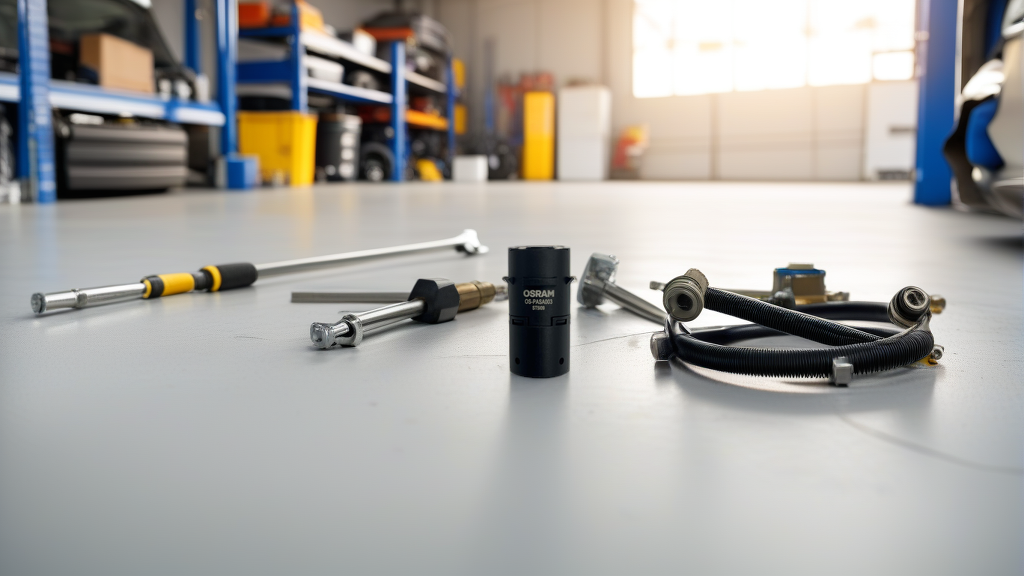
The aftermarket parking sensor market has quietly matured over the last three years, and the OS-PASA003 from OSRAM is part of that shift. For Audi owners and independent shops, the OE number 7H0919275C has become something of a lightning rod — it appears across five different Audi applications, from the Q7 to the A8, yet the failure modes are anything but uniform. What separates a five-minute swap from a bumper-off nightmare isn’t the sensor itself; it’s the preparation, the torque discipline, and knowing which generation of harness you’re dealing with.
This is a replacement guide built for the tech who’s already done a dozen of these, and the DIY owner who’s about to learn why Audi’s parking assist is simultaneously brilliant and infuriating.
The Real-World Failure Pattern
Most OS-PASA003 replacements come in with one of two complaints: intermittent “Park Assist Fault” warnings that clear after a restart, or a continuous tone that suggests the sensor is dead on arrival. In my experience, the intermittent fault is almost always a connector issue — water intrusion at the harness, corrosion on the pins, or a cracked clip that lets the sensor vibrate loose. The continuous tone, on the other hand, usually points to the sensor element itself being compromised, often from a stone strike or pressure washing at close range.
Before you order anything, do a proper diagnosis. Plug in VCDS or OBDeleven and read the individual sensor values in the parking brake module (address 10). You’ll see a distance reading that’s frozen at 0 or bouncing erratically. That’s your culprit. Don’t shotgun-replace all four just because one failed — the OS-PASA003 is reasonably priced, but the labor is where you save money.
Tools and Prep: The Bumper Reality
Here’s where the online guides get vague. The Audi Q7 (4L) and the A8 (D3) both use this sensor, but the bumper removal procedure is completely different. The Q7’s rear bumper requires dropping the under-tray and working through the wheel well liners — about 20 minutes with a Torx T30 and a trim tool. The A8 is worse: you’re pulling the tail light housings first, then the bumper cover, and there are hidden screws behind the license plate trim that nobody mentions.
What you actually need:
- Torx T25, T30, and T40 bits (the T40 for the Q7’s bumper carrier bolts)
- Plastic trim removal kit — metal tools will scar the paint
- Dielectric grease (specifically for the connector seal)
- A torque wrench that reads in Nm — this is non-negotiable for the bumper bolts
- Isopropyl alcohol and a lint-free cloth for the sensor seat
Torque specs you’ll actually use:
| Fastener Location | Torque (Nm) |
|---|---|
| Q7 rear bumper carrier bolts (M8) | 20 Nm |
| A8 bumper cover screws (M6) | 8 Nm |
| Sensor retaining clip | Hand-tight, then 1/8 turn |
| Wheel well liner screws | 3 Nm (do not overtighten) |
The Replacement Procedure — Step by Step
Once the bumper is off, the sensor itself is the easy part. The OS-PASA003 uses a standard 22mm press-fit housing with a plastic retaining clip. Here’s the sequence that won’t leave you chasing gremlins:
- Disconnect the harness before you touch the sensor. Pull the red locking tab, then press the release. Don’t yank the wire — the terminals bend easily, and a bent pin is how you create a phantom fault.
- Release the retaining clip with a small flathead screwdriver. It’s a wedge design; push inward, not upward.
- Twist the sensor 30 degrees counterclockwise and pull straight out. If it resists, it’s likely seized from road grime. Use a gentle rocking motion — do not pry against the bumper cover.
- Clean the sensor seat. This is skipped by 80% of first-timers. If there’s old sealant or dirt, the new sensor won’t seat flush, and you’ll get false readings.
- Apply a thin coat of dielectric grease to the O-ring and the connector pins. This isn’t optional on an Audi — the factory uses it, and it’s the single best defense against the moisture failures that killed the original.
- Press the sensor in square, then rotate clockwise to seat the clip. Listen for the click. If it doesn’t click, it’s not in.
- Torque the bumper bolts to spec. Here’s the trap: the Q7’s carrier bolts at 20 Nm feel “loose” to a tech used to Japanese cars. Trust the spec. Overtightening distorts the mounting boss and changes the sensor angle, which throws off the detection zone.
Common Mistake: Reusing the old retaining clip. The plastic gets brittle after 5+ years of heat cycling. A broken clip means the sensor sits proud of the bumper by 2-3mm — enough to trigger intermittent faults at highway speeds. The OS-PASA003 includes a fresh clip; use it.
After Installation: The Calibration Myth
Here’s a bit of trade knowledge that’ll save you a headache. Unlike some Mercedes or BMW systems, the Audi parking assist module (7H0 919 475) does not require a dynamic calibration after sensor replacement. The system self-learns the sensor position within the first 10 seconds of operation. However, you must clear the stored fault codes in address 10 before testing. If you don’t, the module will keep the warning light active even though the sensor is working.
Test procedure: start the engine, shift into reverse, and slowly approach a flat wall. The tone should begin at about 120cm and become continuous at 30cm. If the reading jumps erratically, re-check the connector seating. If it reads “0” immediately, the sensor is either defective or the clip isn’t engaged.
The Verdict: Is the OS-PASA003 Worth It?
For the Audi Q7 and A8 owner, this OSRAM unit is the smart move. It’s a direct OE cross-reference for 7H0919275C and 4B0919275E, meaning the housing dimensions, plug orientation, and frequency output match the factory calibration. I’ve seen cheaper generic sensors that physically fit but use a slightly different resonance frequency — they work for a week, then start phantom-detecting invisible objects. That’s not a risk worth taking when the labor to swap it again is the real cost.
The OS-PASA003 | OSRAM Parking Sensor | Fits Audi | OE# 7H0919275C, 4B0919275E is the one I’d recommend for the independent shop looking to stock a single SKU that covers multiple Audi models. It’s also the right call for the DIY owner who wants to fix this once and not revisit it.
Who should skip it? If you’re driving a 2004-2006 A8 with the original harness, inspect the wiring before ordering. If the connector itself is corroded or the wires are cracked, the sensor is only half the fix — you’ll need to repin the harness or replace the pigtail. That’s a separate job, and no sensor will fix a broken signal path.
Bottom line: The OS-PASA003 delivers factory-fit quality at aftermarket pricing, and with the right torque discipline and a fresh clip, it’s a one-and-done replacement. Buy it, install it properly, and the next time you hear that parking tone, it’ll be because you’re actually close to something.

Recommended Part: OS-PASA003 – OE-grade replacement, in stock now.