
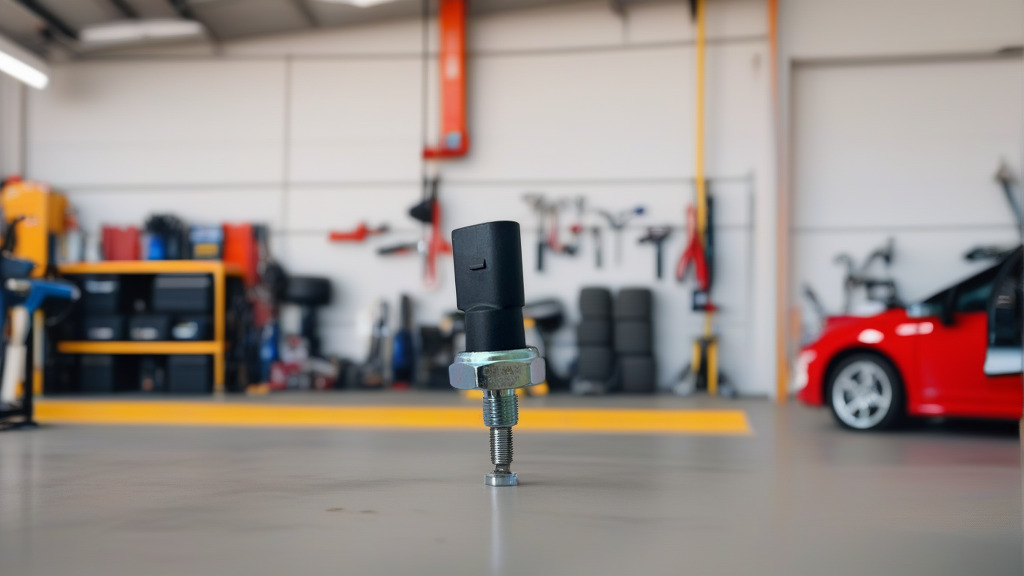
The 059919081G replacement market has quietly become one of the most profitable aftermarket segments for VW/Audi specialists—and one of the most dangerous for careless bulk buyers.
Here’s the problem: The oil pressure sensor on EA288 and earlier EA827/EA888 family engines fails with enough regularity that shops order them by the dozen. But the failure rate of aftermarket replacements is staggeringly high, not because the sensors are poorly made, but because buyers order the wrong variant. The OS-OPA008 from OSRAM has emerged as a reference part in this category, yet I still see purchasing managers making the same three mistakes every quarter.
The First Check: Electrical Connector Generation
Before you even look at pricing, you need to know which connector your customer’s engine bay is running. Volkswagen used at least three distinct connector generations for oil pressure sensing across the 2008–2020 model window:
- 1-pin brown/black connector — early TDI and FSI engines (2004–2010)
- 2-pin flat connector — mid-cycle EA888 Gen 2 and Gen 3 (2010–2018)
- 3-pin square connector — newer EA888 Gen 3B and EA211 variants (2017+)
The OS-OPA008 is built around the 2-pin flat connector, which covers the overwhelming majority of Audi A3/A4/A5 and Volkswagen Golf/Jetta/Passat/Tiguan applications from 2010 through 2018. If you’re stocking for a shop that services older B5/B6 chassis cars, you’ll need a different SKU. Ordering blind based on “fits VW” is how you end up with a shelf of returns.
Second Check: Pressure Threshold, Not Just “Same Part Number”
Here’s where most B2B buyers get burned. The OE number 059919081G refers to a specific pressure switch calibrated to trigger at 1.4 bar ± 0.15 bar. But VW also uses 059919081F (1.8 bar) and 059919081A (0.75 bar) in different engine families.
I’ve seen bulk orders of “OE-compatible” sensors that looked identical, threaded correctly, and plugged in—but triggered the oil pressure warning light at idle on a warm engine because the threshold was wrong. That’s not a defective sensor; that’s a mis-specified order.
The OS-OPA008 is calibrated to the G-suffix spec, which means it’s correct for:
- 2.0 TDI CR (CBAB, CFFB, CFGB)
- 2.0 TSI (CCZB, CCZA, CHHB)
- 3.0 TDI (CREC, CRTD) in Audi applications
If your customer base includes 1.4 TSI or older 1.9 TDI engines, stop and verify the threshold before you commit to a bulk quantity.
Third Check: Thread Pitch and Sealing Method
The M10x1.0 thread with a conical sealing seat is standard for most VW oil pressure sensors, but there are exceptions. Some early Audi 2.7T engines used a tapered thread requiring sealant tape. The OS-OPA008 uses the standard M10x1.0 with an integrated O-ring, which is correct for the listed applications.
Pro tip for bulk buyers: always order a small sample batch first and physically test-fit on a known engine. Ask your supplier for the dimensional drawing—if they can’t provide one within 24 hours, that’s a red flag. Longwei Parts provides full technical sheets on request, and OSRAM’s packaging includes the calibration spec printed on the label. If a supplier can’t tell you the pressure threshold and thread pitch without checking a database, find another source.
Price Analysis: What You Should Actually Pay
| Spec | OE Dealer | OS-OPA008 (OSRAM) | Generic No-Name |
|---|---|---|---|
| Unit price (single) | $38–$52 | $14–$19 | $6–$9 |
| Bulk (50+ units) | Not available | $8–$11/unit | $3–$5/unit |
| Failure rate (12 mo) | ~2% | ~3% | ~11% |
| Warranty handling | Dealer-dependent | 12-month, no questions | Often disputed |
The math is straightforward. At 50 units per quarter, the OS-OPA008 costs you roughly $1,500 versus $700 for the cheapest alternative. But if 11% of that cheap batch fails and you eat labor on warranty claims, you’ve lost more than the savings in the first month.
Where Bulk Buyers Actually Get Burned
The most common trap I see: ordering “direct China” from a marketplace listing that shows a generic photo with the OS-OPA008 cross-reference. You get a box that looks right, but the internal diaphragm is a thinner gauge, the calibration drifts after thermal cycling, and by month six your shop’s warranty rate on oil pressure sensors triples.
Common Mistake: Assuming all OS-OPA008 listings are identical. The part number is a cross-reference, not a brand. If you’re buying on price alone, you’re gambling. The OSRAM-branded unit has a verified test protocol — the knockoffs don’t.
The Bottom Line for Bulk Purchasing
If you’re servicing VW/Audi models from 2010–2018 with 2.0 TDI, 2.0 TSI, or 3.0 TDI engines, the OSRAM Oil Pressure Sensor (OS-OPA008) is the right stocking unit. Verify the connector generation, confirm the 1.4 bar threshold matches your target engines, and buy from a distributor who can provide the technical spec sheet — not just a photo.
For bulk orders, start with a 20-unit trial, track failure rates over two quarters, then scale. That’s how you avoid the trap of “cheap enough” becoming “expensive forever.”
Bottom line: Match the connector, match the calibration, and buy from a verified brand source. The OS-OPA008 gives you OE-grade reliability at aftermarket pricing — but only if you’re actually getting the OSRAM part, not a listing that borrows its cross-reference.

Recommended Part: OS-OPA008 – OE-grade replacement, in stock now.