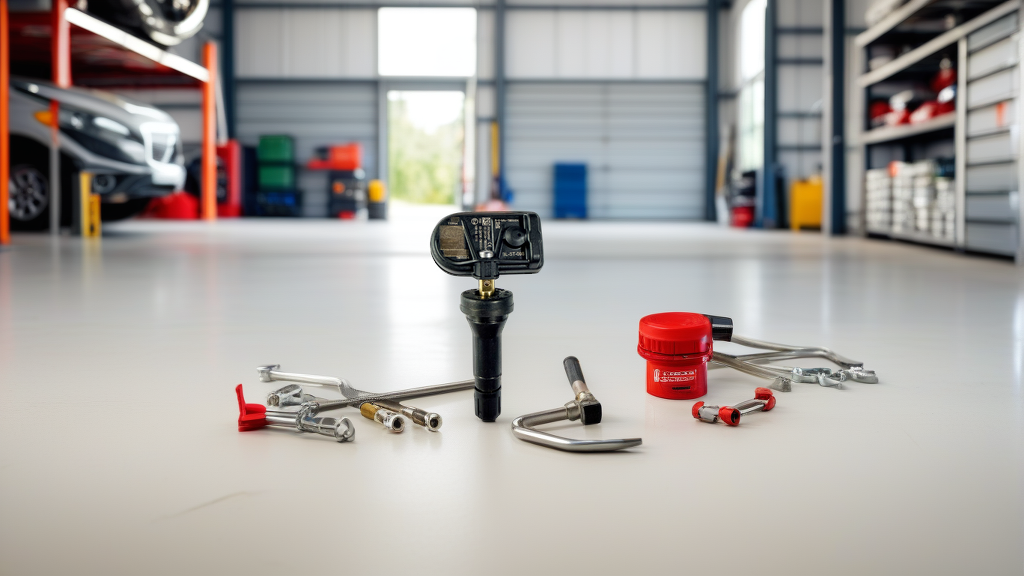
The SEAL U DM-I is a rolling demonstration of how far automotive sensor fusion has come. BYD’s plug-in hybrid SUV doesn’t just rely on mechanical feedback—it depends on a network of pressure, temperature, height, and radar sensors that translate physical conditions into electrical signals the vehicle’s ECUs can interpret in milliseconds. Understanding how these sensors work, and what happens when they fail, matters more than ever for independent shops servicing this growing fleet.
The Measurement Principles Behind the DM-I’s Sensor Suite
At the core of every sensor in the SEAL U DM-I is a transducer that converts a physical quantity into an electrical signal. Take the tire pressure monitoring system (TPMS). The BL-ST-096 sensor uses a piezoresistive pressure element—a silicon diaphragm with embedded resistors that change resistance when deformed by air pressure. That resistance change is converted into a voltage signal, digitized, and transmitted at 433MHz to the body control module. Temperature compensation is built into the same chip, because tire pressure readings drift by roughly 1 psi per 10°F without it.
Height sensors, which the DM-I uses for its adaptive suspension and headlight leveling, work on a different principle: Hall effect or inductive sensing. A magnet attached to the suspension arm rotates past a stationary sensor, generating a voltage proportional to ride height. The ECU reads this as a PWM (pulse-width modulation) signal—the duty cycle of the square wave tells the controller exactly where the suspension sits.
Radar sensors, used for adaptive cruise and blind-spot monitoring, employ frequency-modulated continuous wave (FMCW) technology. They transmit a sweep of frequencies and measure the time delay and frequency shift of the reflected signal. That Doppler shift reveals both distance and relative velocity of the target vehicle. The DM-I’s front radar operates in the 77GHz band, which offers better resolution than the older 24GHz systems but demands cleaner power and more precise signal shielding.
Signal Types: Analog vs. Digital in the DM-I
The DM-I’s sensor suite deliberately mixes signal types. Pressure and temperature sensors output a calibrated analog voltage—typically 0.5V to 4.5V for pressure—which the ECU samples through an analog-to-digital converter. Height sensors use digital PWM outputs because the duty cycle is inherently noise-resistant. Radar modules communicate over CAN bus at 500kbps, sending discrete data packets rather than continuous signals.
This mix matters when diagnosing faults. A TPMS like the BL-ST-096 sends its data as a 433MHz RF burst every 60 seconds when the vehicle is parked, and more frequently when moving. The receiver in the DM-I must lock onto that signal without interference from the vehicle’s own electronics. That’s why the sensor’s frequency stability and transmission power are critical—a weak or drifting signal gets ignored, triggering a false low-pressure warning.
Why the BL-ST-096 Fits the DM-I’s Architecture
For shops servicing the SEAL U DM-I, the aftermarket TPMS landscape has matured considerably. The BL-ST-096 is a pre-programmed, clamp-in sensor from BH-Sens (Baolong Technology) that operates at 433MHz—the exact frequency BYD spec’d for this platform. It covers 34 vehicle applications, including the 2025+ DM-I models, and replaces OE part numbers EUEA3609200B and 110964.
What makes this sensor worth considering is its consistency. Baolong is one of the largest OE TPMS manufacturers globally, so the BL-ST-096 uses the same piezoresistive sensing element and ASIC as factory-installed units. That means the temperature compensation curve matches BYD’s expectations, and the transmission timing—randomized to prevent signal collision with other vehicles—behaves identically to the original.
Pro Tip: When installing a pre-programmed sensor, always verify that the sensor ID matches the vehicle’s existing registration. On the DM-I, you can relearn a new sensor using the OE scan tool or a universal TPMS tool that supports the BYD protocol. Don’t rely on automatic relearn—it’s not guaranteed on this platform.
Market Outlook and Buyer Takeaway
As BYD continues its global expansion, the installed base of SEAL U DM-I vehicles will grow in markets outside China—particularly in Europe, Southeast Asia, and Latin America. Independent shops that understand the sensor architecture will have a distinct advantage. The BL-ST-096 offers a direct replacement path that doesn’t require dealer-level programming, and at a fraction of the OEM price.
For the shop owner: stock a few of these sensors, learn the relearn procedure, and you’re positioned to capture TPMS service work on a vehicle that’s only going to become more common. The sensor technology itself is proven—the challenge is matching the right part to the right platform. That’s where the BL-ST-096 earns its place on the shelf.