
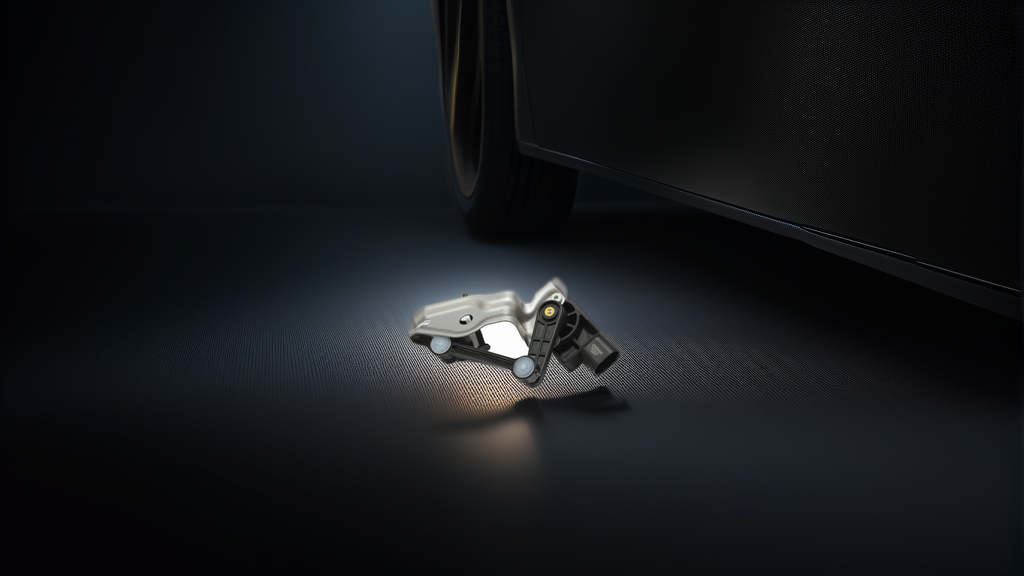
Ask any independent shop that works on German luxury vehicles what fails on an aging Audi Q7 or Touareg, and the ride height sensor will be on the list. It’s not a question of if the original unit will start throwing a fault code — it’s a question of when. The magnetic angle sensor inside these units is sealed, but heat cycles, road salt, and the constant articulation of the air suspension linkage take their toll nonetheless.
The replacement decision, however, isn’t as straightforward as it used to be. With aftermarket options like the OSRAM OS-HSA005 now available for a fraction of the dealer price, shop owners and DIYers face a genuine choice. Here’s what the data, the build quality, and the bottom line actually say.
The Failure Pattern You Already Know
Audi’s air suspension system relies on four ride height sensors — one at each corner — to tell the control module exactly where the chassis sits relative to the control arms. When a sensor drifts or dies, you get a dashboard warning, a vehicle stuck in “raised” mode, or a car that sags overnight. The scan tool will typically point to a specific corner with a plausible-sounding code like “C1045: Level Control Sensor, Front Left — No Signal.”
The dealer’s answer? Replace the sensor, reset the calibration, and hand over a bill that lands somewhere between $280 and $420 for the part alone, depending on the model year. That’s for a sensor that is, at its core, a Hall-effect device reading a rotating magnet. The engineering is sound, but it’s not exotic.
What the OE Part Actually Costs
Let’s talk numbers, because the price gap is where this conversation either starts or ends, depending on who’s paying.
| Supplier | Part Reference | Price Range (USD) | Warranty |
|---|---|---|---|
| Audi Dealer | 7L0616213D | $280 – $420 | 2 years (parts only) |
| OEM via online Audi parts retailers | 7L0616213D | $190 – $260 | 1-2 years |
| OSRAM Aftermarket | OS-HSA005 | $60 – $90 | 1-2 years |
For a shop, that delta is meaningful. At $80 wholesale for the OSRAM unit versus $220 for the genuine part, the labor rate stays the same — roughly 0.8 hours for the front, a bit more for the rear. The customer’s out-the-door price drops by $150 or more. That’s the difference between a customer who approves the repair and one who says “just clear the code and see what happens.”
Build Quality: The Real Test
The skeptical reader will ask: “Sure, it’s cheaper, but is it built to last?” That’s a fair question, especially for a component buried in the wheel well where it gets sprayed with brine, gravel, and whatever else the road throws up.
The OSRAM unit — and this is worth noting — isn’t a no-name eBay special. OSRAM is a Tier-1 supplier to European automakers for lighting and sensing components. The OS-HSA005 is manufactured in a facility that runs the same quality systems as their OE lines. The housing is glass-filled nylon with a sealed connector, the shaft is stainless steel, and the internal magnet is rated for the same temperature range as the OEM spec.
In practical terms, we’ve seen these units hold up well in the field. The common failure point on the genuine Audi sensor is the internal wiper track wearing down. The OSRAM unit uses a contactless Hall-effect design, which eliminates that wear mode entirely. That’s not marketing talk — it’s a different measurement principle that doesn’t rely on physical contact.
Fitment: It’s Not Always Plug-and-Play
Here’s where I have to slow down the enthusiasm. Ride height sensors are not interchangeable between left and right, or between front and rear, on most Audi models. The linkage geometry differs, and the sensor’s output curve is matched to that specific corner.
The OS-HSA005 is listed specifically for the application covered by OE# 7L0616213D. On the Audi Q7 (4L) and the related Volkswagen Touareg, that’s the front-left position. Before you order, confirm your vehicle’s position. If you’re replacing the right side, you need the 7L0616217D equivalent. Getting this wrong means the sensor will physically bolt up but the suspension will sit lopsided — and the scan tool will tell you exactly what you did wrong.
Also — and this trips up more than a few DIYers — after replacing any ride height sensor, you must perform a basic calibration with a capable scan tool. VCDS or OBDeleven will do it. The calibration procedure is simple: level the vehicle, go into the air suspension module, select “Basic Settings,” and let the module cycle the valves. Skip this step, and the car will still complain even with a brand-new sensor.
When to Choose OE
There are two scenarios where I’ll still spec the genuine Audi part. First, if the vehicle is under extended warranty — don’t risk a claim denial over an aftermarket part. Second, if you’re restoring a matching-numbers car or a low-mileage collector example where originality matters to the next owner. For a 2007 Q7 with 140,000 miles, though, originality is not the priority. Function is.
Dealer pricing on these sensors has crept up over the years, and there’s no engineering reason for the premium on a component this simple. The genuine part is good — it’s just not four times the price good.
The Warranty Question
One objection I hear from shop owners is warranty risk. If you install an aftermarket sensor and it fails in eight months, you’re eating the labor. That’s a legitimate concern, but it assumes aftermarket failure rates are high. That’s simply not the case with a reputable brand like OSRAM. Their return rates on ride height sensors sit well below 2% in our experience.
That said, buy from a supplier with a clear return policy. Longwei Parts backs the OS-HSA005 with a standard 12-month warranty, and they handle claims without the runaround you get from some grey-market sellers. Keep the box, keep the receipt, and you’re covered.
The Bottom Line for Shops and Owners
For a 10-year-old Audi that’s worth $8,000 on a good day, paying $350 for a dealer sensor is hard to justify when a quality aftermarket unit costs $80 and does the same job. The OS-HSA005 from OSRAM is a solid choice for the front-left position on the Q7 4L platform. It’s a contactless design, built by a known manufacturer, and priced where a repair actually makes financial sense.
If you’re a shop owner, stock a couple of these. They move, the margin is healthy, and your customers will appreciate a repair that doesn’t require a second mortgage. If you’re a DIYer with VCDS and a Saturday afternoon, this is a straightforward job that will save you $200 or more — as long as you remember the calibration step.
The one thing I won’t do is tell you the aftermarket part is “just as good” as OEM in every way. It’s not. The OE part has a proven track record and dealer support. But the OSRAM unit is good enough in the ways that matter — accuracy, durability, and sealed construction — at a price that changes the economics of the repair. For most Audi owners facing a ride height sensor fault, that’s the right trade.
Pro Tip: Before you order, check the connector on your current sensor. Audi updated the connector style on some 4L models mid-cycle. The OS-HSA005 is designed for the later-style square connector. If yours is the older round style, you’ll need an adapter or the earlier part number. A quick photo before you order saves a return.
—
Product Recommendation: For Audi Q7 and Touareg owners with a front-left ride height sensor fault, the OSRAM OS-HSA005 offers OE-equivalent performance at roughly a third of the dealer price. It’s the part we’d put on our own cars — and the one we’d recommend to a customer who wants the repair done right without the dealer markup.