
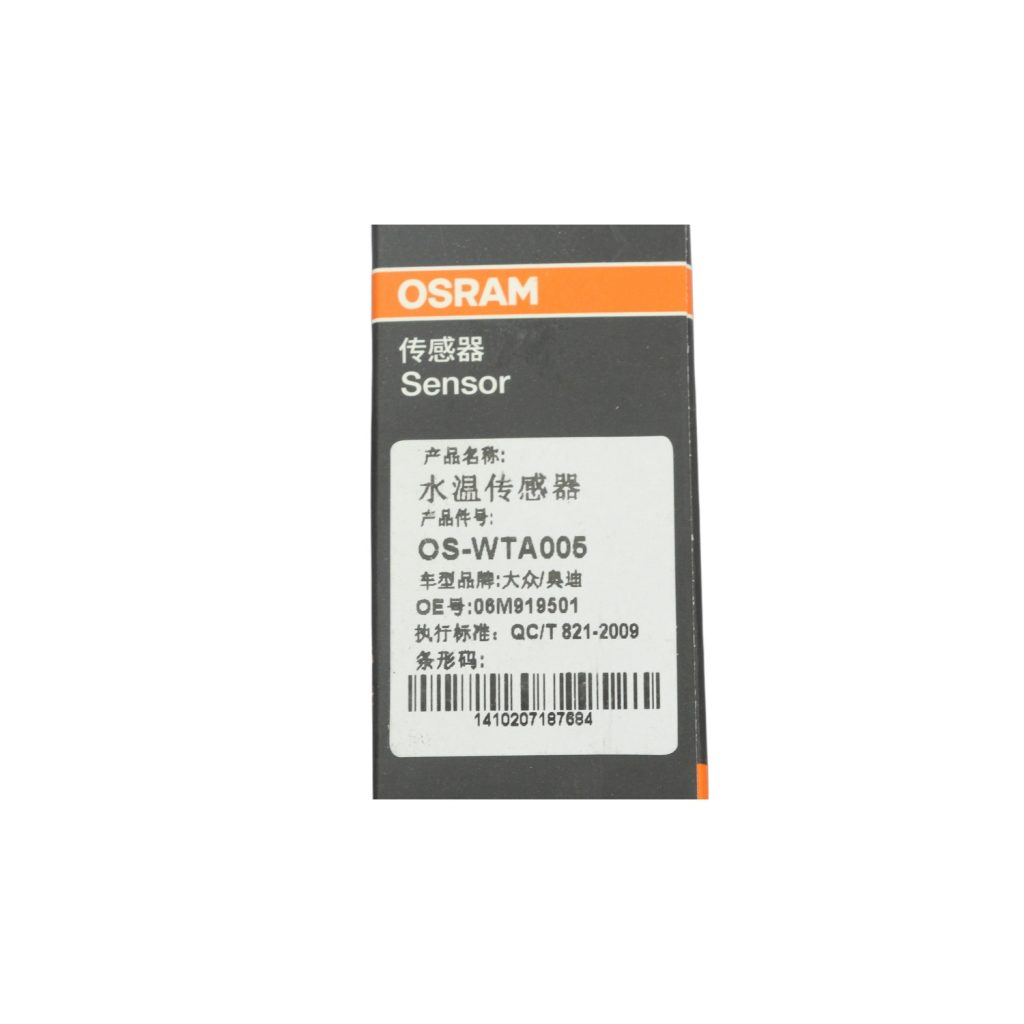
Audi)’s move toward centralized thermal management in its EA888 and EA839 engine families has put a spotlight on a humble component: the coolant temperature sensor. What looks like a simple brass probe is actually a precision transducer whose resistance tells the engine control unit (ECU) how to shape fuel delivery, ignition timing, and radiator fan speed. The physics hasn’t changed in decades — but the tolerances have tightened, and aftermarket options like the | OE# 06M919501](https://longweiparts.com/product/os-wta005-osram-coolant-temperature-sensor-fits-audi-oe-06m919501/”>OS-WTA005) from OSRAM have had to step up to match factory-grade accuracy.
At the heart of the OS-WTA005 is a negative temperature coefficient (NTC) thermistor. As coolant temperature rises, the ceramic semiconductor’s resistance drops — non-linearly, following the Steinhart-Hart equation. The ECU reads this as a voltage divider, converting resistance into a 0-5V analog signal. At -40°C, resistance can be tens of thousands of ohms; at 120°C, it collapses to a few hundred. That wide swing means the signal path has to be clean, because a single ohm of contact resistance at the connector can mimic a temperature shift of several degrees.
Audi’s newer platforms, though, are moving away from pure analog. Many B9-generation models transmit coolant temperature over the LIN bus as a digital frame, where the sensor itself contains a small microcontroller and transmits data packets rather than a raw voltage. The OS-WTA005 covers both architectures, which is why it fits six Audi applications — from the 2.0 TFSI to the 3.0 TDI — and makes it a favorite among independent shops that don’t want to stock five part numbers.
Height, pressure, and radar sensors in Audi’s driver assistance and suspension systems work on different principles — magnetostrictive for ride height, MEMS capacitive for boost pressure, and frequency-modulated continuous wave (FMCW) for adaptive cruise. But the coolant temperature sensor is the one that, when it fails, takes the whole car down. A shorted NTC can read -45°C, sending the ECU into cold-start enrichment and flooding the cylinders. An open circuit reads 150°C, triggering limp mode and a radiator fan that runs at full speed during a cold start.
Key Specs — OS-WTA005
- Brand: OSRAM
- Type: Coolant Temperature Sensor
- Compatibility: Audi, 6 applications
- OE Reference: 06M919501
- Construction: NTC thermistor, sealed brass housing
- Output: Analog voltage / LIN-compatible (vehicle dependent)
Market Outlook
As Audi phases in updated engine management over the next model years, aftermarket suppliers are consolidating part numbers. The | OE# 06M919501](https://longweiparts.com/product/os-wta005-osram-coolant-temperature-sensor-fits-audi-oe-06m919501/”>OS-WTA005) is one of the few sensors that bridges the gap between older analog-reading ECUs and newer LIN-bus modules, making it a solid stock-up item for distributors serving independent Audi specialists. For 2026, expect more of the same: fewer sensor variants, smarter digital communication, and a continued premium on accurate measurement.
If you’re replacing a failed coolant temperature sensor on an Audi, the | OE# 06M919501](https://longweiparts.com/product/os-wta005-osram-coolant-temperature-sensor-fits-audi-oe-06m919501/”>OS-WTA005) is the part to keep in the drawer — it covers the spread, signals correctly, and removes the guesswork.