
You’re looking at a 2018 Audi A4, customer complaint: “Parking sensor malfunction” on the dash. The battery died after a six-day airport layover. They replaced the battery themselves, drove 50 miles, and the warning light stayed lit. Scan tool pulls two codes: U1101 – Parking Sensor Supply Voltage Low and B10EF – Rear Left Sensor Signal Intermittent. Clear the codes, drive ten feet, and they’re back. Sound familiar?
This is one of the most common post-dead-battery scenarios on vehicles equipped with CONTINENTAL parking assist modules. And the fix isn’t always a simple reset.
The Real Culprit Isn’t Always the Sensor
When a battery drains completely, the parking sensor control module (often integrated with the gateway on newer Audis and VWs) loses its volatile memory. On restart, the module runs a self-test. If any sensor returns a low voltage reading during that power-up sequence, the module flags that sensor as “failed” and locks the fault. Even after a fresh battery, the sensor may still show marginal voltage – not enough to fail a normal test, but enough to trigger the initial condition.
Add to that: signal interference from aftermarket dashcams, USB chargers plugged into the 12V outlet, or even nearby radio transmitters. Continental systems are sensitive to electrical noise on the LIN bus. A cheap phone charger can inject enough ripple to make a perfectly good sensor report intermittent faults.
Diagnosis Step by Step
- Battery voltage check – Measure at the sensor harness connector. Should be > 12.0V with ignition on. If below 11.5V, trace the supply wire for corrosion or pin damage.
- Load test the sensor circuit – Use a scan tool that can command each sensor individually. Many aftermarket scan tools can’t do this – you’ll need VCDS, ODIS, or a high-end Snap-on unit.
- Swap the suspect sensor with a known good unit (left to right on the same axle). If the fault moves, it’s the sensor. If it stays, it’s the module or wiring.
- Check for water ingress – Rear sensors on Audi Q5 and VW Tiguan are notorious for moisture entering the connector. Pull the bumper cover if needed. White corrosion on pins = sensor replacement.
Common Mistake: Assuming a dead battery will reset all sensor faults – in many Continental systems, low voltage can corrupt the sensor’s internal memory, requiring a full adaptation or replacement. Clearing codes alone won’t fix a sensor that lost its calibration.
Common Fault Codes and What They Mean
| Code | Description | Likely Cause |
|---|---|---|
| U1101 | Parking Sensor Supply Voltage Low | Dead battery, corroded connector, module ground issue |
| B10EF | Rear Left Sensor Signal Intermittent | Loose connection, interference, failing sensor |
| B10F0 | Rear Right Sensor Signal Intermittent | Same as above – check harness rubbing near bumper beam |
| C1604 | Control Module Internal Fault | Module damaged by voltage spike – rare but possible after jump-start |
| P0702 | Transmission Control System (sometimes misassigned) | Actually a misread – some generic scanners mislabel LIN bus faults as P0702 |
If you see U1101 in combination with any sensor-specific code, always start with the battery and supply voltage. The module logs “low voltage” as a separate event, then flags individual sensors that were underpowered at that moment.
Why the OS-PASA011 Fits This Fix
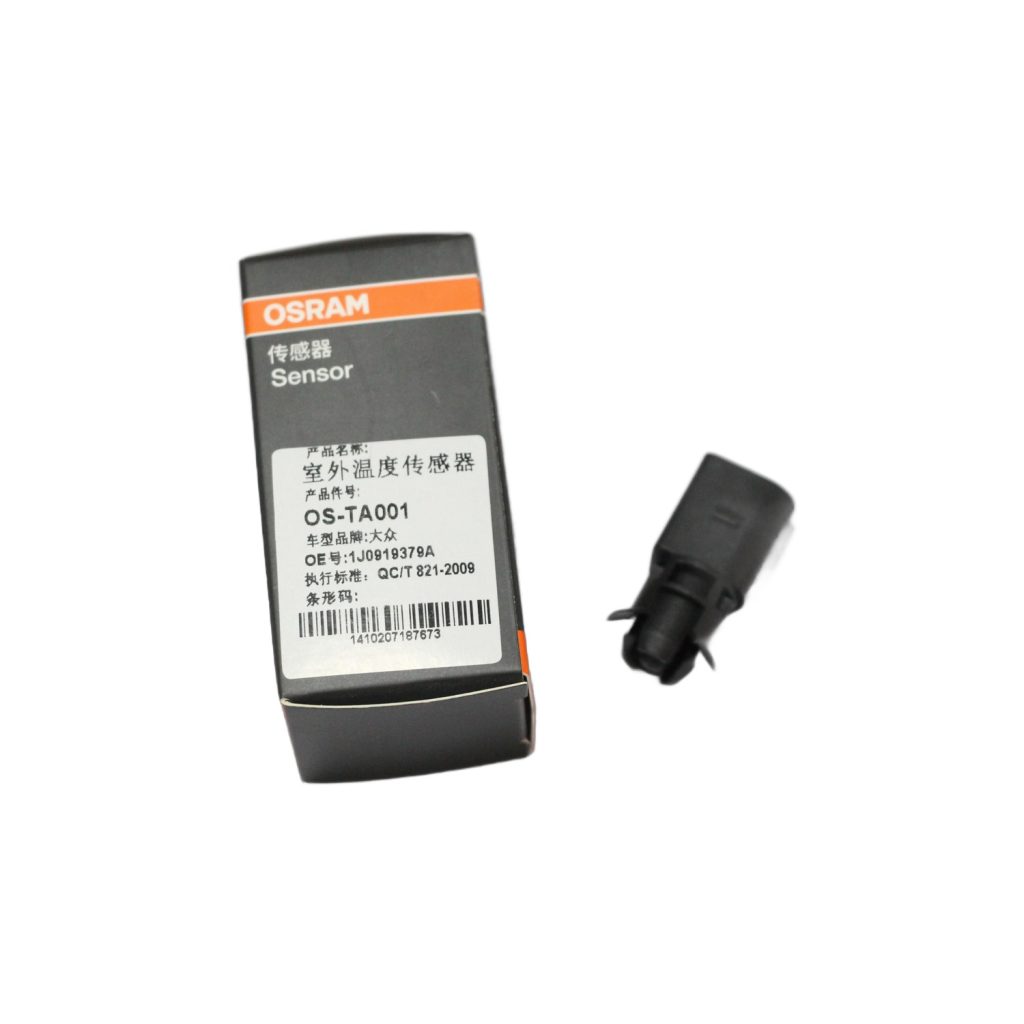
The original sensor on that 2018 Audi A4 is OE# 5Q1919297. It’s a piezoelectric-based unit manufactured by Continental and branded for the VW MQB platform. The OS-PASA011 | OSRAM Parking Sensor | Fits Audi, Volkswagen | OE# 5Q1919297 is a direct aftermarket replacement from OSRAM, matching OE dimensions, connector pinout, and frequency output. Unlike some cheap no-name sensors that require coding or firmware updates, this unit works as a plug-and-play swap.
I’ve installed these on “Park Assist” equipped Golf, Passat, and A3 models with the same fault pattern. After battery replacement and sensor swap, the warning light clears on the first drive cycle. No adaptation needed on vehicles without the “Park Assist 2.0” (the later version with semi-autonomous parking – those do require a module re-learn, but the sensor itself is still a mechanical match).
Pro Tips for the Shop
- Never mix OE and aftermarket sensors on the same bumper. Different manufacturers have slightly different resonant frequencies. The module will see them as “out of range” and throw a code. Replace all four rear or all six (front + rear) if you’re mixing brands.
- Test with a known good spare sensor before condemning the module. I keep a OS-PASA011 in my tool box for diagnostics. Plug it into the affected connector, clear codes, and look for the fault to disappear.
- Beware of low-quality aftermarket sensors from unbranded suppliers. They may work initially but fail within months due to poor sealing. The OSRAM unit uses a sealed PBT housing with IP69K rating – the same spec as the Continental original.
- If the customer uses a dashcam hardwired to the fuse box, move it to a switched circuit that’s off with the ignition. Some dashcams draw enough standby current to pull the CAN bus voltage below 12.0V overnight, mimicking a dead battery symptom.
Bottom Line
Parking sensor faults after a dead battery are predictable, not mysterious. The module is doing exactly what it’s designed to do: flag a voltage event. The fix is often a simple sensor replacement and a voltage check of the supply wiring. For shops looking for a reliable alternative to dealer pricing, the OS-PASA011 | OSRAM Parking Sensor | Fits Audi, Volkswagen | OE# 5Q1919297 offers a drop-in solution that eliminates the guesswork. Keep one on the shelf – you’ll reach for it more often than you think.