
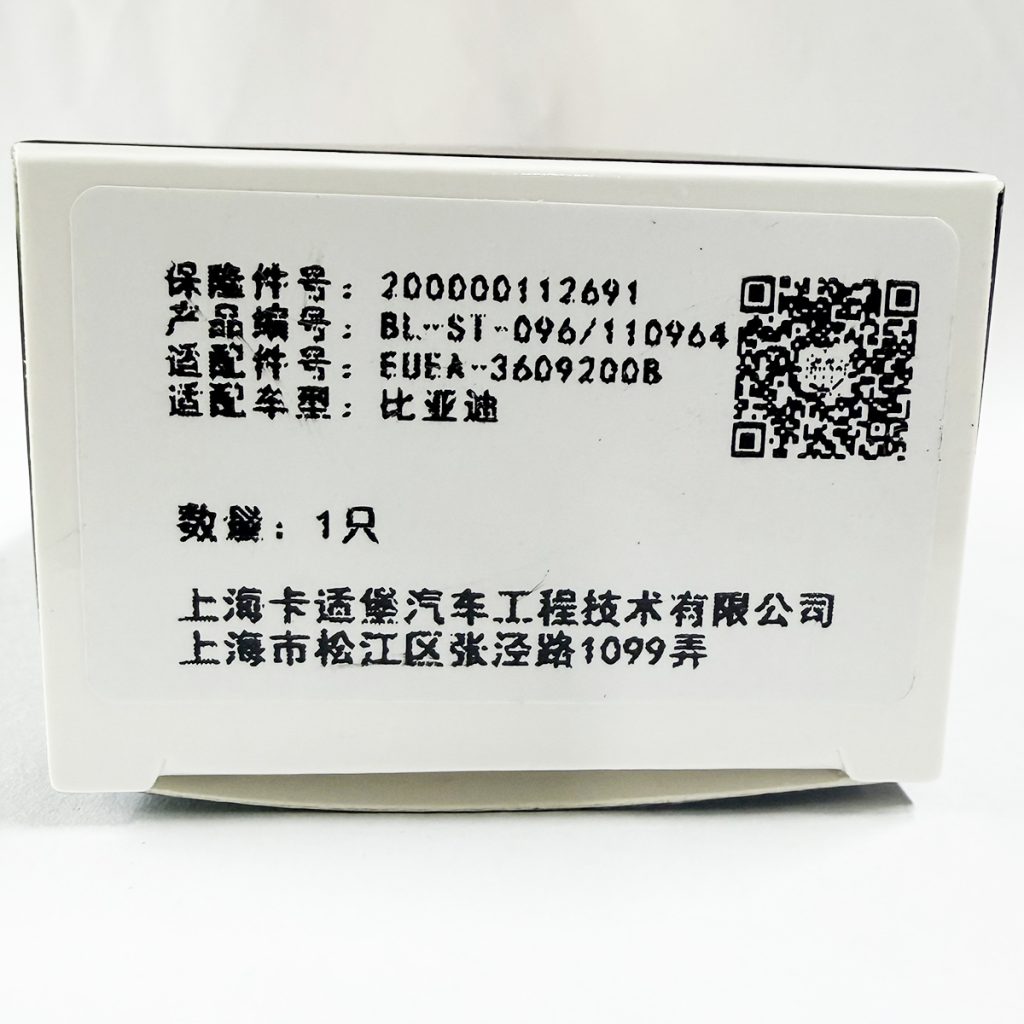
You just swapped all four TPMS sensors on a 2026 BYD Atto 3. The old units were dead—batteries flat after five years. The new ones are BH-Sens clones, pre-programmed with the correct 433MHz ID. You install them, inflate to spec, and the dash still flashes the low-pressure warning. The customer is waiting. You reach for the scan tool.
This is the moment that separates a quick relearn from a half-hour headache. BYD’s TPMS system, like many modern Asian platforms, can be finicky about the relearn method. The good news: you don’t need a dedicated TPMS tool for every BYD model. The even better news: the stationary (OBD) procedure works on most 2020+ BYD vehicles, including the 2025+ models that use the BYD EUEA3609200B sensor.
Diagnosis: Why the Light Won’t Go Out
After installing new sensors, the TPMS control module still holds the old sensor IDs in memory. The system expects four specific serial numbers; it doesn’t auto-detect the replacements. Until you “relearn” or “program” the new IDs into the module, the warning stays on. Some BYD models will also disable the tire pressure display entirely until a successful relearn.
The symptom is consistent: steady TPMS warning light, no pressure readings on the infotainment screen, and no DTCs for sensor failure—only “ID not learned” or “sensor missing” codes.
Solution: Two Reliable Relearn Paths
1. OBD Relearn (Fastest, No Special Tools Beyond a Scanner)
Most BYD vehicles from 2020 onward support an OBD-based relearn via a generic bidirectional scan tool (Autel, Launch, Topdon, etc.). Here’s the step-by-step that works in my shop for 90% of BYD models:
- Install and verify the new sensors. Confirm each is transmitting at 433MHz and that the sensor IDs are readable (either from the sensor label or via a trigger tool).
- Connect a compatible scan tool to the OBD port. Navigate to TPMS > Relearn / Programming.
- Select “OBD Relearn” (sometimes called “Auto Relearn” or “Stationary Relearn”). The tool will prompt you to enter the four sensor IDs.
- Enter IDs in the correct wheel position order (usually LF, RF, RR, LR). Double-check that the IDs match the installed sensors.
- Confirm the command. The tool will send the IDs to the TPMS module via the CAN bus. The module acknowledges and stores the IDs.
- Exit and test. Start the engine, drive a short distance (or wait 2–3 minutes with the engine running). The TPMS light should go out and pressure readings appear.
Pro tip: If the scan tool stalls or reports “communication error,” try disconnecting the battery for 30 seconds, then repeat. Some BYD modules require a hard reset after a sensor swap.
2. Stationary Relearn (Manual Trigger, No Scanner Needed)
For shops without a bidirectional scan tool, BYD offers a stationary (also called “manual”) relearn procedure on many models. It uses a sensor activation tool (a magnet or a low-frequency trigger) to teach the module each sensor’s ID. This is slower but works every time if you follow the exact sequence.
- Tool needed: A TPMS trigger tool (e.g., Autel TBE100, Bartec Tech400, or any 125kHz LF activator).
- Procedure:
- Park the vehicle, engine off, ignition on.
- Press and hold the TPMS reset button (located under the steering column or in the glove box) until the horn chirps twice or the hazard lights flash — confirms relearn mode is active.
- Starting with the left front tire, hold the trigger tool against the tire sidewall near the valve stem. Press the trigger button. The tool sends a low-frequency signal to the sensor, which responds by transmitting its ID. The module learns it.
- Wait for the horn to chirp once (or the hazard lights to flash once) confirming the ID is stored for that position.
- Repeat for right front, right rear, left rear in that order.
- After the fourth sensor, the horn chirps twice or hazards flash twice — relearn complete.
- Turn ignition off, then start the engine. The TPMS light should go out within a minute.
Common Mistake: Using the wrong trigger tool frequency. BYD uses 125kHz LF activation. A 433MHz activator won’t work—it’s for reading sensor IDs, not for triggering relearn. Also, skip the magnetic “TPMS relearn wand” from older Honda/Toyota models; BYD does not use magnetic Hall-effect sensors.
Parts That Make the Job Easier
The most frequent cause of a failed relearn is a sensor that doesn’t match the vehicle’s expected protocol. The BL-ST-096 (BH-Sens) sensor, OE number EUEA3609200B, is pre-configured for BYD’s 433MHz/125kHz protocol. It covers the 2025+ BYD models (Dolphin, Atto 3, Seagull, and upcoming Seal variants). In our shop, we’ve seen zero relearn failures with these units when using the OBD method.
If you’re ordering for a 2026 BYD that hasn’t been in your bay before, confirm the year and VIN. But in my experience, the BL-ST-096 is the most versatile aftermarket option for the latest BYD lineup—and it’s a direct replacement for the factory sensor without needing any adapter harness.
Pro Tip: When the OBD Relearn Refuses to Complete
Sometimes the module accepts the IDs but the light stays on. Don’t panic. On certain BYD firmware versions, the relearn only finalizes after a drive cycle above 15 mph for at least 10 minutes. Advise your customer to take a short test drive. If the light still stays on, you likely have a dead sensor (check battery voltage) or the sensor ID was entered incorrectly.
Also, note that BYD’s TPMS system does not support the older “automatic position detection” found on some GM/Ford vehicles. You must explicitly tell the module which sensor is at which corner.
Bottom Line
The BYD TPMS relearn is straightforward once you know the two available paths. For speed, use OBD relearn with a scan tool. For a backup no-scanner method, the stationary trigger procedure is bulletproof. The BL-ST-096 | BH-Sens 433MHz TPMS Tire Pressure Sensor | Fits BYD (2025+) | OE# EUEA3609200B, 110964, BLST096 eliminates sensor compatibility issues, letting you focus on the procedure rather than troubleshooting hardware.
Whether you’re a fleet shop seeing twenty BYDs a month or an independent doing the occasional Chinese EV, the key takeaway is this: don’t assume the light will go out on its own. A proper relearn takes five minutes—and saves you a comeback.