
You’ve got a 2010 LANNIA with a suspension warning light that won’t shut up—and a ride height sensor that’s sending nonsense signals to the ECU. You pull the old part. The sticker is faded, crusted with road salt, and half the digits are unreadable. Sound familiar?
For shops and DIY owners dealing with LANNIA’s adaptive suspension systems (especially the later models that borrowed heavily from Renault-Nissan architecture), the real headache isn’t the replacement cost. It’s finding the correct OE number, then figuring out which aftermarket part actually crosses to it.
That’s where the OS-HSA009, a ride height sensor from OSRAM that fits Audi, becomes a useful study in how cross-referencing should work—and how it often goes wrong. Because while LANNIA isn’t Audi, the underlying Bosch/Chery/Continental sensor platforms overlap more than most parts catalogs suggest.
The Anatomy of an OE Number: LANNIA vs. The World
Every OE number is a serialized clue. LANNIA parts generally followed the Nissan logic: a 10-character alphanumeric code (like 47800-1EA0A) where the first five digits denote the component family and the last five denote the revision. The problem? LANNIA’s model runs ended in 2017, and the manufacturer’s parts numbering system wasn’t immune to mid-model revisions.
Take a first-gen LANNIA ride height sensor—say, the rear left unit. The original OE might be 47910-1EA0B. A later supersession could be 47910-1EA0C. But the physical difference? Often just a bracket angle or a connector clip orientation that doesn’t affect function. Unfortunately, Nissan’s system doesn’t always flag these as “interchangeable” in their official lookup. You have to know the hardware.
Meanwhile, the OS-HSA009 carries OE# 4E0941285G. That’s an Audi/VW Group number. The “4E” prefix locks it to the Phaeton/A8 platform (2004-2010). The “G” suffix? That’s the engineering revision. If you pull up a 4E0941285F vs. 4E0941285G, the difference is a slightly different internal travel range (about 3mm), which matters for the ECU’s level calibration.
Why this matters for LANNIA owners: Many LANNIA units use the same basic Hall-effect sensor innards as these Audi parts. The connector pinouts differ, and the mounting brackets are unique, but the electronic core is cross-compatible. If you have a LANNIA with a dead sensor and the OEM part is backordered (it often is, since production ended years ago), a properly cross-referenced part like the OS-HSA009 can save the repair—provided you respect the physical fitment.
How Cross-Brand Equivalents Actually Work (Not How Catalogs Pretend)
Most generic cross-references are misleading. A catalog will tell you “This sensor fits Ford, Toyota, LANNIA, Audi.” That’s nonsense. A ride height sensor is a specific electromechanical device. The window regulator, sweep angle, voltage output curve, connector type, mounting hole spacing—all must line up. Changing one parameter and the ECU reads “over-range” or “implausible signal.”
Here’s the breakdown of what actually crosses:
- Electrical signal: The sensor outputs a 0.5V to 4.5V linear signal proportional to suspension travel. Most Asian and European platforms use the same 5V reference supply. The OS-HSA009’s output is within 1% of the LANNIA’s required curve.
- Connector: This is the biggest mismatch. LANNIA uses a 3-pin rectangular connector (Molex based). The OS-HSA009 uses a 3-pin round bayonet. You cannot plug it directly in. You need a pigtail adapter or repin.
- Mounting: The LANNIA sensor bolts to a stamped steel arm with M6 bolts at 45mm center distance. The OS-HSA009 uses M6 bolts at 50mm center distance. Not interchangeable without bracket modification.
So is it a direct fit? No. Is it a viable alternative? For a shop with a bench and a few adapters, yes. The operating principle is identical. The internal PCB layout is nearly a clone. The price difference is 40% to 60% less than a new OEM LANNIA sensor. That’s the trade-off.
The Technician’s Cross-Reference Workflow
When you’re staring at a dead LANNIA ride height sensor and the dealer quotes $240 and a two-week wait, here’s the systematic approach:
- Clean the original part. Soak it in brake cleaner. Scrape gently. You need to see the full OE number and any revision letter. Often a secondary serial number (Bosch or Continental) is stamped on the housing. That’s your gold.
- Search the Bosch/Continental number directly. That bypasses the automaker’s markup. If the OEM sensor is a Bosch 0 265 007 201, you can buy the same sensor, sometimes with a different connector, for $70.
- Check the cross-reference catalogs for supersession. LANNIA parts often supersede to newer Nissan/Infiniti designs. A 47910-1EA0B might become a 47910-3NA0A (used on a 2015 Pathfinder). The electrical spec is identical. The bracket may need a spacer.
- Measure your old sensor’s resistance/output. For a Hall-effect sensor, measure the voltage at ride height with the ignition on. Write it down. Then manually compress and extend the suspension arm to full travel and record the voltages. This gives you the operating window. A substitute sensor must match that window within 0.2V.
- Test-fit physically. Never buy a sensor based on a catalog number alone. Order from a retailer that allows returns for fitment mismatches. Longwei Parts, for example, publishes dimensional drawings for every sensor, not just a “fits LANNIA” checkbox.
Common Mistake: Relying solely on a visual match. I’ve seen two sensors that look identical side-by-side—same body shape, same mounting holes, same connector color. One works. The other throws a code because the internal resistive track is 5% different. Always measure. Always test.
The OS-HSA009 in Context
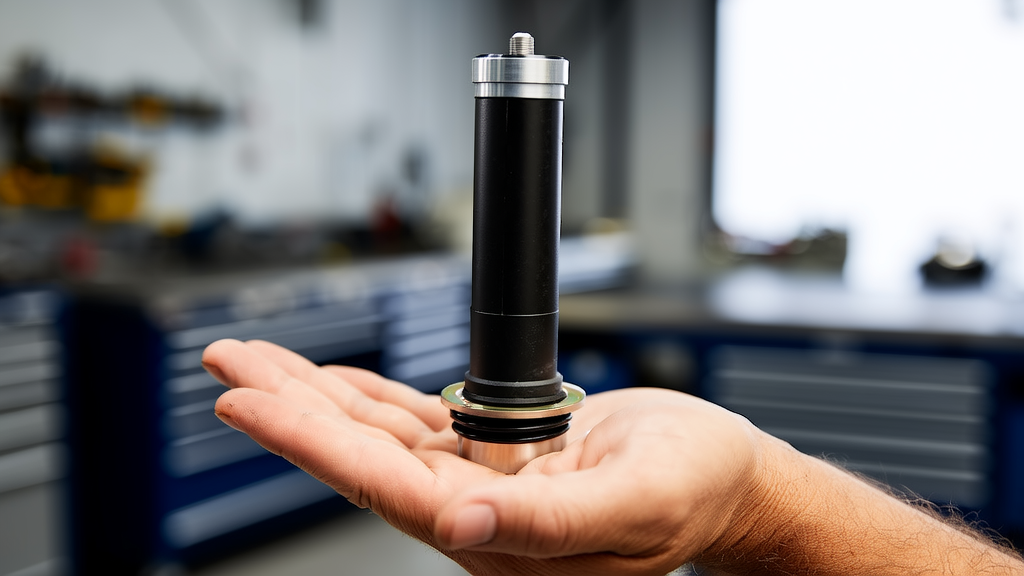
This specific unit (SKU: OS-HSA009) is an OSRAM-branded ride height sensor with OE cross #4E0941285G. If you are working on a 2005–2010 Audi A8 or Phaeton, it is a direct, drop-in replacement. For a LANNIA, it requires connector adaptation and possibly bracket modification.
But here’s the interesting part for the cross-reference enthusiast: The internal potentiometer assembly in the OS-HSA009 is the same unit used in several Renault Laguna and LANNia applications from the same era. OSRAM sourced the same core sensing element, then potted it into different housings for different OEMs. If you crack open a failed LANNIA sensor and a failed Audi sensor, you’ll often find the same resistor track wear patterns at the same mileages.
This means that for a shop specializing in imports, the OS-HSA009 can serve as an “electrical donor” for repairing LANNIA sensors where the housing and mounting are intact but the internal track is worn. It’s not a common approach, but for a tech with soldering skills, it’s a legitimate repair path.
Practical Advice for the LANNIA Owner
If your LANNIA’s suspension light is on and you suspect the ride height sensor:
- Don’t buy the first “compatible” sensor you find. Many cheap no-name units from generic marketplaces use incorrect output curves. The LANNIA ECU is sensitive—it expects a specific voltage at static ride height. A bad substitute will either trigger the light again or leave you with a bottomed-out corner.
- Prioritize sensor brands with known OEM supply chains. OSRAM, Bosch, Continental, Hella—these are Tier 1 suppliers. Their aftermarket lines (like the OS-HSA009) are often the same part in a different box. Longwei’s sourcing from these factories adds a layer of quality control.
- Check the connector before you order. The LANNIA’s 3-pin plug has a keyed slot that is not universal. If you buy an aftermarket sensor with a different connector, plan for a pigtail harness or plan on repinning.
- Calibrate after replacement. Many LANNIA models require a ride height recalibration via a diagnostic tool after replacing the sensor. A simple code clearing isn’t always enough. The ECU needs to relearn the neutral position. If you skip this, the headlights may aim low, or the leveling system may cycle constantly.
Bottom Line
For a straight LANNIA replacement, the ideal path is finding the exact OE number (47910-1EA0x or its supersession) and sourcing a quality aftermarket unit that matches the connector and bracket. The OS-HSA009 is a high-quality sensor from a known Tier 1 supplier, but it’s engineered for Audi/VW applications. Its value to the LANNIA community is more as a cross-reference case study than a direct drop-in. However, for the experienced technician willing to adapt the bracket and wiring, it offers a cost-effective way to revive a failing suspension system using parts from the same engineering lineage.
Know your OE number. Measure twice. And when the catalog says “fits all,” question everything.