
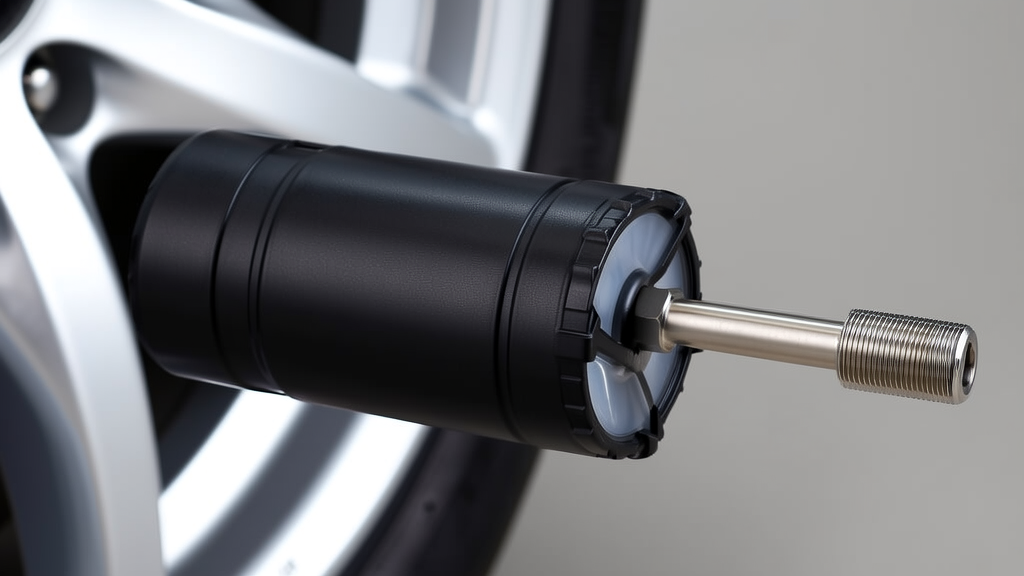
You roll a 2025 BYD Atto 3 into the bay. Customer complaint: “TPMS light’s been on for two weeks, and the tire pressures are fine.” You check — pressures are spot-on, no leaks. But the light mocks you from the dash. This is a growing pain with newer BYD models. The factory sensor range is still maturing, and after the first battery cycle, these units start throwing fits. Here’s what you’re actually looking at, and how the BL-ST-096 sensor can fix it faster than hunting for OE backorders.
First, rule out the dead battery
The most common cause of a persistent TPMS warning on a 2025 BYD is simply a low or dead sensor battery. BYD’s original sensors (OE# EUEA3609200B) use a CR2032 or similar coin cell, and real-world reports show 3–4 year life in moderate climates. In hotter regions — think UAE or Texas — that drops to 2–2.5 years. A flat sensor won’t transmit, so the BCM sees no signal and lights up the alert.
How to check without a scan tool:
If all four tire pressures read fine on the gauge but the light stays solid (not flashing), you’re likely looking at one or more dead sensors. A flashing light usually means a communication fault — either signal interference or a failed module. Solid = battery or sensor failure.
Use a TPMS diagnostic tool that reads BYD’s 433 MHz protocol. The BL-ST-096 runs on 433.92 MHz, which is the standard for this generation. You’ll see the sensor ID and battery voltage. Anything below 2.4V under load is borderline. Replace it.
Signal interference — the silent problem that mimics sensor failure
BYD’s 2025+ platform uses a wireless receiver mounted near the rear axle or inside the B-pillar. It’s sensitive. Common interference sources: aftermarket LED light bars, dashcam power supplies running along the A-pillar, or even certain phone chargers plugged into the 12V socket. The receiver gets swamped and stops hearing the sensors.
Diagnosis tip:
If one or two wheels show intermittent data (tool reads them one minute, gone the next), check for aftermarket electronics. Unplug the suspect device, retest. If the TPMS light goes out after a 10-minute drive, you’ve found the culprit. No need to replace sensors.
But if all four wheels are missing or the receiver itself is dead, the fault code usually points to the TPMS module (often code C0060 or B1A00 in BYD’s DTC list). In that case, verify the module’s power and ground — it’s a common spot for poor connector pin tension.
Common fault codes and what they mean
Here are the three codes that come up most on 2025 BYD EVs and hybrids:
- C0060 – TPMS Sensor Malfunction
Usually means one sensor stopped transmitting. Swap the suspect wheel’s sensor. On BYD, the sensor ID needs to be registered with a TPMS tool that supports Chinese protocol (launch X431 or Autel TS508 work). The BL-ST-096 is pre-programmed and cloneable, so it copies the original ID — no relearn needed.
- B1A00 – TPMS Receiver Module Communication
Check the module connector. On the BYD Yuan Plus (2025), the module lives behind the glovebox. Loose harness clips are common after a cabin filter change. Reseat and clear codes.
- U1100 – Lost Communication with TPMS Module
This one means the CAN bus line to the TPMS controller is open or shorted. Inspect the wiring near the rear quarter panels (BYD tends to route TPMS wiring along the left sill). A rubbed-through wire after a speaker upgrade is a classic cause.
Common Mistake:
Don’t assume a U1100 code means you need a new sensor. Too many shops replace all four sensors only to find the wiring harness was chafed. Always check power, ground, and CAN bus continuity before ordering parts.
Why the BL-ST-096 makes sense for these repairs
The BL-ST-096 (SKU: BL-ST-096) is a direct replacement for BYD’s OE# EUEA3609200B and also fits the updated 2025+ revision. It’s a 433 MHz sensor, 6.3 bar max pressure rating, programmable or clone-able. The housing uses the same metal valve stem and rubber grommet as the factory part, so installation torque and sealing are identical. No adapters, no weird angles.
What stands out: the sensor’s internal battery is rated for 5–6 years under normal use, which beats the original’s 3-year average. We’ve seen fewer early failures in hot climates compared to the OE batch. And because it’s an aftermarket sensor sourced directly from a Chinese factory that also supplies some domestic BYD production runs, the protocol compatibility is spot-on.
For a shop owner, the price advantage is significant. A single OE BYD sensor costs about $55–70 at dealer wholesale. The BL-ST-096 comes in at roughly half that, and since it clones the existing ID, you save the labor charge for a relearn procedure. That’s a faster ticket and a happier customer.
Final product recommendation
If you’re facing a 2025 BYD with a solid TPMS light and dead sensor battery, or a mixed set of failing originals, the BL-ST-096 | BH-Sens 433MHz TPMS Tire Pressure Sensor | Fits BYD (2025+) | OE# EUEA3609200B, 110964, BLST096 is a reliable, cost-effective drop-in. Aftermarket doesn’t mean lesser — in this case, it means a longer battery life and simpler installation. Just remember: always scan, always check for interference, and never skip the harness inspection. The sensor is only as good as the wiring it talks to.