
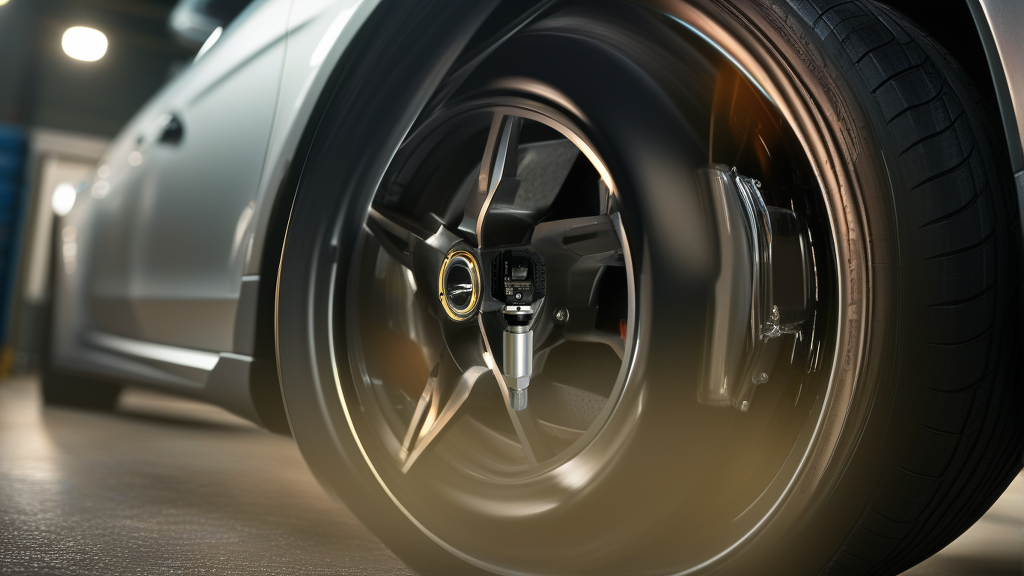
You’ve got a 2021 Bestune T77 rolling into the bay. The customer says the TPMS light has been on for two weeks. You scan the system—no sensor data from the right rear. Pull the wheel, pop the tire, and find the clamp-in sensor cracked at the stem base. Classic battery-expansion failure. The OE part is a Baolong unit with a five-year life expectancy, but this one only made it three. Time to install a drop-in replacement that won’t leave you chasing programming hiccups.
For 国雅 vehicles—spanning Bestune, FAW, and Hongqi models—the aftermarket has settled on a reliable, pre-programmed solution: the BL-ST-040 from BH-Sens. It’s a 433MHz clamp-in sensor that matches OE numbers 3602100FD, 3602100FDA, and 3778080DB01A. No clone tool, no dealer programming needed—just install and let the car learn it on the next drive. Here’s how to do it right the first time.
—
Tools You’ll Actually Need
Skip the gimmicks. For a clean 国雅 TPMS installation, gather:
- T25 Torx bit (for sensor-to-valve stem screws on some generations)
- 10mm deep socket + torque wrench (for the lug nuts)
- 1/4-inch drive with a 6mm hex socket or T20 Torx (for the sensor retaining nut if your vehicle uses a standard clamp-in design)
- Tire machine / manual tire spoons (if you’re doing this roadside, careful—sensor damage is easy)
- Digital tire pressure gauge (set to 35–38 psi per 国雅 spec for most passenger models)
- Tire bead lubricant
- Replacement rubber grommet (if the valve stem seal looks dried out—common on 2018–2022 units)
Torque specs that matter: The sensor retaining nut should be tightened to 4–5 Nm (35–44 in-lbs). Over-tighten and you’ll crack the brass housing. The lug nuts get 110 Nm (81 ft-lbs) on Bestune models, 100 Nm on older FAW vehicles. Always double-check the owner’s manual or a database; 国雅 spec can vary between the Hongqi H5 and the Bestune X40.
—
Step-by-Step Replacement: The Right Way
1. Diagnose the faulty sensor
Use a 433MHz TPMS tool that supports universal learning. The 国雅 system often uses the “auto-locate” protocol—drive the car above 25 km/h for 10 minutes, and the car matches sensor IDs to wheel positions automatically. But if you’re replacing only one sensor, you don’t need to program anything. The BL-ST-040 ships pre-programmed with a static ID that the vehicle’s receiver will pick up after a short drive.
2. Remove the wheel and dismount the tire
Break the bead opposite the valve stem to avoid pinching the sensor. On clamp-in designs, the sensor sits inside the wheel well, attached to the valve stem with a retaining nut. Use a T25 Torx to loosen the sensor from the stem if your sensor uses a separate bracket—some newer 国雅 applications (2020+ Hongqi E-HS9) have an integrated unit.
3. Install the new sensor
Slide the new BL-ST-040 through the valve hole. Make sure the rubber grommet sits flush against the wheel inner surface. Thread the retaining nut by hand, then torque to 4–5 Nm. Do not use an impact driver—you’ll strip the threads or damage the ceramic antenna inside.
4. Mount the tire and balance
Lubricate the bead and inflate to the target pressure. Check for leaks around the valve stem with soapy water. Rebalance the wheel—the BL-ST-040 weighs about 28 grams, similar to OE, but you’d be surprised how many shops skip this and get a shimmy at 110 km/h.
5. Reinstall and learn
Torque the lug nuts to spec in a star pattern. Lower the car. Start the engine and drive above 25 km/h. On most 国雅 modules, the system recognizes the new sensor within 2–5 minutes of driving. If the light stays on, check for a dead battery in the sensor (rare with new stock) or a receiver fault. The BL-ST-040 uses the common Panasonic CR2032 variant, so battery life matches the OE 5–7 year window.
—
Common Mistakes and Pro Tips
– Mistake #1: Using a universal “auto-learn” sensor without verifying the frequency. 国雅 uses 433MHz exclusively—don’t assume a 315MHz sensor will work even if the bracket fits. The BL-ST-040 is locked to 433MHz.
– Mistake #2: Forgetting the rubber grommet. A torn or missing grommet causes a slow leak that drives customers crazy. Always replace it.
– Mistake #3: Over-torquing the sensor nut. Hand-tight plus a quarter turn with a 6mm hex is enough. The nut’s job is to seal the grommet, not to clamp the sensor in a vice.
– Pro Tip: If you’re replacing all four sensors, do them one at a time and drive after each. The 国雅 system can get confused if two new IDs appear simultaneously—it may require a dealer scan tool to clear the error.
– Pro Tip: Keep the original sensor’s metal bracket if your car uses a separate clamp design. Aftermarket sensors sometimes come with a generic bracket that doesn’t fit 国雅 wheels properly. The BL-ST-040 includes the correct bracket for Bestune and Hongqi.
—
The Bottom Line for Shop Owners
The BL-ST-040 is a direct, pre-programmed replacement that eliminates programming fees and the risk of a no-learn situation. It’s a Baolong Technology product—the same OEM supplier that 国雅 uses for factory sensors—so build quality is identical to the original. Only the label changes.
If you’re tired of chasing clone tool compatibility or dealing with sensors that “forget” their ID after a tire rotation, this is the part to stock. One SKU covers the majority of 国雅 vehicles from 2018 onward, including the increasingly common Hongqi E-HS9 and Bestune NAT. Keep a few on the shelf, and your TPMS diagnostics will turn into quick, profitable installs.
—
Product recommendation: For your next 国雅 TPMS job, grab the BL-ST-040 | BH-Sens 433MHz TPMS Tire Pressure Sensor | Fits Bestune, FAW, Hongqi | OE# 3602100FD, 3602100FDA, 3778080DB01A. It’s the same internals as the OE sensor at a fraction of the dealer cost. No programming, no headaches—just a solid install that gets the light off and the customer back on the road.