
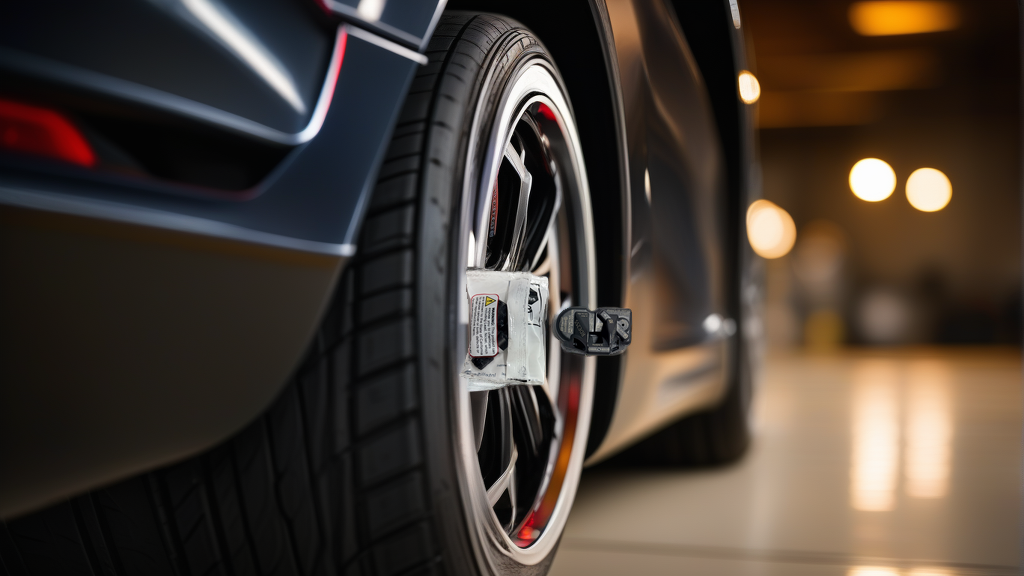
Why Choosing the Right TPMS Sensor Matters
A TPMS sensor that doesn’t match your GLA Class will either fail to pair with the vehicle’s receiver or give false pressure readings. Worse, a wrong frequency can cause intermittent dropouts, and a mismatched valve stem type may lead to air leaks. For a B2B buyer, stocking the wrong sensors means returns, unhappy customers, and wasted inventory.
What to Check Before Ordering a TPMS Sensor for Your GLA Class
1. Model Year & Generation
The Mercedes GLA Class (X156, 2014–2019; H247, 2020–present) uses different TPMS generations.
- 2014–2019 GLA (X156): Original equipment typically used 433 MHz sensors from brands like HUF or Schrader. Some late‑model years may have switched to 315 MHz.
- 2020+ GLA (H247): Newer models often use 315 MHz or even 2.4 GHz sensors, depending on market and options.
Always confirm your specific year by reading the QR code or numbers on the existing sensor – do not rely solely on the year listed online.
2. Frequency & Protocol
The three common frequencies for GLA Class sensors:
| Frequency | Typical Years | Notes | |||
|---|---|---|---|---|---|
| 433 MHz | 2014–2019 (early) | Most common for X156; check if your vehicle uses “direct” or “indirect” TPMS – only direct sensors are affected. | |||
| 315 MHz | 2018–2024 (some markets) | Used in North American models post‑2018, also in some H247 variants. | |||
| 2.4 GHz | 2020+ (Tesla‑style systems) | Rare on GLA, but some aftermarket sensors now support 2.4 GHz for multi‑vehicle compatibility. For example, the [RDE255V26 | BH-Sens 2.4GHz TPMS Tire Pressure Sensor | Fits Tesla | OE# 149070101B, 149070100B, 149070101C](https://longweiparts.com/product/bh-sens-2-4ghz-tpms-tire-pressure-sensor-fits-tesla-oe-149070101b-149070100b-149070101c-rde255v26/) is a pre‑programmed 2.4 GHz sensor originally designed for Tesla, yet the same technology is available for GLA‑specific kits. |
Check your owner’s manual or look up the OE number on the sensor housing.
3. Clamp‑In vs Snap‑In
The GLA Class exclusively uses clamp‑in (metal valve stem) sensors. Snap‑in sensors will not fit. When ordering, look for “clamp‑in” in the product description; avoid snap‑in unless you have an adapter or custom rim.
4. Pre‑Programmed vs Programmable
- Pre‑programmed – Comes with the exact OE firmware matched to a list of OE numbers. Plug‑and‑play with no programming tool needed. Best for quick replacement.
- Programmable – Blank sensor you clone with a TPMS tool. Offers flexibility for mixed fleets but requires a programmer.
For a GLA Class, pre‑programmed sensors that match your vehicle’s OE number (e.g., 000 905 57 00, 000 905 89 00, etc.) save time. If you run a repair shop, programmable sensors reduce inventory depth – you stock one blank and program it on the spot.
How to Confirm OE Compatibility for Your GLA Class
- Remove your current sensor – Look for a sticker or laser‑etched number. Common OE prefixes for GLA:
A000905...,A000..., orWX.... - Check the frequency – Often printed as “433 MHz” or “315 MHz” on the sensor.
- Verify the valve stem length – The GLA uses a standard 45° angle clamp‑in; some aftermarket sensors have a shorter stem that may not clear the rim notch.
- Use a trusted fitment database – Enter your VIN or model year on Longwei Parts’ search tool to see which OE numbers match.
B2B Bulk Buying Notes for GLA Class TPMS Sensors
When ordering multiple sensors for your workshop or distribution:
- Frequency matching is critical. Do not mix 433 MHz and 315 MHz sensors in the same batch – they cannot be reprogrammed to the other frequency.
- Check the packaging date. TPMS sensors have a battery lifespan of 6–8 years from manufacture. Buy from stock that is less than 2 years old to maximize shelf life.
- Order pre‑programmed for common OE numbers. If your customers mainly drive 2016–2018 GLA, order sensors pre‑loaded with the top five OE numbers for that range. For rare years, keep a few programmable units.
- Demand clear labeling. Each sensor box should show the OE number, frequency, and “clamp‑in” or “snap‑in”. This reduces confusion on the shop floor.
- Test one unit first. Before buying a bulk lot, order a single unit, install it on a GLA, and verify that it pairs and reads correctly at cold and hot pressures.
Recommended Part for Quick Replacement
If you need a reliable, pre‑programmed TPMS sensor for a vehicle that uses the 1490701xx‑B/‑C/‑D/‑E family (common on Tesla), the RDE255V26 | BH-Sens 2.4GHz TPMS Tire Pressure Sensor | Fits Tesla | OE# 149070101B, 149070100B, 149070101C from BH‑Sens (Baolong Technology) is a solid choice. While it is designed for Tesla, the same BH‑Sens technology and rigorous QC apply to their GLA‑compatible sensors. For GLA owners, look for BH‑Sens sensors that match your OE number – they offer the same 2.4 GHz or 433 MHz pre‑programmed options.
FAQ
Can I use a Tesla TPMS sensor on my Mercedes GLA Class?
No – the Tesla sensor uses a different protocol and OE number range (1490701xx). The GLA requires its own OE numbers and frequencies. Always match the sensor to your vehicle’s make and model.
Does my GLA Class need a relearn procedure after replacing TPMS sensors?
Yes, most GLA models require a relearn procedure using an OBD2 tool or a magnet‑based method. The process varies by year. Consult your vehicle manual or a TPMS tool guide. Pre‑programmed sensors do not eliminate the relearn step – they only skip sensor programming.
What is the average lifespan of a TPMS sensor on a GLA Class?
Typically 5–7 years, after which the battery dies. If your GLA is 2017 or older and you’ve never replaced the sensors, expect them to fail soon. Replace all four at once to avoid staggered failures.
Can I install a 315 MHz sensor on a 433 MHz GLA Class?
No – the receiver in your vehicle is tuned to a specific frequency. Mixing frequencies will cause the sensor to never transmit. Buy only the frequency that matches your GLA’s original equipment.